
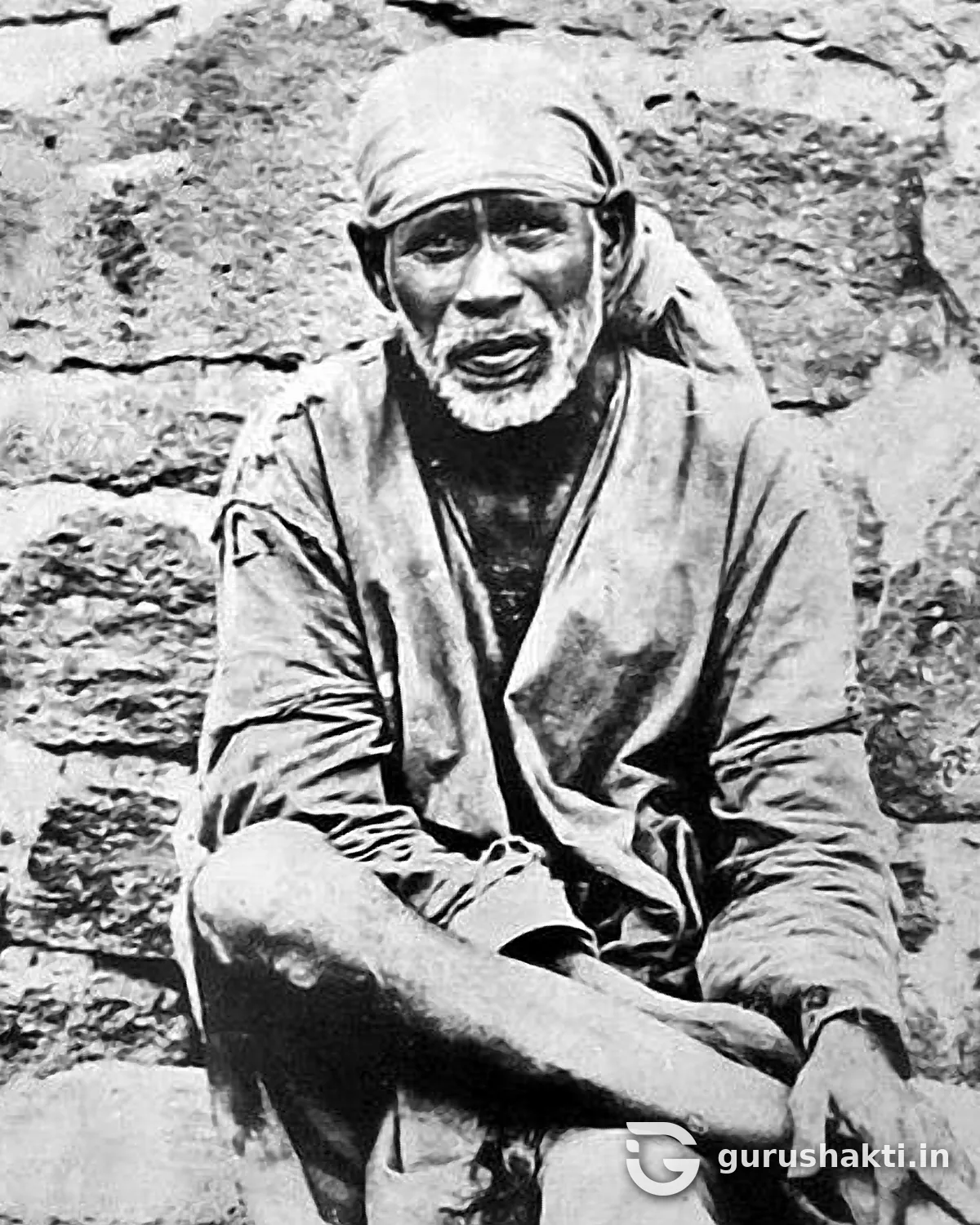
Around 1858, a wedding party belonging to the family of Chand Patil arrived in the village of Shirdi. With it came a young holy man who had been seen there a few years earlier, sitting under a neem tree. Mhalsapati, a local devotee, greeted him with two words: "Ya Sai." The name stayed. From then on the village knew him as Sai Baba.
Nobody knows where he was born, to whom, or into which faith. What Shirdi knew was the man in front of them. He lived in a ruined mosque, begged for his food, cooked for others, and kept a fire burning whose ash he gave away. He asked people for only two things: shraddha (faith) and saburi (patience).
Life story
A young man under a neem tree
According to devotee tradition preserved by the Shree Saibaba Sansthan, he was first seen in Shirdi around 1854. He was a young man of about sixteen, sitting under a neem tree. That spot is now called Gurusthan, "the place of the guru." He spoke of having a guru, and devotees believe Gurusthan holds that guru's tomb.
His birth date, birthplace, birth name, family and the religion he was born into are not recorded. The year c. 1838, sometimes given for his birth, is a later estimate worked back from his apparent age.
"Ya Sai"
Around 1857 he left Shirdi for a time. About a year later he came back with the wedding party of Chand Patil's family. Mhalsapati greeted him, "Ya Sai," and from that greeting came the name Sai Baba.
He settled in a ruined mosque, which he called Dwarkamai. There he kept a dhuni, a sacred fire that was always burning. He gave its ash, called udi, to those who came to him. He begged for food in the village, cooked meals himself and served them to others.
Dwarkamai, the Chavadi and the arati
Over the years, a circle of devotees grew around him. Among them were Mhalsapati, Madhavrao Deshpande (known as Shama), Tatya Kote Patil and Abdul Baba. Later came Hemadpant, the name by which G. R. Dabholkar is known, and Upasni Maharaj.
In 1909 he began to sleep on alternate nights at the Chavadi in Shirdi. From 10 December 1909, arati (worship with lamps) to him was made a regular practice. In 1912 padukas (sacred footprints) were installed at Gurusthan, and work to renovate Dwarkamai was completed.
Booty's wada and the samadhi
In 1915 Gopalrao Booty, a devotee, began building a wada, a large house, in Shirdi. It would become the Samadhi Mandir.
Sai Baba died on 15 October 1918, the day of Vijayadashami. His body was laid to rest in Booty's wada, and the building became his shrine.
After 1918
In the early 1920s the Shree Saibaba Sansthan was formed with court approval to care for the shrine. The Sansthan's own site gives 1921; other sources give 1922. Hemadpant's Shri Sai Satcharita, in Marathi, became the main record of his life and teaching. On 7 October 1954 a white marble statue of Sai Baba was installed in the Samadhi Mandir, where devotees see it today.
Core teachings
Shraddha and saburi
The teaching most closely tied to Sai Baba is shraddha and saburi: faith and patience. In the Shri Sai Satcharita, these are the two coins every seeker must offer. Faith means trusting the guru and God even when the way is unclear. Patience means waiting without forcing an answer. He gave this teaching in the episode of Radhabai Deshmukh, told below. Neither coin costs money, yet both take a lifetime to give in full.
One Master for all
The Sansthan's history records his teaching that there is one Master (Malik) over all. In the same spirit, he taught that Ram and Rahim are one. He lived in a mosque he named Dwarkamai and kept a sacred fire burning there. For a seeker, the lesson is to look for the one God behind many names.
Feed and share
According to the Shri Sai Satcharita, he cooked food with his own hands and served it to people who came to Dwarkamai. He asked his devotees to feed the hungry. For a man who begged for his own meals, this was no small thing. Whatever he had, he shared. Feeding others was, in his teaching, a direct way to serve God.
Surrender to the guru
The Shri Sai Satcharita returns often to one theme: trust the guru completely and let go of pride. Surrender here does not mean giving up thought. It means setting aside the ego that insists on its own way. A devotee who has offered faith and patience can rest in the guru's care instead of fighting every turn of life.
A simple life
He lived in a mosque, begged for food in the village and owned almost nothing, as the Sansthan records. His needs were few. That plainness was itself a teaching. It showed devotees that the spiritual life does not need wealth or display, and that what you give away matters more than what you keep.
Principles for daily life
- Practise patience once a day. Choose one hard situation each day and meet it with saburi: wait, breathe, and do not force the outcome.
- Share food. This week, feed someone who cannot repay you, a worker, a stranger or a hungry animal.
- See one God behind many names. Speak respectfully of every faith, and notice when you are tempted not to.
- Keep a simple routine. A short daily prayer or arati at home, at the same hour, is enough.
- Let go of results. Do your part fully, then leave the result to God, as a devotee trusts the guru.
- Live a little lighter. Give away one thing you no longer need.
Places of pilgrimage
- Samadhi Mandir, Shirdi, Maharashtra. His tomb and the white marble murti installed in 1954. Four aratis are held each day.
- Dwarkamai, Shirdi, Maharashtra. The mosque where he lived. The dhuni still burns, and udi from it is given to visitors.
- Chavadi, Shirdi, Maharashtra. Where he slept on alternate nights from 1909. A palkhi (palanquin) procession comes here on Thursdays.
- Gurusthan, Shirdi, Maharashtra. The neem tree where he was first seen, with the padukas installed in 1912.
- Lendi Baug, Shirdi, Maharashtra. The garden where the Nanda Deep lamp burns between a neem and a bodhi tree.
Legacy today
Shirdi is now a temple town built around one man's simple life. The Shree Saibaba Sansthan Trust, formed in the early 1920s, manages the Samadhi Mandir. The daily aratis that began in 1909 continue, as does the Thursday palkhi to the Chavadi. On the hundredth anniversary of his samadhi in 2018, lakhs of devotees came to Shirdi for Dussehra.
The Shri Sai Satcharita, which the Sansthan makes available in its e-library, remains the main text for devotees. He is revered by Hindus and Muslims alike. He should not be confused with Sathya Sai Baba of Puttaparthi (1926–2011), a different teacher.
Images
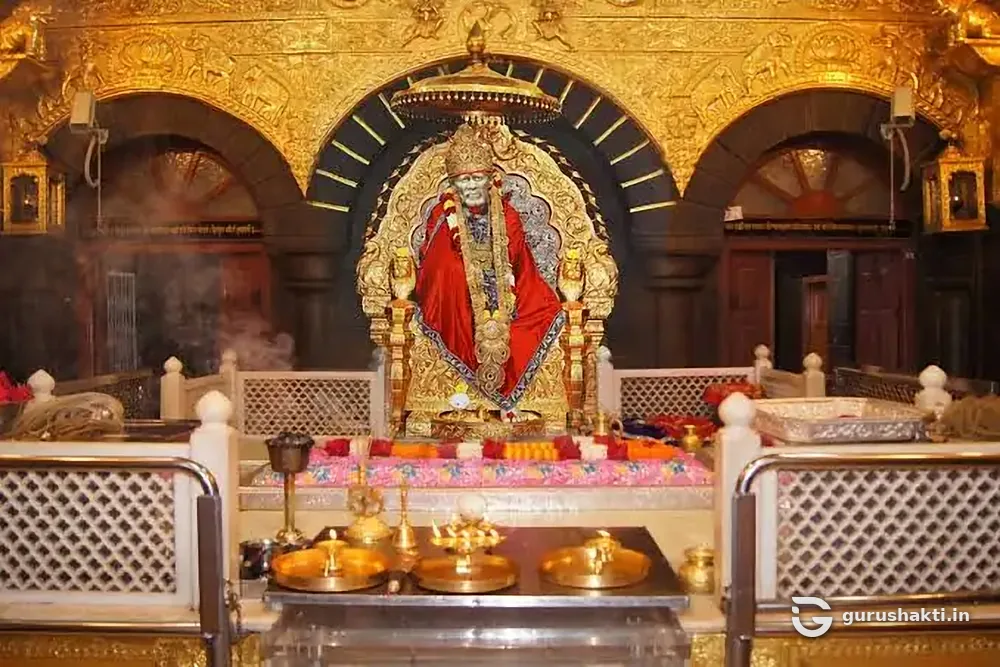
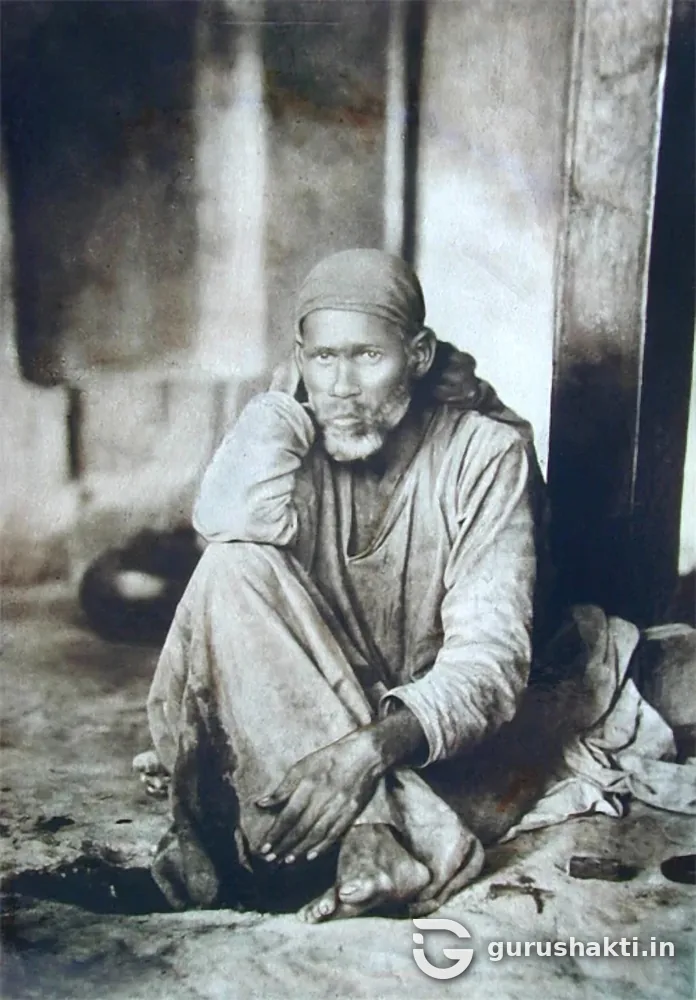
Image may be restored, upscaled or regenerated with generative AI.
Walk the path
Sai Baba asked for faith and patience, not grand rituals. This week, you might light a small lamp at home each evening and sit with it for a few minutes, offering a short prayer or arati. Choose one situation where you would usually rush, and practise saburi instead. Cook or buy a meal for someone who is hungry, as he did in Dwarkamai. Let these small acts become steady habits, at your own pace.
Frequently asked questions
Was Sai Baba Hindu or Muslim?
His birth, family and the religion he was born into are not documented. He lived in a mosque he named Dwarkamai, kept a sacred fire, and taught that Ram and Rahim are one. In his lifetime and today, he has been revered by both Hindus and Muslims. Gurushakti honours him as a saint of the bhakti tradition.
What does Shraddha Saburi mean?
Shraddha means faith and saburi means patience. In the Shri Sai Satcharita, these are the two coins every seeker must offer. Sai Baba taught this to Radhabai Deshmukh, who fasted to make him give her a mantra. He told her that faith and patience mattered more than any formula.
When did Shirdi Sai Baba take samadhi?
He took mahasamadhi on 15 October 1918, the day of Vijayadashami, at Shirdi in Maharashtra. His body was laid to rest in the wada that the devotee Gopalrao Booty had begun building in 1915. That building is now the Shri Sai Baba Samadhi Mandir.
What is udi and why is it given at Shirdi?
Udi is the sacred ash from the dhuni, the fire Sai Baba kept burning in Dwarkamai. He gave it to those who came to him, and the dhuni still burns there today. Devotees receive udi as his prasad and a reminder of his presence. It is a token of faith, not a promised cure.
What is the Shri Sai Satcharita?
It is the main account of Sai Baba's life and teachings, written in Marathi by his devotee Hemadpant, G. R. Dabholkar. It records episodes such as Radhabai Deshmukh's fast and his teaching of shraddha and saburi. The Shree Saibaba Sansthan Trust makes it available through its online e-library.
Sources
Researched and written by GuruShakti, October 2026.