
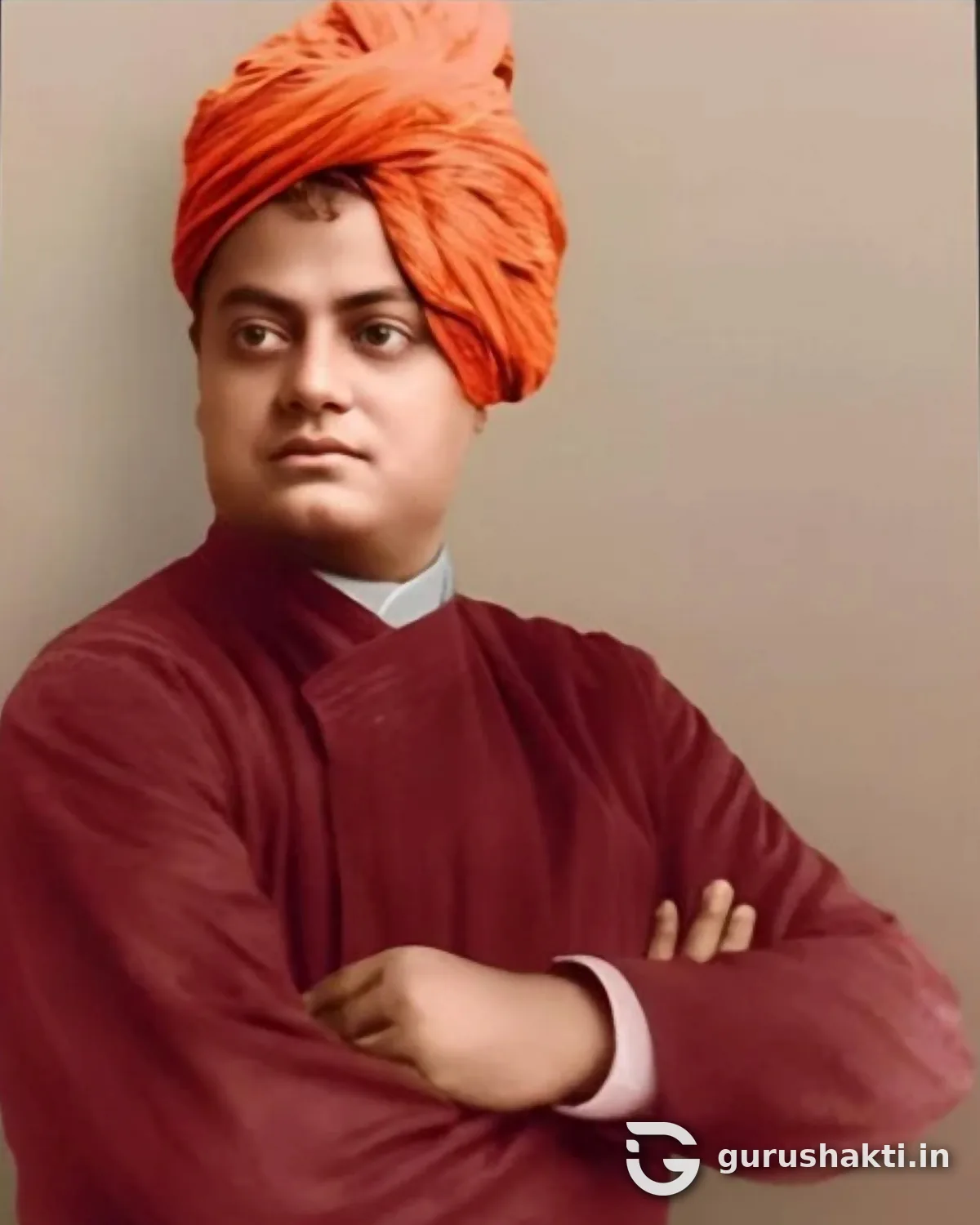
On 11 September 1893, at the World's Parliament of Religions in Chicago, a thirty-year-old monk from Calcutta rose to speak. His first words were "Sisters and Brothers of America." Thousands in the hall stood and applauded for a long time before he could go on. When he did, he quoted a hymn about many rivers that start in different places and all flow into one sea.
That monk was Swami Vivekananda. In a few minutes he set out a plea for harmony between faiths that is still read today. His deeper message was simpler. He taught that every person carries the divine within, and that the surest way to worship God is to serve people who are poor and suffering. Today, India marks his birthday as National Youth Day.
Life story
Narendra of Calcutta
He was born on 12 January 1863 in Calcutta, in Bengal, and named Narendranath Datta. In the story of his early years he is remembered simply as Narendra. The house where he was born, on Gour Mohan Mukherjee Street in Kolkata, still stands and is now a cultural centre.
Some Hindu calendars mark his birthday by the lunar date, Paush Krishna Saptami, which falls on a different day each year. The national observance keeps to 12 January.
The question at Dakshineswar
In November 1881, Narendra first met Sri Ramakrishna at the Dakshineswar Kali Temple near Calcutta. Devotees recount the question he put to the older man: "Have you seen God?" Ramakrishna told him yes, as clearly as he was seeing Narendra.
Narendra became one of the young disciples who gathered around Ramakrishna. When Ramakrishna passed away on 16 August 1886, it was Narendra who led this group. In 1887 they took formal vows of sannyasa (monastic renunciation) together at Baranagar.
Wandering India
From 1890 to 1893 he travelled across India as a wandering monk. What he saw on the road stayed with him: the poverty of ordinary people, village after village.
At the end of 1892 he reached the southern tip of India at Kanyakumari. From 25 to 27 December he meditated for three days on a rock off the shore. There he resolved on his mission: to carry India's message to the world. The Vivekananda Rock Memorial now stands on that rock.
Chicago and the West
On 11 September 1893 he opened his address at the World's Parliament of Religions in Chicago. He spoke against sectarianism and fanaticism, and for the idea that different paths lead to the same goal.
For the next four years, from 1893 to 1897, he taught Vedanta in the United States and in England. He gained many Western students of Vedanta. His disciples included Margaret Noble, later Sister Nivedita, and Swami Sadananda. Josephine MacLeod was a friend and supporter.
The Mission and Belur
He returned to India and, on 1 May 1897, founded the Ramakrishna Mission in Calcutta. Its purpose joined monastic life to service of the poor. In 1898 land was acquired at Belur, in Howrah, for a monastery. This became Belur Math. In 1899 the Advaita Ashrama at Mayavati, in the Himalayas of Uttarakhand, was founded under his inspiration.
He passed away at Belur Math on 4 July 1902. He was 39 years old.
Core teachings
The divine within
Vivekananda's central teaching is that every person is divine in potential. Spiritual life, he said, is the work of bringing that divinity out. In the preface to Raja Yoga he wrote: "Each soul is potentially divine." This changes how you look at yourself and at others. On this view, the task is not to become something new but to uncover what is already there.
Four paths, one goal
He taught four yogas, four ways to reach the same goal: work (karma yoga), devotion (bhakti yoga), control of the mind (raja yoga) and knowledge (jnana yoga). In the Raja Yoga preface he says a person may follow one of these, several, or all. What matters is the goal, not the outer form. In the same passage he wrote: "Doctrines… or temples, or forms, are but secondary details."
Harmony of religions
At Chicago in 1893 he told the Parliament that different paths lead to the same goal, and that sectarianism and fanaticism must be rejected. He made the point with a hymn about many rivers flowing into one sea. If God is one, then sincere seekers on other roads are fellow travellers, not rivals.
Service as worship
The principle behind the Ramakrishna Mission's work is Shiva-jnane jiva seva: serve living beings, knowing them to be Shiva. Serving the poor and suffering is serving God. This is why the Mission he founded in 1897 joins prayer with practical help. Here service is a form of worship in itself, not charity handed down from above. The person you help is, in his view, God in front of you.
Education that makes people
He wanted education to do more than fill the mind with facts. As Belur Math records his words, education should build character, strengthen the mind and expand the intellect. He called this man-making education. For him, reading and study were tools for building a strong, kind, steady human being.
Principles for daily life
- Start the day strong. Each morning, remind yourself that you are strong and that the divine is within you. Say it quietly before looking at your phone.
- Respect other faiths. This week, avoid sectarian talk. If a conversation turns to running down another religion, step away from it.
- Serve as worship. Help one person in need as if you were serving God. Do it with respect, not pity.
- Read to build character. Read a few pages every day, choosing something that makes you a better person, not only a better-informed one.
- Choose one ideal. Pick a single ideal and work at it steadily, a little each day, rather than chasing many at once.
- Pick your path. Notice whether work, devotion, meditation or study comes most naturally to you, and give it a regular place in your week.
Places of pilgrimage
- Belur Math, Howrah, West Bengal. Headquarters of the Ramakrishna Math and Mission. Visitors can see his room and the memorial temple. He passed away here in 1902.
- Swami Vivekananda's Ancestral House, Kolkata, West Bengal. His birthplace on Gour Mohan Mukherjee Street, now a cultural centre.
- Vivekananda Rock Memorial, Kanyakumari, Tamil Nadu. Built on the rock where he meditated in December 1892, and dedicated in 1970.
- Dakshineswar Kali Temple, Kolkata, West Bengal. Where he first met Sri Ramakrishna in 1881.
- Advaita Ashrama, Mayavati, Champawat, Uttarakhand. The Himalayan ashram founded in 1899 under his inspiration.
Legacy today
The Ramakrishna Mission he founded on 1 May 1897 still works from Belur Math, alongside the Ramakrishna Math, the monastic order. Its service work rests on his principle of Shiva-jnane jiva seva, serving people as God. The Complete Works of Swami Vivekananda, published by Advaita Ashrama, gathers his lectures and letters in nine volumes.
India marks his birthday, 12 January, as National Youth Day. At Kanyakumari, the Vivekananda Rock Memorial, run by Vivekananda Kendra, receives visitors on the rock where he meditated. His Chicago address is still read for its opening words and its plea for harmony between faiths. Many sayings circulate in his name online; the reliable ones are those found in the Complete Works.
Images
Image may be restored, upscaled or regenerated with generative AI.
Walk the path
Vivekananda's way starts with a change of view: seeing the divine in yourself and in the next person you meet. This week, you might spend five quiet minutes each morning with that thought. Then put it to work. Offer some seva (selfless service) to someone in need, or give daan (a gift) to a cause that serves the poor, with the respect you would show in a temple. Read a page of his Complete Works each evening. Let the practice grow slowly and steadily.
Frequently asked questions
What did Swami Vivekananda say in his Chicago speech?
On 11 September 1893, at the World's Parliament of Religions, he opened with "Sisters and Brothers of America," which drew a long standing ovation. He quoted a hymn about many rivers flowing into one sea. His message was that different paths lead to the same goal, and that sectarianism and fanaticism should be rejected.
Who was Swami Vivekananda's guru?
His guru was Sri Ramakrishna Paramahamsa. Narendra first met him in November 1881 at the Dakshineswar Kali Temple near Calcutta. After Ramakrishna passed away on 16 August 1886, Narendra led his young disciples, and in 1887 they took monastic vows together at Baranagar. The Ramakrishna Mission carries his guru's name.
Why is National Youth Day celebrated on 12 January?
Swami Vivekananda was born on 12 January 1863 in Calcutta, and India observes his birthday as National Youth Day. The day draws on his call for strength, education that builds character, and service to others. Some calendars mark his birthday by the Hindu lunar date, which falls on a different day.
What are the main teachings of Swami Vivekananda?
He taught that each soul is potentially divine, and that work, devotion, meditation and knowledge are all paths to that divinity. He stood for harmony between religions. He taught that serving the poor and suffering is serving God. He also called for education that builds character, strengthens the mind and expands the intellect.
How did Swami Vivekananda die?
He passed away at Belur Math, Howrah, on 4 July 1902, at the age of 39. Belur Math stands on land acquired for the monastery in 1898 and is the headquarters of the Ramakrishna Math and Mission. Popular retellings often describe the cause loosely; this page keeps to what is recorded.
Sources
Researched and written by GuruShakti, October 2026.