
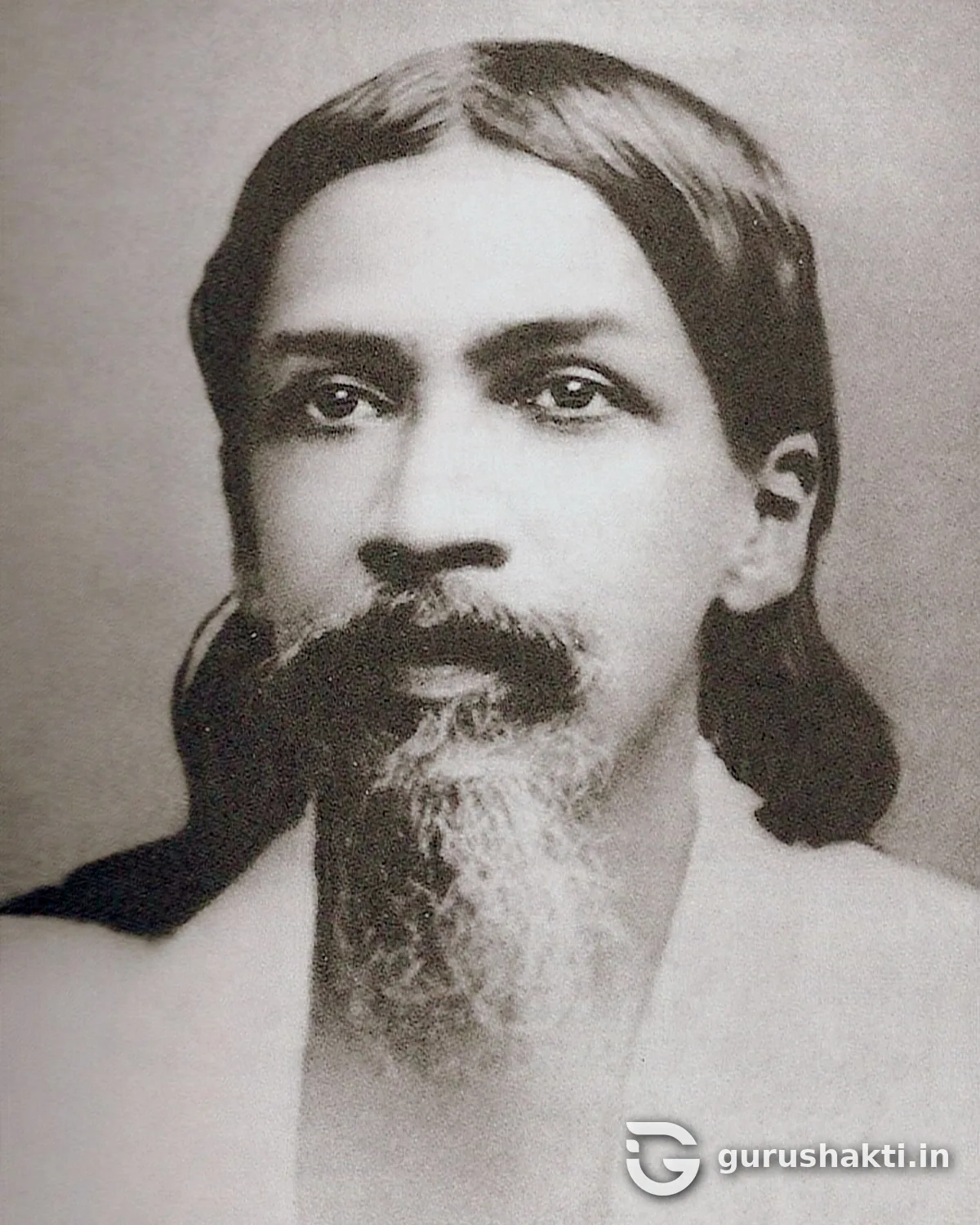
In May 1908 a nationalist leader was arrested and held in Alipore jail while the British tried him in the Alipore Bomb Case. He spent a year there as an undertrial prisoner. When he came out, acquitted, he spoke at Uttarpara on 30 May 1909 about what had happened inside. In his cell, he said, he had begun to see Vasudeva, Krishna, everywhere: in the walls, the trees, the warders and his fellow prisoners.
That man was Aurobindo Ghose, later Sri Aurobindo. A year after the speech he left politics and went to Pondicherry, where he spent forty years in yoga. He did not teach escape from the world. He taught that "all life is Yoga", that work, family and public life can all become spiritual practice, and that the real aim is a change in how we see and who we are. For anyone trying to live a spiritual life without leaving their ordinary one, he is a guide.
Life story
A childhood in England
Aurobindo Ghose was born in Calcutta on 15 August 1872. In 1879, at seven, he was sent to England. He studied at St Paul's School in London and then at King's College, Cambridge.
Thirteen years in Baroda
In 1893 he returned to India. For thirteen years he worked in the service of Baroda State and taught at Baroda College. Quietly, he was also involved in revolutionary work for India's freedom. In 1905, in Baroda, he began the practice of yoga.
The nationalist leader
After the Partition of Bengal he moved to Calcutta in 1906 and became a leader of the nationalists. The Sri Aurobindo Ashram records that he was the first to call publicly for India's complete independence.
In 1908 he had his first major spiritual realisation. That same year he received brief guidance from the Maharashtrian yogi Vishnu Bhaskar Lele. Tradition holds that Sri Aurobindo accepted no formal guru. Lele's help was short and early, and the path that followed was his own.
Alipore jail
In May 1908 he was arrested in the Alipore Bomb Case and held for a year in Alipore jail as an undertrial. In May 1909 he was acquitted. On 30 May 1909 he spoke at Uttarpara. In that speech, kept by the Sri Aurobindo Institute of Culture in Kolkata, he described how in jail he had come to see Vasudeva everywhere around him.
To Pondicherry
In 1910 he left politics. He went by way of Chandernagore to Pondicherry, then under French rule, and settled there for the rest of his life. He gave himself to yoga and to writing.
The Mother and the Ashram
His closest spiritual collaborator was Mirra Alfassa, known as the Mother. On 24 November 1926, which the Ashram observes as Siddhi Day, Sri Aurobindo withdrew into seclusion. From then the Ashram took shape under the Mother's care. He gave darshan (a chance for devotees to see him) only on special days.
On 5 December 1950 he left his body in Pondicherry. On 9 December he was laid in the Ashram Samadhi. After his passing, in 1968, the Mother founded Auroville near Pondicherry.
Core teachings
All life is Yoga
The opening of The Synthesis of Yoga states it in four words: "All life is Yoga." For Sri Aurobindo, spiritual practice is not a separate compartment kept for the prayer room. Work, relationships and the small tasks of the day can all become sadhana (spiritual practice) when done with the right inner attitude.
Transformation, not escape
Many paths aim at personal liberation from the world. Sri Aurobindo aimed further. The goal of his yoga, as the Ashram and Britannica describe it, is to change human nature itself, bringing the divine into earthly life rather than leaving earthly life behind. The world is not a trap to get out of. It is the place where the divine is meant to be expressed.
Evolution of consciousness
Sri Aurobindo saw humanity as a stage on the way, not the end of the road. Consciousness, he taught, is still evolving, toward a higher level he called "supramental". The Auroville account of its founders presents this as central to his vision. Human beings are, in this view, a transitional stage, and the next step of evolution is an inner one.
A change of consciousness
For Sri Aurobindo, yoga is not mainly a set of techniques. The Sri Aurobindo Society, citing his collected works, gives his view that the whole meaning of yoga is "a change of consciousness": a change in how we see, and in what we are. Methods help, but the aim is to become different from within, not only to behave differently.
The Divine in everything
In Alipore jail, by his own account at Uttarpara, Sri Aurobindo saw Vasudeva in the walls, the trees, the warders and the other prisoners. This was not a theory for him but an experience. The Divine is not only in temples or in meditation. It is present in the people and things around us, including those we find hardest to love.
Principles for daily life
- Make work an offering. Choose one task this week and do it with full care, as an offering rather than a chore.
- Begin with aspiration. Start each morning with a short, sincere wish to grow, in your own words.
- Watch your reactions. When anger or fear rises, notice it before acting. The aim is a change in consciousness, which goes deeper than behaviour.
- Keep all paths open. Let knowledge, devotion and action each have a place in your week: some reading, some prayer, some service.
- Serve without hatred. Serve your country and other people this week without ill will toward anyone, as he tried to do in Alipore.
Places of pilgrimage
- Sri Aurobindo Ashram and Samadhi, Puducherry. The samadhi of Sri Aurobindo and the Mother lies under the Service Tree. Darshan days are 21 February, 24 April, 15 August and 24 November.
- Auroville, near Puducherry, Tamil Nadu. The international township founded by the Mother on 28 February 1968, with the Matrimandir at its centre.
- Sri Aurobindo's birthplace, Kolkata, West Bengal. The city where he was born in 1872 and later led the nationalists.
- Alipore, Kolkata, West Bengal. Site of the jail where he spent a year as an undertrial and had his experience of Vasudeva.
- Vadodara (Baroda), Gujarat. The city of his thirteen years in Baroda State service, where he began his yoga in 1905.
Legacy today
The Sri Aurobindo Ashram in Puducherry, which took shape under the Mother after 1926, remains the centre of his work. The samadhi of Sri Aurobindo and the Mother lies there under the Service Tree, and the Ashram keeps four darshan days each year. Auroville, the international township the Mother founded near Puducherry in 1968, builds on their shared vision.
His writings, from The Life Divine and The Synthesis of Yoga to the epic poem Savitri, are held by the Sri Aurobindo Ashram Trust. Disciples such as Nolini Kanta Gupta, K.D. Sethna, Champaklal, M.P. Pandit and Dilip Kumar Roy lived and worked near him. Today the Sri Aurobindo Society and the Sri Aurobindo Institute of Culture in Kolkata carry his teaching to new readers. His birthday, 15 August, is also India's Independence Day.
Images
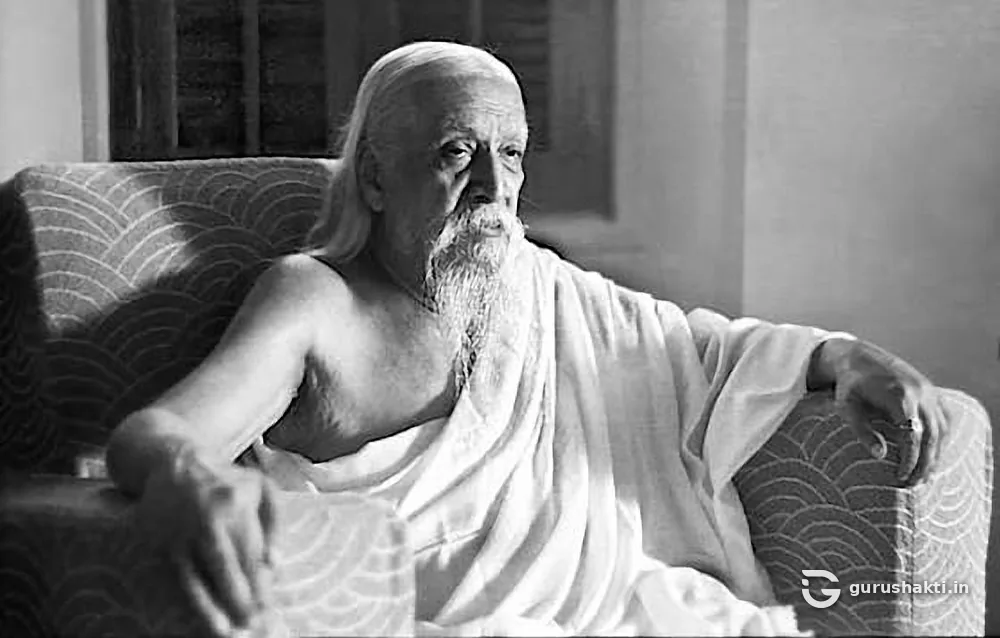
Image may be restored, upscaled or regenerated with generative AI.
Walk the path
Sri Aurobindo's yoga starts where you already are. This week, pick one ordinary task, cooking, a report, a phone call to a relative, and do it slowly and well, as an offering. Begin each morning with one sincere sentence of aspiration in your own words. When you feel irritation rising, pause and look at it, without judgement. If you are near Puducherry, sit for a while by the Samadhi. Nothing dramatic is needed. "All life is Yoga."
Frequently asked questions
What is Integral Yoga?
Integral Yoga, or Purna Yoga, is the path Sri Aurobindo developed, drawing on Vedantic and Tantric roots. It holds that "all life is Yoga": work, relationships and daily life can all become spiritual practice. Its aim reaches beyond personal liberation, to a change of consciousness that brings the divine into earthly life.
Why did Sri Aurobindo leave politics?
In 1910, after his year in Alipore jail and his acquittal, Sri Aurobindo left political life and went to Pondicherry. Devotees recount that he followed an inner command. He had begun yoga in Baroda in 1905, and in jail he came to see Vasudeva everywhere. From 1910 he gave the rest of his life to yoga.
Who was the Mother of Sri Aurobindo Ashram?
The Mother was Mirra Alfassa, Sri Aurobindo's closest spiritual collaborator. After his withdrawal into seclusion on 24 November 1926, the Ashram took shape under her care. She founded Auroville in 1968, after his passing. She and Sri Aurobindo share the samadhi under the Service Tree at the Ashram.
What happened to Sri Aurobindo in Alipore jail?
He was arrested in May 1908 in the Alipore Bomb Case and spent a year in Alipore jail as an undertrial. In his Uttarpara speech of 30 May 1909, after his acquittal, he described how he had come to see Vasudeva, Krishna, everywhere: in the walls, the trees, the warders and fellow prisoners.
Is Sri Aurobindo's birthday the same as India's Independence Day?
Yes. Sri Aurobindo was born on 15 August 1872, and 15 August is India's Independence Day. He himself remarked on the coincidence of the two dates. The day is one of the four darshan days at the Sri Aurobindo Ashram in Puducherry.
Sources
Researched and written by GuruShakti, October 2026.