
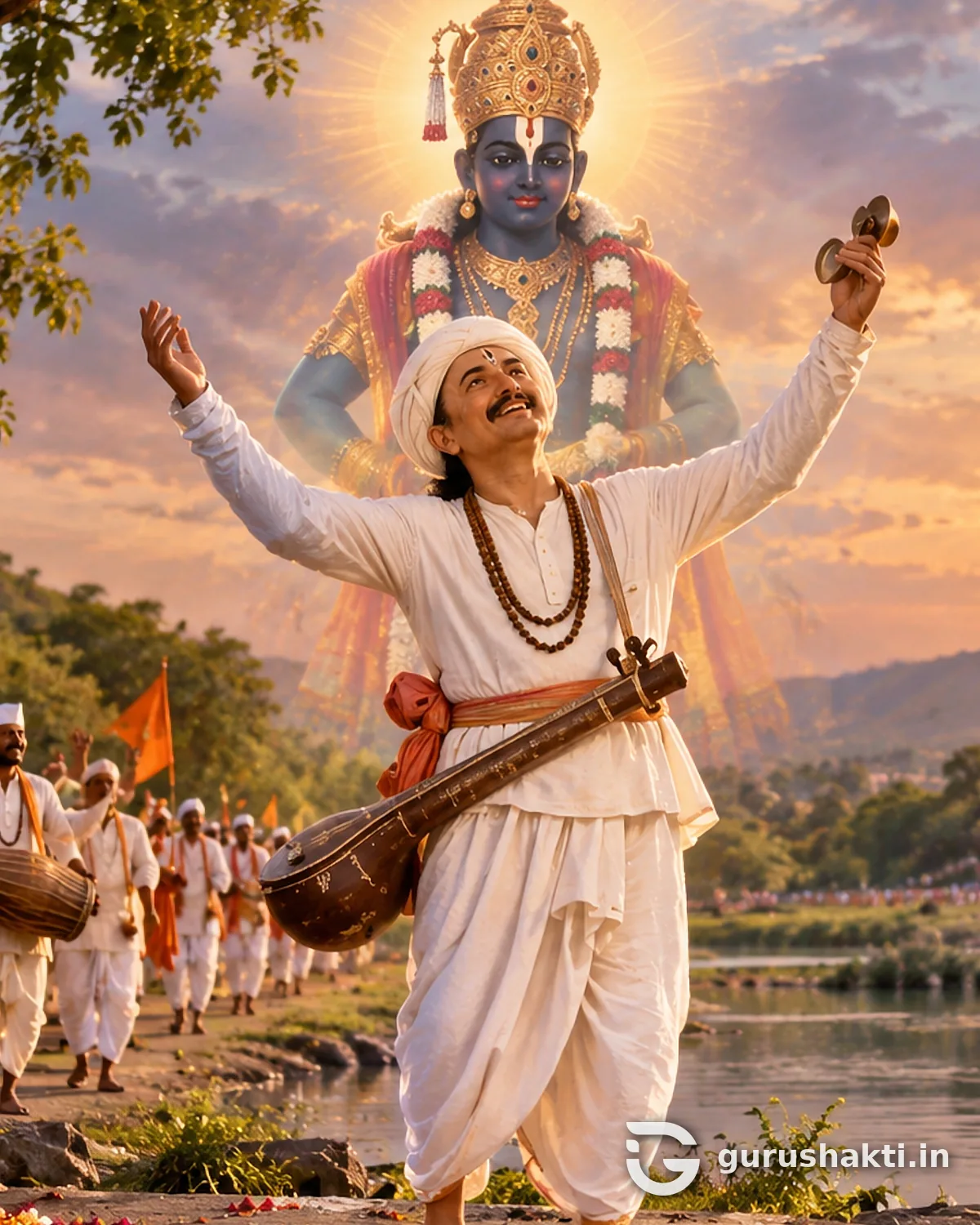
On the bank of the Indrayani at Dehu, a grain trader's son once watched his own notebooks sink into the river. He had filled them with abhangs, devotional songs in Marathi, the language of the farmers and shopkeepers around him. A learned man had objected that a non-Brahmin had no right to explain scripture, and Tukaram was made to drown his work. He sat down on a stone at Dehu and stayed there, fasting and praying, for 13 days. Devotees recount that the notebooks then rose to the surface unharmed.
The stone is still worshipped, and the songs are still sung. Sant Tukaram matters because he showed that the name of God, sung in your own language, is a complete path. He also left a simple test of holiness that anyone can apply: a true saint is one who treats the suffering as his own.
Life story
A trader's son in Dehu
Tukaram was born in Dehu, a village on the Indrayani river near Pune. Britannica gives the year as around 1608; other years have been proposed, among them 1568, 1577 and 1598. His family were grain traders and farmers, of the Kunbi-Maratha community, and they had been devotees of Vitthal for generations. Vitthal, also called Vithoba, is the deity of the great temple at Pandharpur.
While still in his teens, Tukaram lost his parents. The family business and the household fell to him.
Famine and loss
Around 1629 and 1630 a severe famine struck the Deccan. In it Tukaram lost his first wife, Rakhumabai, and a son. The business failed. Tradition remembers that during the famine he gave grain away rather than hold it back.
After this he turned away from trade. Through the 1630s he studied the saints who had come before him and spent long periods meditating on Bhandara hill, near Dehu. The world of profit and loss no longer held him.
A guru in a dream
Tukaram had no teacher in the usual sense. Devotees recount that in a dream he received initiation from Babaji Chaitanya, also known as Raghava Chaitanya, who gave him the name-mantra "Rama Krishna Hari". In another dream, Sant Namdev and Vitthal appeared and asked him to compose abhangs.
He began to sing kirtans (devotional song with teaching). His abhangs were plain, direct and in Marathi, and they spread quickly among ordinary people. In this he stood in the line of the Varkari saints before him: Jnaneshwar, Namdev and Eknath.
The notebooks in the Indrayani
Not everyone welcomed a trader singing about God. Orthodox opponents told him he had no right to interpret scripture, and he was made to sink his notebooks in the Indrayani. Tukaram responded by sitting on a stone at Dehu in fasting and prayer for 13 days. Tradition says that the notebooks surfaced, undamaged.
The story is part of his life, and it is told today without blame on any community. What devotees remember is his answer to it: fasting and prayer.
Fame and departure
In the 1640s his fame grew. Among his disciples was Bahinabai, herself a poet-saint. Tradition also links him with the young Chhatrapati Shivaji, though historians debate how much of this is history.
Around 1650 his life at Dehu came to an end. Historians do not agree on how. Varkaris hold that he did not die in the usual way at all: he departed in his body to Vaikuntha, the abode of Vishnu. The event is called Vaikunthagaman, and the day is kept as Tukaram Beej, on the second day of the dark half of Phalgun. For this reason he has no samadhi.
His songs were gathered as the Tukaram Gatha, with some 4,000 to 4,600 abhangs. A government edition printed in 1873 contains 4,607. On 14 June 2022 the Shila Mandir at Dehu, built around the stone of his 13-day penance, was dedicated.
Core teachings
The name of God is enough
Tukaram taught that chanting Vitthal's name with love is a complete spiritual path. No costly ritual is needed, no priest, no learned language. You can sing to God in the words you use at home. His own mantra, "Rama Krishna Hari", is three names and nothing more. For farmers, traders and labourers who could never afford elaborate worship, this was freedom. The name was something they could carry into the fields and the market.
God is where the suffering are cared for
In one of his best-known abhangs, Tukaram defines a saint in one breath. "जे का रंजले गांजले । त्यासि म्हणे जो आपुले": whoever calls the troubled and oppressed his own. "तोचि साधु ओळखावा । देव तेथेचि जाणावा": know him as a true saint, and know that God is right there. Holiness, for Tukaram, is not measured by ritual or learning. It is measured by how you treat the person who is hurting.
No high and low before God
Tukaram taught that God does not see caste or status. Only devotion counts. He lived this himself: a trader from a farming community who sang about God in the people's language, and who was told he had no right to do so. In his teaching, the devotee's love is what matters before Vitthal, and birth does not make anyone nearer or farther.
Nature as family
Tukaram found God in solitude among trees, on Bhandara hill and around Dehu. In abhang 2376 of the Gatha he sings "वृक्ष वल्ली आम्हा सोयरे वनचरे": trees, vines and forest creatures are my kin. For him the natural world was not scenery. It was family, and quiet time in it supported devotion.
Honest living with devotion
Tukaram lived much of his life as a householder and trader. His teaching, as scholars such as Sadanand More have summarised it, is that daily life lived truthfully and with kindness can itself be bhakti (loving devotion). You do not have to leave your work to love God. You have to do your work honestly, share in hard times and keep the name on your lips.
Principles for daily life
- Sing or say God's name daily. Use your own language and your own voice, even for two minutes in the morning.
- Treat anyone in distress as family. This week, when you meet someone struggling, ask what you would do if they were your brother or sister.
- Do not judge by caste, wealth or status. Notice when you rank people in your mind, and set it aside.
- Spend quiet time among trees. Walk in a park or sit under a tree without your phone, as Tukaram did on Bhandara hill.
- Earn honestly and share in hard times. Remember that he gave grain away in famine, and give something from your own store this week.
Places of pilgrimage
- Sant Tukaram Maharaj temple, Dehu, Pune district, Maharashtra. The temple in his home village on the Indrayani.
- Shila Mandir, Dehu, Maharashtra. Houses the stone of his 13-day penance; pilgrims bow here before the walk to Pandharpur.
- Bhandara hill, near Dehu, Maharashtra. Where he meditated and composed his abhangs.
- Gatha Mandir, Dehu, Maharashtra. A temple with his abhangs inscribed on its walls.
- Vitthal-Rukmini temple, Pandharpur, Solapur district, Maharashtra. Destination of the Ashadhi Wari pilgrimage; his palkhi (ceremonial palanquin procession) leaves Dehu for it every year.
Legacy today
Tukaram's abhangs are still sung by Varkaris in Maharashtra, and his palkhi sets out from Dehu each year for the Ashadhi Wari to Pandharpur. The Tukaram Gatha keeps his songs in print; the 1873 government edition holds 4,607 abhangs. His verses are inscribed on the walls of the Gatha Mandir at Dehu.
His disciple Bahinabai became a poet-saint in her own right. Tradition credits Santaji Jagnade with preserving his songs. Each year Varkaris keep Tukaram Beej in memory of his departure. In 2022 the stone of his penance received its own temple, the Shila Mandir. Scholars such as Sadanand More have written on the meaning of his abhangs.
Images
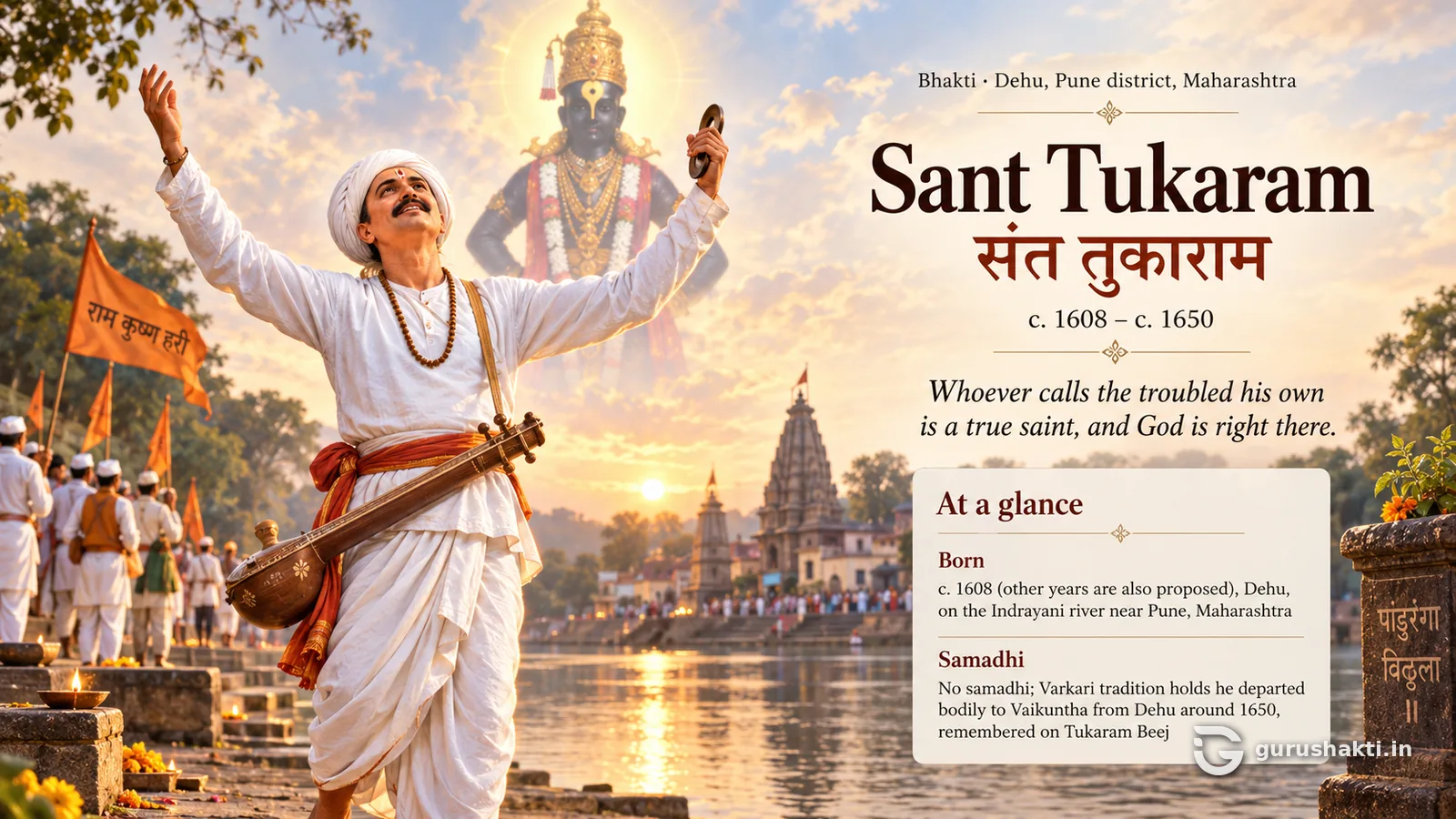
Image may be restored, upscaled or regenerated with generative AI.
Walk the path
Tukaram asked for nothing grand. This week, sing or simply say "Rama Krishna Hari" for a few minutes each day, in a quiet corner or while you walk. Then look for one person who is struggling, and treat them, even briefly, as your own family. If you can, give something away: food, grain or time. Sit under a tree once and let the silence be enough. There is no target to reach. The practice is the name, and the kindness.
Frequently asked questions
Who was Sant Tukaram?
Sant Tukaram was a Marathi poet-saint of the Varkari tradition, born around 1608 in Dehu near Pune into a family of grain traders and farmers. After losing his wife, son and business in a famine, he turned fully to devotion to Vitthal of Pandharpur. His abhangs, collected in the Tukaram Gatha, are still sung today.
When was Sant Tukaram born and when did he die?
He was born around 1608, though other years such as 1568, 1577 and 1598 have been proposed. His life at Dehu ended around 1650; Britannica gives 1649, and most Varkari sources keep 1650. Varkaris believe he departed bodily to Vaikuntha rather than dying in the usual way.
What is an abhang?
An abhang is a devotional song in Marathi, the form in which the Varkari saints sang to Vitthal. Tukaram composed some 4,000 to 4,600 of them, collected in the Tukaram Gatha. They are sung in kirtans, and many are inscribed on the walls of the Gatha Mandir at Dehu.
What happened to Tukaram's Gatha in the Indrayani river?
Orthodox opponents told Tukaram he had no right to interpret scripture, and he was made to sink his notebooks of abhangs in the Indrayani at Dehu. He sat fasting and praying on a stone for 13 days. Tradition holds that the notebooks then resurfaced unharmed. The stone is now kept in the Shila Mandir.
What is Tukaram Beej?
Tukaram Beej is the day Varkaris remember Tukaram's departure to Vaikuntha, which they believe he reached in his body. It falls on Phalgun Vadya Dvitiya, the second day of the dark half of the month of Phalgun. For Varkaris it is a day to remember him with devotion.
Sources
- Tukaram — Encyclopaedia Britannica
- PM in Pune: About the Shila Mandir at Dehu — Press Information Bureau
- PM's address at the inauguration of the Sant Tukaram Maharaj temple, Dehu — PMIndia
- Tukaram — New World Encyclopedia
- जे का रंजले गांजले — Dr Sadanand More
- Abhang 204 and 2376, Sartha Gatha — Warkari Rojnishi
Researched and written by GuruShakti, October 2026.