
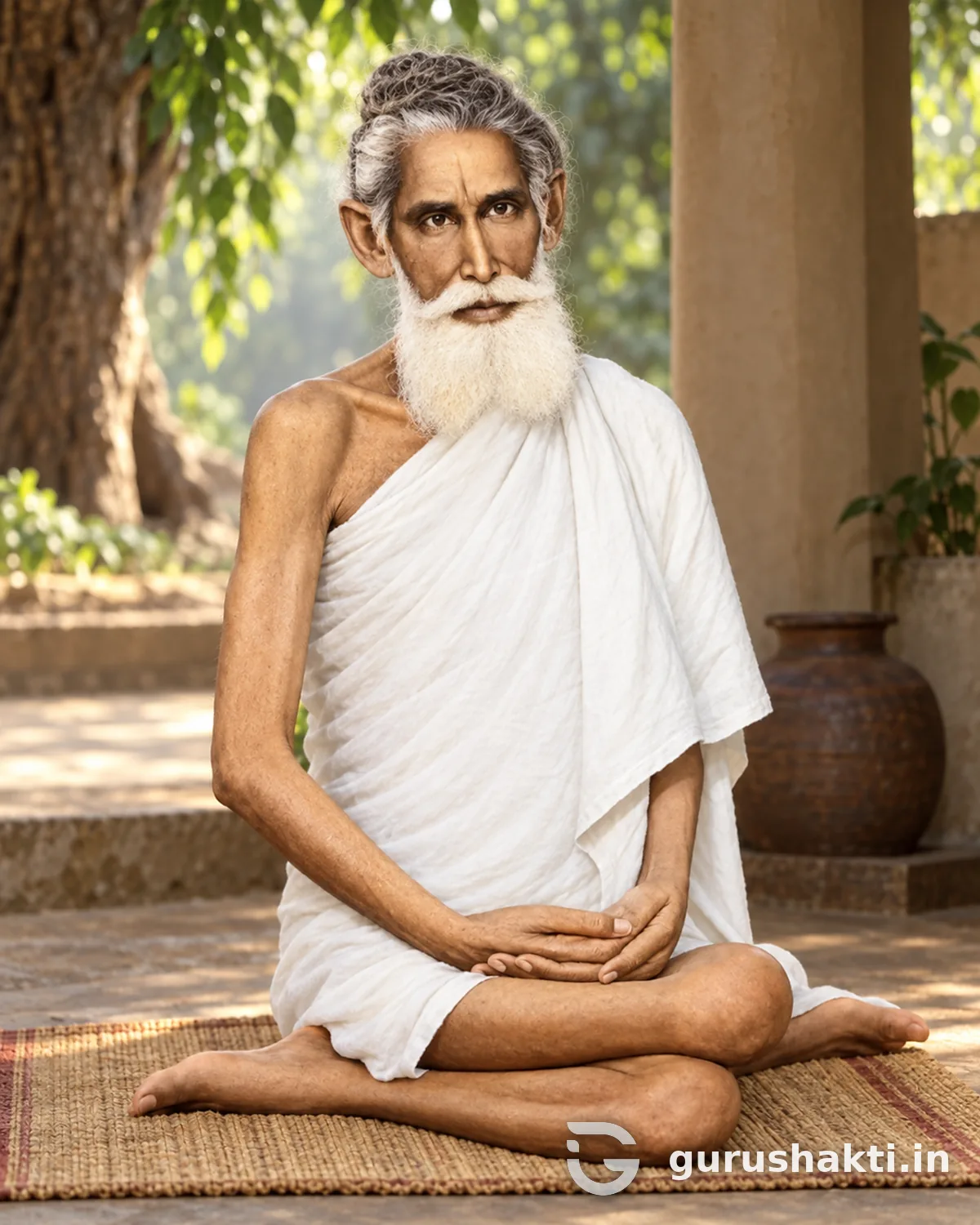
At the ashram in Baradi, food was never only for people. Devotees recount that Baba Loknath would call out "come, come" in Bengali, and birds, insects and animals would gather to eat. He shared out each portion equally, to his disciples and to the creatures around them. He taught that God dwells in all beings.
Baba Loknath Brahmachari spent his last years in this village in Sonargaon, in what is now Bangladesh. He wrote no books. Yet his ashram at Baradi and his temples in West Bengal still draw pilgrims, and devotees still repeat his words when trouble comes. His life shows a plain way of practice: control anger, serve every living being, and remember the Divine when life turns hard.
Life story
A child promised to God
According to tradition, he was born in 1730 on Janmashtami, the festival of Krishna's birth. His biographer Dr Asimbaran De gives the date as 18 Bhadra 1137 in the Bengali calendar, which is 29 August 1730. Two villages in present-day North 24 Parganas, West Bengal, claim his birthplace: Chakla and Kachua.
His mother was Kamala Devi. Sources differ on his father's name, giving Ramnarayan Ghosal or Ramkanai Ghoshal. The Lokenath Divine Life Mission describes him as the fourth child. Dr De writes that the couple, devout Brahmins, had wished for a son who would become a sannyasi (a renunciate).
The Sanskrit scholar Acharya Bhagaban Ganguly of Kachua named the boy Loknath. The mission explains the name as "lord of the worlds".
Leaving home at eleven
At eleven, Loknath received the upanayana (the sacred thread ceremony) from Bhagaban Ganguly. He then left home as a brahmachari, a celibate student of the spirit. His friend Benimadhab was initiated with him and went too.
The guru first took the two boys to the jungles around the Kali temple at Kalighat, in Kolkata. Later, Dr De writes, they practised in the forests west of the Ganga.
Decades of discipline
According to the mission, Loknath spent more than thirty years in ashtanga yoga (the eight-limbed path) and hatha yoga (the yoga of posture and breath) under his guru. He kept his vow of celibacy and practised fasting. Tradition places his realisation in the Himalayas. The mission records that he attained nirvikalpa samadhi, the deepest state of meditative absorption, at about ninety.
Devotees also believe that he later travelled far beyond India. The mission names Mecca, Afghanistan and Persia among the places he is said to have visited. These journeys belong to devotee tradition, not recorded history.
Chandranath Hill and the road to Baradi
Before he settled, tradition places him at Chandranath Hill, in present-day Bangladesh. Dr De writes that he met the Bengali saint Vijaykrishna Goswami there, and devotees count Goswami among those he blessed.
Around 1270 in the Bengali calendar, about 1863, he came to Baradi, a village in Sonargaon, in the Narayanganj area. The man who brought him was Dengu Karmakar, a local resident. Devotees recount that Dengu had been cleared of a false criminal charge after receiving the yogi's blessing.
Dengu's family was uneasy about keeping an unclothed ascetic at home. A local landlord, known as Nag Babu, then gave a plot of uncultivated land beside the cremation ground. A simple thatched hut went up, and this became the ashram.
Twenty-six years at Baradi
Baba Loknath lived at Baradi for about twenty-six years. A widowed cowherd woman, remembered as Gowalini Ma, looked after the ashram. Animals lived there too: Dr De mentions an ox named Kalachand.
Devotees recount that he once appeared as a witness in a court at Narayanganj and gave his age as over 150. Devotees hold that he lived to 160. These figures are part of his tradition, and they are best read in that spirit.
The final day
On 19 Jyaishtha 1297 in the Bengali calendar, which the mission gives as 2 June 1890, Baba Loknath left the body at the Baradi ashram. Dr De writes that he sat in gomukhasana (the cow-face posture) and passed in meditation shortly before noon. According to the mission, his eyes stayed open and his body remained seated.
He had told his devotees how his body was to be treated. A sandalwood pyre was built at the ashram, and Ramkumar Chakraborty performed the rites. His samadhi stands at Baradi today.
Core teachings
God in every creature
Baba Loknath's best-known habit was feeding animals, birds and insects with the same care he gave people. Dr De records that he called them to eat and shared food equally. His reason was simple: God dwells in all beings. Devotees take from this that a hungry bird and a hungry person deserve the same care.
Remembering him in danger
Devotees hold dear his assurance, recorded by Dr De: "Wherever you face danger, in battle, forest, water or jungle, remember me." The Lokenath Divine Life Mission gives a similar English version. Devotees understand this as a call to turn the mind towards the Divine when fear rises. Gurushakti offers it as a teaching of faith and steadiness, with no promise of any outcome.
The enemy called anger
Dr De records his plain warning: "Anger is a person's greatest enemy." Alongside it he named ego: as long as the sense of "I" rules, he taught, a person stays bound.
The household as a fortress
Baba Loknath was a lifelong celibate, but he did not ask his visitors to give up their homes. Dr De records his image: "Household life is a fortress." If one must fight the inner battle, he said, it is better to fight from inside the fort. Family life, with its duties and steady routine, can protect and support spiritual effort.
Grace freely given
Dr De records another of his sayings: "My grace lies scattered; you need only gather it." Grace, in this teaching, is not rationed or sold. It is already present, and the seeker's task is to become open enough to receive it. The mission records that he spoke of living on after the body in subtle form. For his devotees, this is why his presence still feels near.
Principles for daily life
- Feed one creature. Put out grain or water for birds or a stray animal once this week, and do it with the same care you would give a guest.
- Let anger pass before you speak. When anger rises, wait a few breaths. Speak only after it has settled.
- Practise at home. Treat your household duties as part of your spiritual life. Do one daily task this week with full attention.
- Remember calmly in trouble. When something goes wrong, pause and turn your mind to the Divine for a moment before you act.
- Keep a simple discipline. Choose one small habit, such as moderate meals or ten minutes of quiet sitting, and keep it every day this week.
- Look for grace already present. Each evening, recall one kindness you received that day and give thanks for it.
Places of pilgrimage
- Sri Sri Loknath Brahmachari Ashram, Baradi, Sonargaon, Narayanganj, Bangladesh. His ashram and samadhi, about 35 km from Dhaka. The grounds include a pond and a Durga mandap. Pilgrims sit quietly near the samadhi and offer prayers.
- Chakla Dham, Deganga block, North 24 Parganas, West Bengal. A well-known temple of Baba Loknath at one of his two claimed birthplaces.
- Kachua Dham, Basirhat II, North 24 Parganas, West Bengal. The other claimed birthplace, where large crowds gather for his birthday celebrations.
- Kalighat, Kolkata, West Bengal. By tradition, the place where he and Benimadhab began their training with their guru.
Legacy today
Baba Loknath left no written teaching. The ashram at Baradi keeps his samadhi and draws pilgrims to Sonargaon. In West Bengal, temples at Chakla and Kachua draw large crowds, especially on his birthday, which devotees keep on Janmashtami.
The Lokenath Divine Life Mission, with its centre in Kolkata, teaches in his name today and has published a life of him, The Incredible Life of a Himalayan Yogi (2014). Bengali biographies such as Dr Asimbaran De's Ajana Mahayogi Baba Loknath collect his sayings and the stories of Baradi.
Walk the path
Baba Loknath's practice was simple, and it can begin at your own door. This week, set out a little grain or water for the birds each morning, as he did at Baradi. If you can, offer daan (giving) in the form of a meal to someone who needs one.
When anger rises, wait a few breaths before speaking. When worry comes, sit quietly for a moment and remember the Divine, in his name or any name you hold dear. Nothing more is needed. Steady, small acts of kindness were the heart of his way.
Frequently asked questions
Did Baba Loknath really live for 160 years?
Devotees hold that he was born in 1730 and passed away in 1890, which would make about 160 years. This is tradition, not verified history. His birth date is disputed, and the story that he told a court he was over 150 comes from devotees. His death at Baradi in 1890 is the firmest date.
Where is Baba Loknath's ashram and samadhi?
His ashram and samadhi are at Baradi, in Sonargaon, Narayanganj district, Bangladesh, about 35 km from Dhaka. The land was given by a local landlord beside the cremation ground, and he lived there for about twenty-six years. He left the body at the ashram in 1890.
Where was Baba Loknath born?
Two villages in North 24 Parganas, West Bengal, claim to be his birthplace: Chakla and Kachua. Both have temples, Chakla Dham and Kachua Dham, and both draw pilgrims for his birthday. Tradition places his birth in 1730 on Janmashtami, the festival of Krishna's birth.
Who was Baba Loknath's guru?
His guru was Acharya Bhagaban Ganguly of Kachua, a Sanskrit scholar. He gave Loknath the sacred thread at eleven and led him and his friend Benimadhab into years of yoga practice, first near Kalighat and later in the forests and, by tradition, the Himalayas.
What does "remember me in danger" mean?
Dr Asimbaran De records his words: wherever you face danger, in battle, forest, water or jungle, remember me. Devotees take this as a call to turn the mind to the Divine when fear rises. It is a practice of faith and steadiness, not a promise that difficulties will never come.
Sources
- About Baba Lokenath – Lokenath Divine Life Mission
- Ajana Mahayogi Baba Loknath (Bengali), Dr Asimbaran De – contents
- Ajana Mahayogi Baba Loknath: Baradi chapter
- Ajana Mahayogi Baba Loknath: sayings chapter
- Tourism – North 24 Parganas District, Government of West Bengal
- Baradi Loknath Babar Ashram – Smithsonian Magazine Photo Contest
Researched and written by GuruShakti, October 2026.