
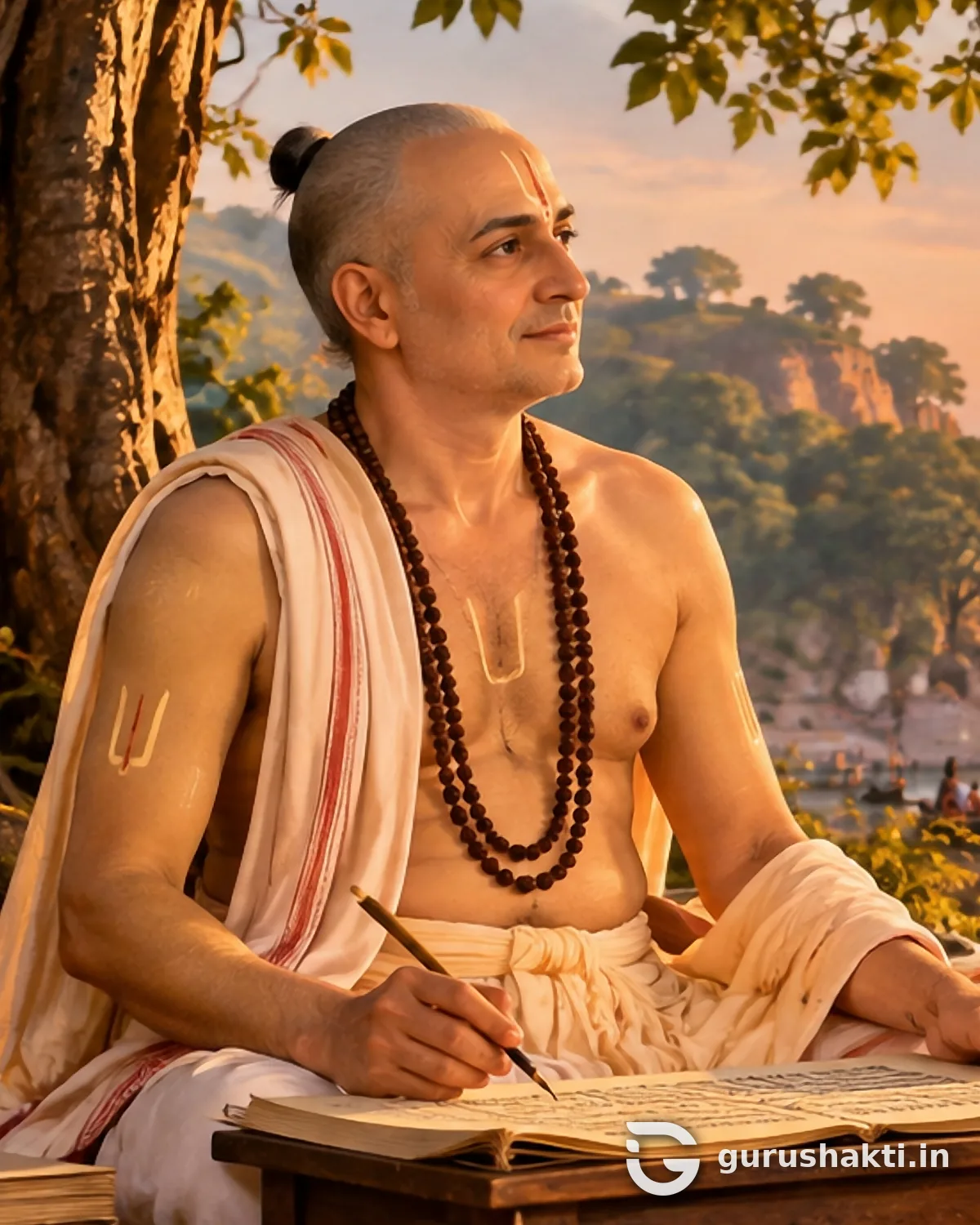
On Ram Navami in 1574 or 1575, in Ayodhya, a wandering devotee of Rama began to write. Devotees say he sat beneath a banyan tree. He did not write in Sanskrit, the language of the learned. He wrote in Awadhi, the speech of the villages around him. He said he was singing Rama's story for his own heart's joy. About two years, seven months and twenty-six days later, mostly in Varanasi, the work was complete. It was the Shri Ramcharitmanas.
The poet was Goswami Tulsidas. His Manas (as devotees call it) is recited in homes, staged in Ramlilas and sung at kathas across North India. The Hanuman Chalisa, traditionally attributed to him, is recited by devotees of Hanuman to this day. For a seeker today, Tulsidas offers a path that asks for no learning: remember Rama's Name, treat every person as a home of the divine, and do good to others.
Life story
Rambola of Rajapur
The year of Tulsidas's birth is uncertain. Popular tradition gives 1497, Hindupedia gives 1532, and many scholars, including Britannica, place it around 1543. Only the year of his death, 1623, is agreed. He was probably born at Rajapur, in today's Chitrakoot district of Uttar Pradesh, to Atmaram Dube and Hulsi. Tradition says he was born with teeth and was named Rambola. As a small boy he was left without family care.
The sadhu Narharidas
The sadhu Narharidas, also called Narharyanand, took the boy in. By tradition Narharidas belonged to the line of Swami Ramananda. He taught the child the story of the Ramayana and gave him the name Tulsidas. As a youth, Tulsidas went on to study Sanskrit and the scriptures, reportedly at Kashi (Varanasi).
Ratnavali and the turning point
As a young man Tulsidas married Ratnavali. Their infant son, Tarak, died. Devotees recount that Tulsidas was so attached to his wife that he could not bear to be apart from her. When she went to her father's house, he followed her there. Ratnavali rebuked him. If he loved Rama as he loved this body of bone and skin, she said, he would be free. The body is not lasting; love for Rama is. Those words, tradition says, turned him to renunciation. He left home for a life of devotion.
The years of wandering
For years Tulsidas lived as a wandering devotee of Rama. Little is recorded of where he went, and these years are known mostly through the accounts of devotees. Tradition holds that Hanuman guided him, and that at Chitrakoot, on today's border of Uttar Pradesh and Madhya Pradesh, he was blessed with Rama's darshan (sacred sight). Devotees say Rama came while he was grinding sandalwood paste. These accounts come from later biographies of the saint, and devotees cherish them.
In 1574 by most accounts, on Ram Navami, he began the Ramcharitmanas in Ayodhya. He finished it about two years, seven months and twenty-six days later, largely in Varanasi. Britannica dates the writing to 1574 through 1576 or 1577. He opened it with a Sanskrit verse saying that he sang Raghunath's story svantah sukhaya, for his own heart's joy. He wrote it in Awadhi so that ordinary people, not only Sanskrit scholars, could hear Rama's story in their own tongue.
Last years in Varanasi
Tulsidas settled in Varanasi, by the Ganga at Assi. There he wrote the Vinay Patrika, a long prayer of humble surrender, along with Kavitavali, Gitavali, Dohavali and Krishna Gitavali. He founded the Sankat Mochan Hanuman Temple, which still stands in the city and today hosts an annual music festival. The Hanuman Chalisa is traditionally attributed to him.
From the late 16th century onward, the Ramlila of Ramnagar near Varanasi, and Ramlilas in villages, began to stage his Manas. In this way his poem spread across North India. Tulsi Ghat at Assi, where he lived, is still associated with his akhara and relics. Tulsidas left the body in 1623 at Assi Ghat in Varanasi. By tradition the day was Shravan Shukla Saptami, Samvat 1680.
Core teachings
Rama's Name above all
For Tulsidas, the surest path for ordinary people in this age is to chant and remember Rama's Name. In the Bal Kand of the Ramcharitmanas he sings the praise of the Name. Britannica describes his work as centred on bhakti (loving devotion). The Name needs no wealth, no learning and no special place. It can be remembered at home, at work or on the road.
See God in all beings
In the Bal Kand, Tulsidas writes: "Knowing the whole world as filled with Sita-Rama, I bow with folded hands." For him the divine couple is not only in the temple. They are present in every creature. So the devotee bows to everyone with respect, the good and the difficult alike. This teaching turns daily life into worship, because every meeting is a meeting with the Lord he loved.
Serving others is the highest dharma
In the Uttar Kand of the Ramcharitmanas, Tulsidas puts it plainly: "No dharma equals doing good to others; no sin equals causing them pain." The President of India has quoted this line. For Tulsidas, devotion is not complete without kindness. The one who chants Rama's Name and then hurts another has missed the point. Doing good to others, in small ways and large, is the greatest duty.
Devotion in the people's language
Tulsidas knew Sanskrit well, yet he chose to write his Rama epic in Awadhi. As Britannica notes, this let the Rama story reach everyone, not only scholars. He opened the Ramcharitmanas by saying he sang Raghunath's story "for his own heart's joy". Written in that plain voice, his chaupais (verses of the Manas) could be recited by ordinary people at home and staged in the Ramlilas of village and town.
Humility and surrender
Tulsidas approached God as a humble servant. His Vinay Patrika, written in Varanasi, is a long prayer of this kind, in which the poet comes before Rama as a humble servant. The opening of the Hanuman Chalisa carries the same spirit. With the dust of the guru's feet, the devotee first cleans the mirror of his own mind. Only then does he begin to sing.
Principles for daily life
- Keep the Name close. Remember God's Name through the day this week, in whatever language comes naturally to you.
- Bow to everyone. Treat every person you meet as a dwelling of the divine, and greet them with respect.
- Help, do not hurt. Help others whenever you can, and avoid causing pain by word or deed.
- Clean the mirror first. Begin study or work with a moment of humility before the guru, cleaning "the mirror of the mind".
- Read a few lines daily. Read or listen to a few lines of the Ramcharitmanas or the Hanuman Chalisa each day.
Places of pilgrimage
- Sankat Mochan Hanuman Temple, Varanasi, Uttar Pradesh. The Hanuman temple founded by Tulsidas; it hosts the annual Sankat Mochan music festival.
- Tulsi Ghat (Assi), Varanasi, Uttar Pradesh. Where he lived and passed away; his akhara and relics are associated with the ghat.
- Tulsi Manas Mandir, Varanasi, Uttar Pradesh. A modern temple with the whole Ramcharitmanas inscribed on its walls.
- Rajapur, Chitrakoot, Uttar Pradesh. His traditional birthplace, with a temple and an old manuscript of the Manas.
- Chitrakoot, Uttar Pradesh and Madhya Pradesh. Where tradition says he had Rama's darshan.
- Ayodhya, Uttar Pradesh. Where he began the Ramcharitmanas.
Legacy today
Tulsidas founded no formal lineage of disciples. His influence travels instead through three living streams. The first is Manas katha, the public recitation and explanation of the Ramcharitmanas. The second is the Ramlila, from the Ramlila of Ramnagar near Varanasi to village stages, which has performed his Manas since the late 16th century. The third is Hanuman devotion: the Sankat Mochan temple he founded in Varanasi, its annual music festival, and the Hanuman Chalisa, traditionally attributed to him. In Varanasi, the Tulsi Manas Mandir carries the whole Manas on its walls, and Tulsi Ghat keeps his memory at Assi. His Jayanti is kept on Shravan Shukla Saptami.
Images
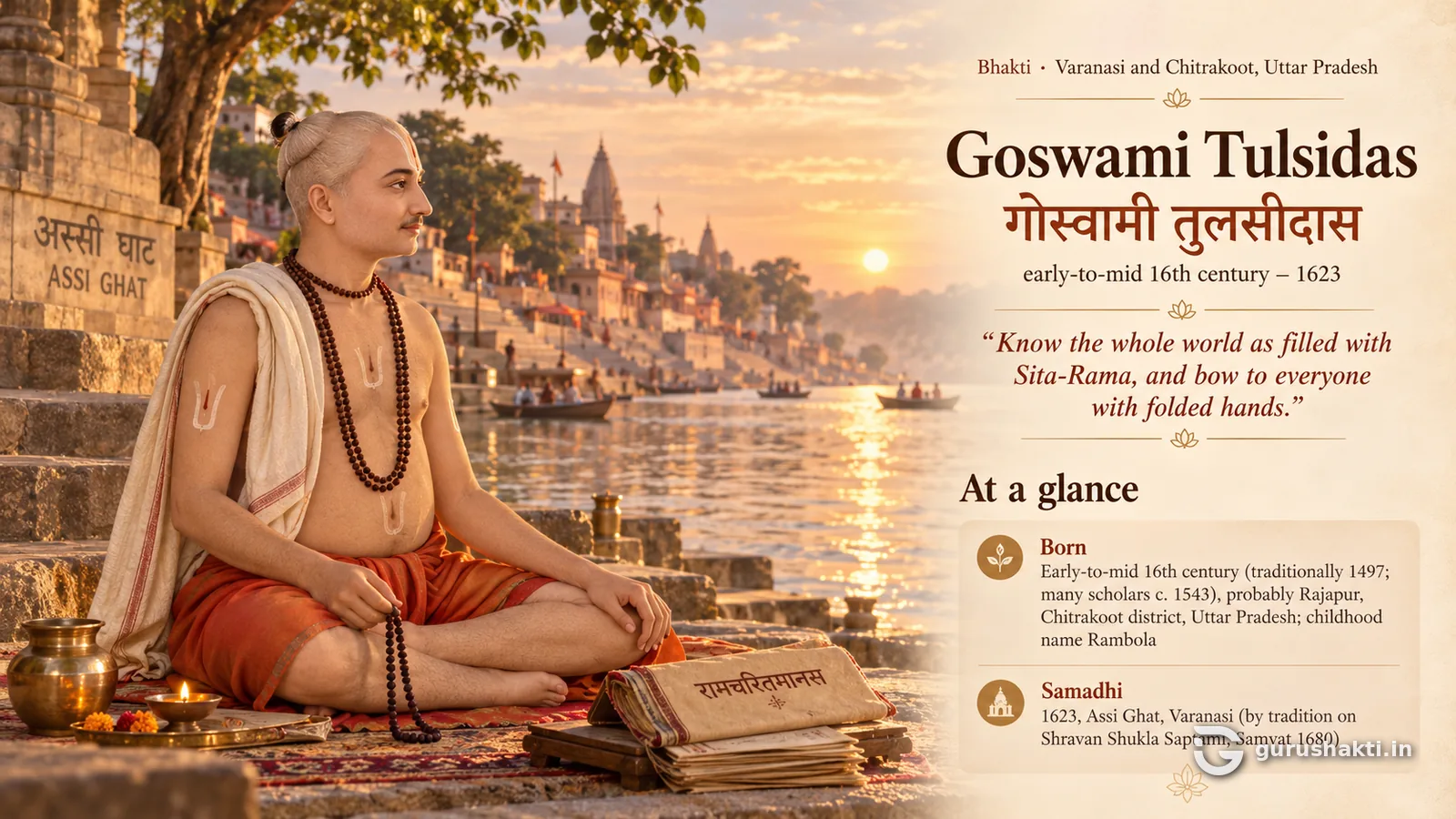
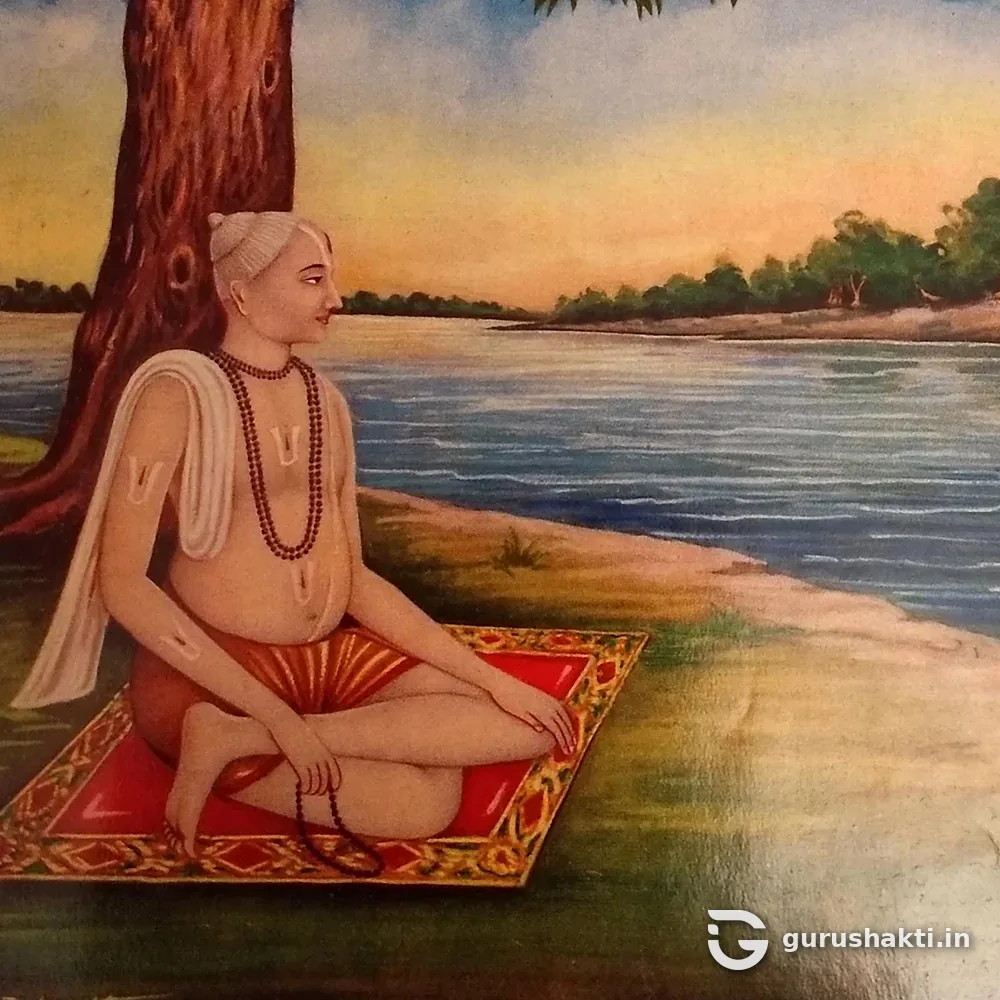
Image may be restored, upscaled or regenerated with generative AI.
Walk the path
Tulsidas asked only for a heart turned to Rama. This week, you might recite the Hanuman Chalisa once each morning, slowly, beginning with its first line about cleaning the mirror of the mind. Or read a few chaupais of the Ramcharitmanas before sleep. Through the day, let Rama's Name return to you whenever you remember. And do one deliberate kindness for someone, keeping in mind his line that no dharma equals doing good to others.
Frequently asked questions
Who wrote the Hanuman Chalisa?
The Hanuman Chalisa is traditionally attributed to Goswami Tulsidas, the poet-saint of the 16th and early 17th centuries who wrote the Ramcharitmanas. It opens with the doha "श्रीगुरु चरन सरोज रज": with the dust of the guru's lotus feet, I polish the mirror of my mind. Tulsidas also founded the Sankat Mochan Hanuman Temple in Varanasi.
When and where did Tulsidas write the Ramcharitmanas?
He began the Ramcharitmanas on Ram Navami in Ayodhya, in 1574 by most accounts (some sources say 1575). He completed it about two years, seven months and twenty-six days later, largely in Varanasi. He wrote it in Awadhi, so that everyone, not only Sanskrit scholars, could hear Rama's story.
Who was the guru of Tulsidas?
By tradition, his guru was the sadhu Narharidas, also called Narharyanand, of the line of Swami Ramananda. Narharidas took him in as a boy when he was left without family care. He taught him the Ramayana and gave him the name Tulsidas. Later the young Tulsidas studied Sanskrit and the scriptures, reportedly at Kashi.
What is the story of Tulsidas and his wife Ratnavali?
Devotees recount that Tulsidas was so attached to his wife Ratnavali that he followed her to her father's house. She told him that if he loved Rama as much as this body of bone and skin, he would be free. Her words, tradition says, turned him to a life of devotion.
When is Tulsidas Jayanti celebrated?
Tulsidas Jayanti falls on Shravan Shukla Saptami, the seventh day of the bright half of the month of Shravan. Because it follows the Hindu lunar calendar, its date in the Gregorian calendar changes each year. By tradition, he also left the body on this tithi (lunar day), in Samvat 1680.
Sources
Researched and written by GuruShakti, October 2026.