
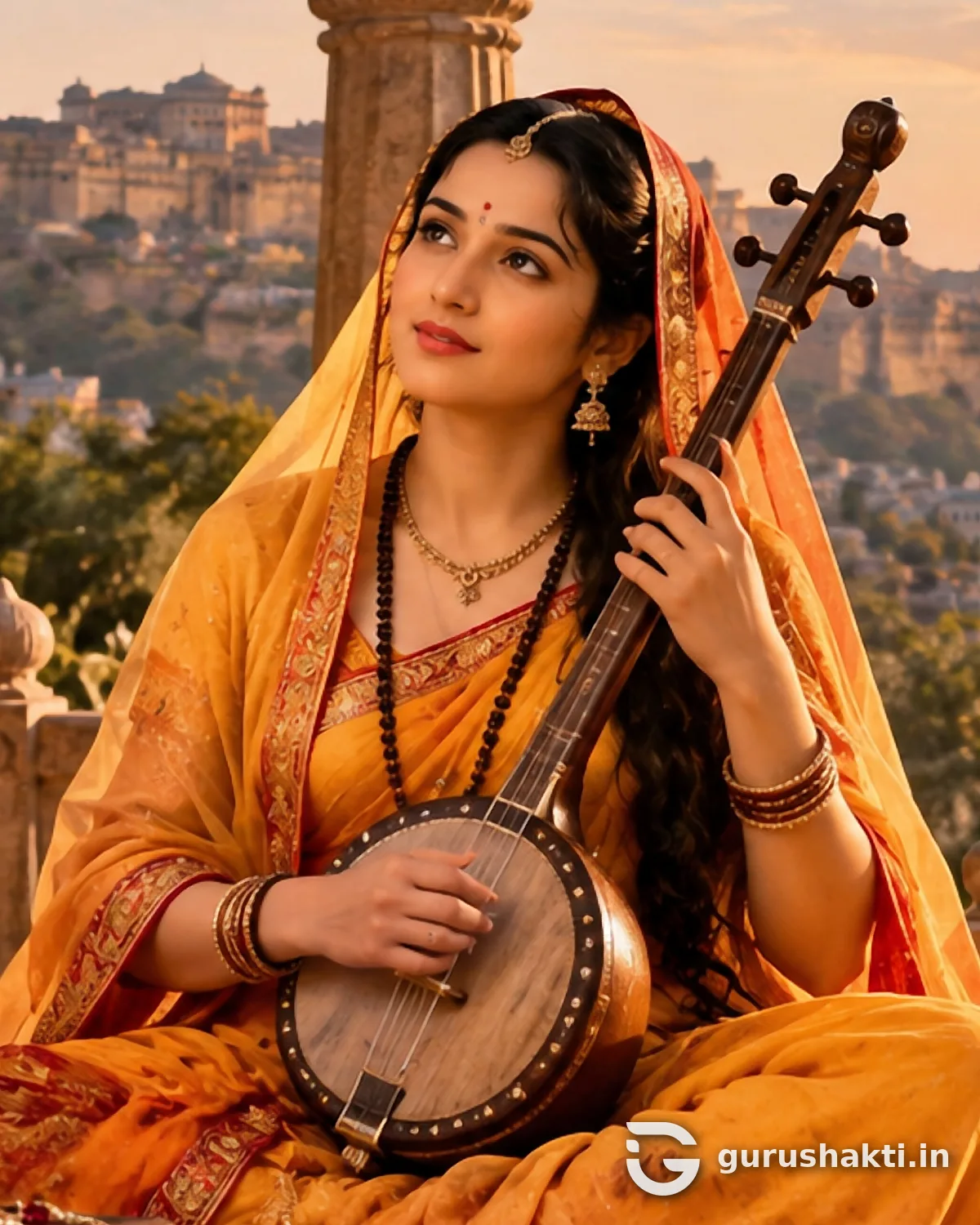
A young widow sits in her private temple at the royal court of Mewar. Sadhus and pilgrims come through the door, and she sits among them and sings to Krishna, whom she calls Giridhar Gopal, the cowherd who lifted the mountain. Her husband's family wants a quieter, more fitting life from a princess. She keeps singing. In one song she says it plainly: Giridhar Gopal is hers, and no one else.
That is nearly all we know for certain about Mirabai, and it is enough. Almost five hundred years later her songs are still sung in homes, temples and gatherings across India. She had no title, no ashram and no disciples in the usual sense. What she left was a way of loving God that anyone can take up: personal, wholehearted, sung aloud, and steady under pressure. For people who feel ritual is beyond them, she shows another door.
Life story
A princess and her Krishna
Mirabai was born around 1498, by tradition at Merta or the nearby village of Kudaki in Rajasthan. She was a Rajput princess, the only child of Ratan Singh of the Merta Rathore house. No record from her own lifetime survives, so much of what follows comes from later devotional biographies called bhaktamals (garlands of devotees). They should be read as tradition, with love but with care.
Tradition says that as a child she was given, or chose, a small image of Krishna as Giridhar Gopal. She took him as her lifelong beloved. Devotees believe this childhood bond shaped everything that came after, and her songs speak of Krishna as husband, friend and only refuge.
Marriage into Mewar
In 1516 she was married to Bhoj Raj, the crown prince of Mewar and son of Rana Sangram Singh, known as Rana Sanga. It was a marriage between two important Rajput houses. Within a few years it ended. Around 1521 Bhoj Raj died, probably from wounds received in battle.
Later accounts say that Mirabai declined to commit sati, the practice of a widow dying on her husband's funeral pyre. She remained at the Mewar court as a young widow, and she turned more completely to Krishna.
Years of pressure and song
Through the 1520s and 1530s Mirabai faced pressure and hostility from her husband's family, and later accounts single out Vikram Singh in particular. Some of the songs attributed to her allude to attempts on her life. Historians cannot confirm the details, and it is fairer to speak of a family and a saint who saw the world very differently than of villains.
Through all of this she spent her days in her private temple. She sang, and she received sadhus (wandering holy men) and pilgrims. For a woman of a royal house to sit openly in such company was unusual. For Mirabai it was simply satsang (the company of the sincere), and she would not give it up.
Leaving for Merta and Vrindavan
In the later 1530s Mirabai left Mewar and returned to Merta, her childhood home. From there she set out on pilgrimage. Tradition places her in Vrindavan, the land of Krishna's childhood, for some years, and a 19th-century temple there marks her stay. She had left the palace behind and kept only her song.
The last night at Dwarka
Her final years were spent in Dwarka, in Gujarat. Around 1546, envoys came from Mewar to bring her back. Devotees recount that she asked to spend one night at the Ranchhodji temple, the Dwarkadhish temple. In the morning she was gone, and she was never seen again.
Sources give her passing as 1546, 1547 or around 1557. Tradition holds that she merged into the image of Krishna she had loved since childhood.
Core teachings
Love is the whole path
Mirabai did not teach a system. She approached God as the Beloved, and her songs show that total, personal love is enough. No ritual qualification, no learning and no special birth are needed. A princess and a pilgrim stand in the same place before Krishna. What matters is whether the heart is truly given. This made her songs open to anyone who could sing them, in any home.
One refuge
Her best-known line says it in a few words. In the pada that begins "Mere to Giridhar Gopal, doosro na koi", cited by Hinduism Today, she declares Giridhar Gopal her only one. Devotion, for Mirabai, means not dividing the heart between God and everything else that pulls at it. Rank, family approval and comfort all came second. The one thing she would not share was her love.
Courage without bitterness
Mirabai held to her path against the wishes of her family and the expectations of her caste and society. Britannica notes that she did so without hatred for those who opposed her. Her courage was quiet: she did not argue, she simply kept singing and kept company with sadhus. It is a model for anyone whose faith is mocked or misunderstood at home.
Satsang and kirtan
Her daily sadhana (spiritual practice) was simple. She sang God's name and praises, kirtan, in the company of sadhus and pilgrims. She did not sit apart in silence. She sang aloud, with others, day after day. In this tradition the song is itself the prayer, and the gathering of sincere people is itself a temple.
God in everyday words
Mirabai sang in the everyday language of her region, Rajasthani mixed with Braj, and her songs travelled into Gujarati too. She used homely images that ordinary people knew: the anklets of a dancer, a jewel, the bazaar. Through such pictures, as Britannica and the Poetry Foundation describe, listeners could feel that God was close, in the world of their own lives.
Principles for daily life
- Choose one form to love. Pick one form of God, as Mira chose Giridhar Gopal, and return to it each day this week, even for a few minutes.
- Sing every day. One bhajan a day is a complete practice. Sing it aloud, at home or on the way to work.
- Keep quiet courage. If someone mocks your faith, answer gently, or not at all. Let your steadiness speak.
- Seek satsang. Spend an hour this week with sincere seekers, at a temple kirtan or a home gathering.
- Talk to God as a friend. Hand over your work and your worries to God the way you would tell a dear friend.
- Let go of one thing. Mira left a palace. Give up one small habit this week that divides your attention from what you love most.
Places of pilgrimage
- Meera Mahal, Merta, Nagaur district, Rajasthan. Her birthplace palace, now a Charbhuja and Meera temple with a museum. A quiet place to begin where her story begins.
- Meera Temple, Chittorgarh Fort, Rajasthan. A temple linked to her worship at the Mewar court, beside the Kumbha Shyam temple. Sit here and think of the young widow who kept singing.
- Meera Temple (Shaligram temple), Vrindavan, Uttar Pradesh. A 19th-century shrine marking the years tradition says she spent in Vrindavan.
- Dwarkadhish Temple, Dwarka, Gujarat. The Ranchhodji temple where, tradition says, she merged with Krishna. Stand before the image she sang to in her last years.
Legacy today
Mirabai founded no order and left no line of disciples. Her legacy lives in song. Her padas are sung by Vaishnava communities devoted to Krishna, by Sant communities of North India, and by singers of every kind, in Rajasthani-Braj and in Gujarati.
In Rajasthan her memory is held in stone: the Meera Mahal at Merta and the Meera Temple in Chittorgarh Fort both draw visitors. In Vrindavan and Dwarka, temples connected to her are part of the pilgrim's round. Scholars continue to sort her own songs from those added in her name over the centuries. The singing has never waited for them.
Images
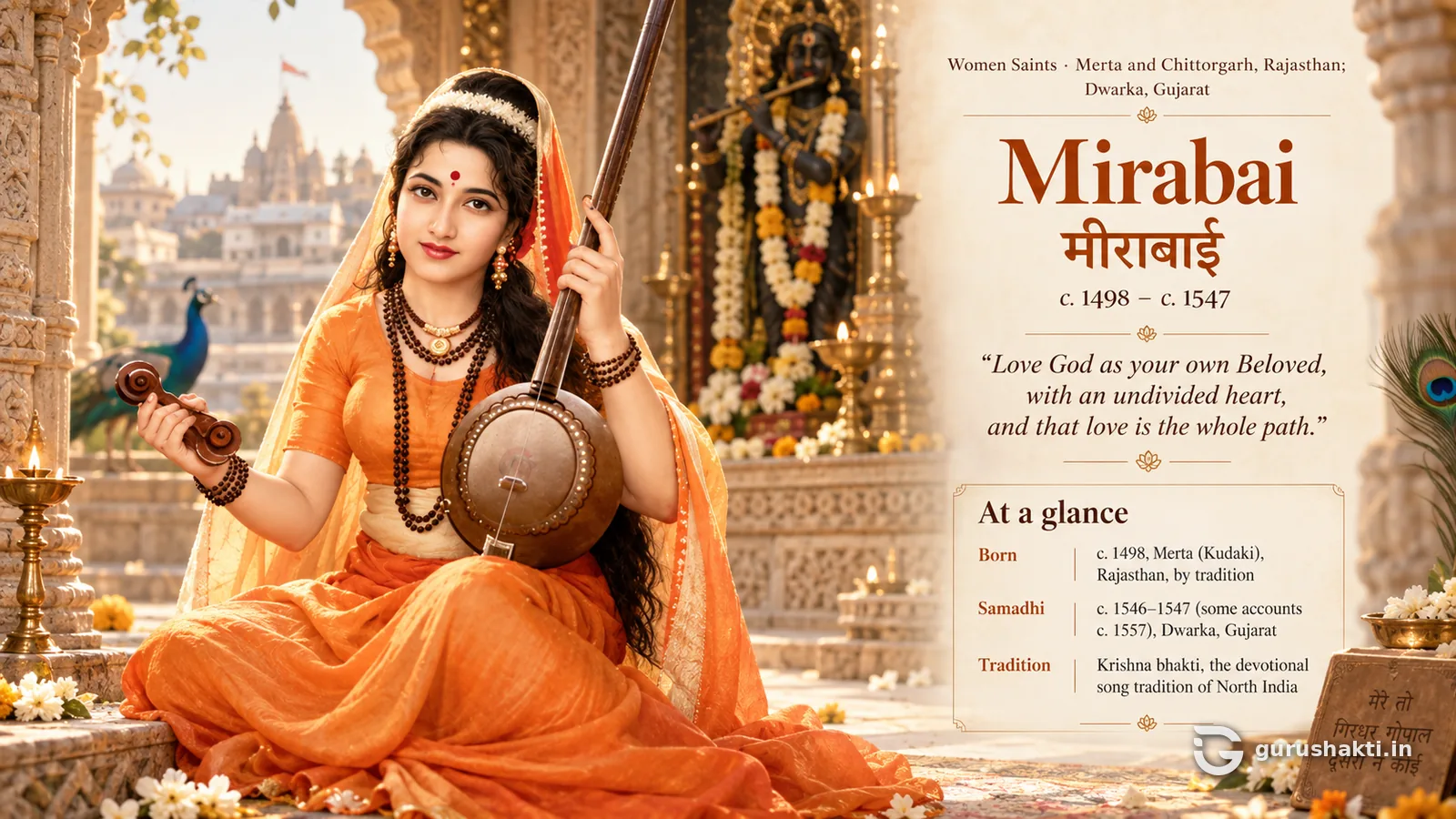
Image may be restored, upscaled or regenerated with generative AI.
Walk the path
Mirabai's way asks for very little equipment. This week, choose one form of God you feel close to and give it a few minutes each day. Sing one bhajan, softly or aloud, and let that be your whole practice for the day. If you can, join a kirtan at a nearby temple and sit among the others as Mira sat among the sadhus. You might also offer a small daan (gift) of flowers or food at a Krishna temple, with no request attached. Let it be love, as hers was.
Frequently asked questions
Who was Mirabai's guru?
Some traditions, and some padas sung in her name, say her guru was Sant Ravidas, and one pada sung in her name calls her a servant at his feet. Other tellings name no human guru at all and see Krishna himself as her only teacher. Both views are held with sincerity by devotees, and the historical record cannot settle the question either way.
Was Mirabai really poisoned?
Devotees recount that a cup of poison was sent to her and did her no harm when she drank it with Krishna's name. Britannica notes that her poems allude to attempts on her life. The details of the story, however, come from later devotional accounts and are best read as devotional legend rather than documented history.
How did Mirabai die?
No record tells us. Tradition holds that around 1546, when envoys came to take her back to Mewar, she spent a night in the Ranchhodji temple at Dwarka and was never seen again. Devotees believe she merged into Krishna's image. Sources give her passing as 1546, 1547 or around 1557.
What language did Mirabai write in?
Her padas are in Rajasthani mixed with Braj. Many are also sung in Gujarati. She used simple, everyday words and images, which is one reason her songs travelled so widely among ordinary people.
Who was Mirabai's husband?
In 1516 she married Bhoj Raj, the crown prince of Mewar and son of Rana Sangram Singh, also known as Rana Sanga. He died around 1521, probably of wounds from battle. Devotees also speak of Krishna as her true husband, the one she chose as a child.
Sources
Researched and written by GuruShakti, October 2026.