
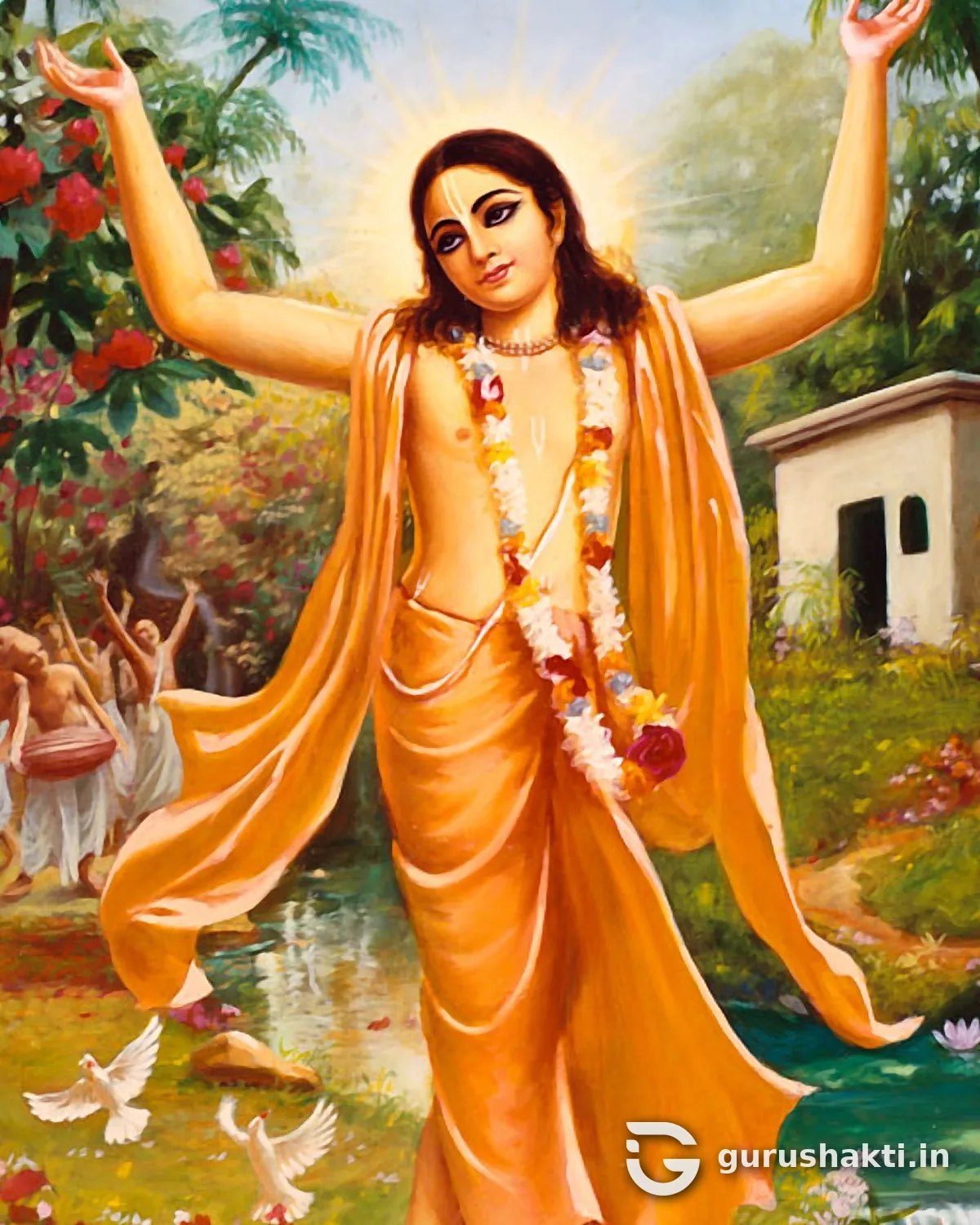
A young scholar from Navadvipa goes to Gaya to perform his father's last rites. He is proud of his learning and runs his own school of Sanskrit. At Gaya he meets Ishvara Puri and takes initiation from him. Devotees recount that he came home a different man, weeping Krishna's name, and could no longer teach grammar.
That scholar was Vishvambhara, called Nimai, whom the world came to know as Sri Chaitanya Mahaprabhu. From that turn at Gaya came a way of worship that is still heard in streets and temples today: people singing God's names together, out loud, in company. He wrote only eight verses. Their message is simple enough for a child: chant the Name, be humble, be patient, and ask God for nothing but love.
Life story
Nimai of Navadvipa
Chaitanya was born on Phalguna Purnima, the full moon of the month of Phalguna, in Shaka 1407, which is February 1486. Britannica gives the year as 1485. Tradition records that a lunar eclipse was taking place at the time. His birthplace was Navadvipa, at the spot now called Mayapur, in Nadia district of West Bengal. His parents were Jagannatha Mishra and Shachi Devi. They named him Vishvambhara, and he was called Nimai at home.
He grew into a celebrated Sanskrit scholar. After his father's death he opened a school of his own.
The turn at Gaya
Around 1508, at about 22, he travelled to Gaya to perform rites for his father. There he met Ishvara Puri and received diksha (initiation) from him. Britannica describes the change as a transformation. The scholar who had loved grammar and debate now cared for one thing, Krishna.
Back in Navadvipa, from about 1508 to 1510, he led kirtan (devotional singing) night after night. Nityananda, Advaita Acharya and Srivasa Thakura joined him, and the singing spilled from homes into the streets. Devotees recount that when the local Kazi, the town's magistrate, banned public kirtan, Chaitanya led a great singing procession to his door, and the ban was lifted.
Sannyasa and Puri
In 1510, at 24, he took sannyasa (the vow of renunciation) from Keshava Bharati at Katwa. He was given the name Shri Krishna Chaitanya. At his mother's wish, Britannica records, he settled at Puri in Odisha, close to the Jagannath temple.
Six years on the road
From about 1510 to 1516 he travelled. He went on pilgrimage through South India, and then journeyed to Vrindavan, where he identified places sacred to Krishna's life. At Prayag and Varanasi he instructed two brothers, Rupa and Sanatana Goswami. They went on to write the theology of his school, and with four others they are remembered as the Six Goswamis of Vrindavan.
The last eighteen years
From about 1516 he stayed in Puri for the rest of his life, some eighteen years. He lived in a room called the Gambhira, and his days were absorbed in ecstatic devotion to Radha and Krishna. He passed away at Puri in 1533 or 1534, aged about 48. No historical record tells us how. Devotees tell several stories of his last moments; all are matters of faith.
Core teachings
The Holy Name
At the centre of Chaitanya's teaching is the Name. Sankirtana, chanting God's names together, is the simplest and most powerful practice for this age, and it is open to everyone, with no barrier of birth or learning. The first verse of the Shikshashtakam says the Name "cleans the mirror of the heart". The third ends with the instruction: "Always sing the name of Hari."
Humility and tolerance
Chaitanya asked his followers to be "humbler than grass, patient as a tree", in the words of the Shikshashtakam's third verse, recorded in the Chaitanya Charitamrita. Grass bends under every foot. A tree stands through heat and rain without complaint. The verse adds that one should give respect to others without expecting any in return. This, for Chaitanya, is the right state of heart for chanting.
Pure, selfless love
Prema (pure love of God) asks for nothing back. In the Shikshashtakam he prays: "Lord, I want no wealth, followers or fame." The devotee asks only for devotion itself. This takes the bargaining out of prayer. One does not chant to get something; one chants because one loves.
The love of Radha and Krishna
For Chaitanya, the highest form of devotion is the love of Radha for Krishna. Her longing, her complete self-giving, is the model for every devotee. Britannica notes that his own last years were spent absorbed in this mood. Gaudiya Vaishnavas, his followers, revere him as Krishna himself in the mood of Radha. This is their belief, held with deep love.
One and different
His followers later gave a name to his view of God and the soul: achintya bhedabheda, inconceivable oneness and difference. The soul is one with God in quality, yet always distinct from God. The Goswamis worked this out in their writings after him. Chaitanya himself left no treatise on it.
Principles for daily life
- Chant every day. Sing or chant God's names for a few minutes each day this week, alone or with family.
- Give respect first. In one conversation each day, offer respect and expect none back.
- Be patient as a tree. When someone speaks harshly this week, pause before you answer, and let it pass.
- Pray for love, not things. For one week, let your prayers ask for nothing except love of God.
- Make it shared and joyful. Invite a friend or neighbour, whatever their background, to sing with you once this week.
Places of pilgrimage
- Sri Mayapur, Nadia, West Bengal. His birthplace, the Yogapith, with temples of the Gaudiya Math and the world headquarters of ISKCON.
- Navadvipa, West Bengal. The town of his early life and his first kirtans. Walk the town where the first night kirtans were sung.
- Katwa, Purba Bardhaman, West Bengal. Where he took sannyasa from Keshava Bharati.
- Jagannath Puri, Odisha. The Jagannath temple, and the Gambhira, the small room where he lived his last years.
- Vrindavan, Uttar Pradesh. The holy places he identified, and the temples of the Goswamis.
Legacy today
Chaitanya founded a living tradition, Gaudiya Vaishnavism, the Krishna devotion of Bengal. His companions in Bengal, Nityananda and Advaita Acharya, and the Six Goswamis in Vrindavan carried it forward, and the Goswamis wrote its theology. The Chaitanya Charitamrita and Chaitanya Bhagavata, written by followers, keep his life and words.
Today the Gaudiya Math and ISKCON, founded much later in 1966, both trace their teaching to him, and both keep temples at his birthplace in Mayapur. Through them, group chanting of Krishna's names is heard well beyond Bengal, Odisha and Vrindavan. His eight verses remain the plainest summary of the path.
Images
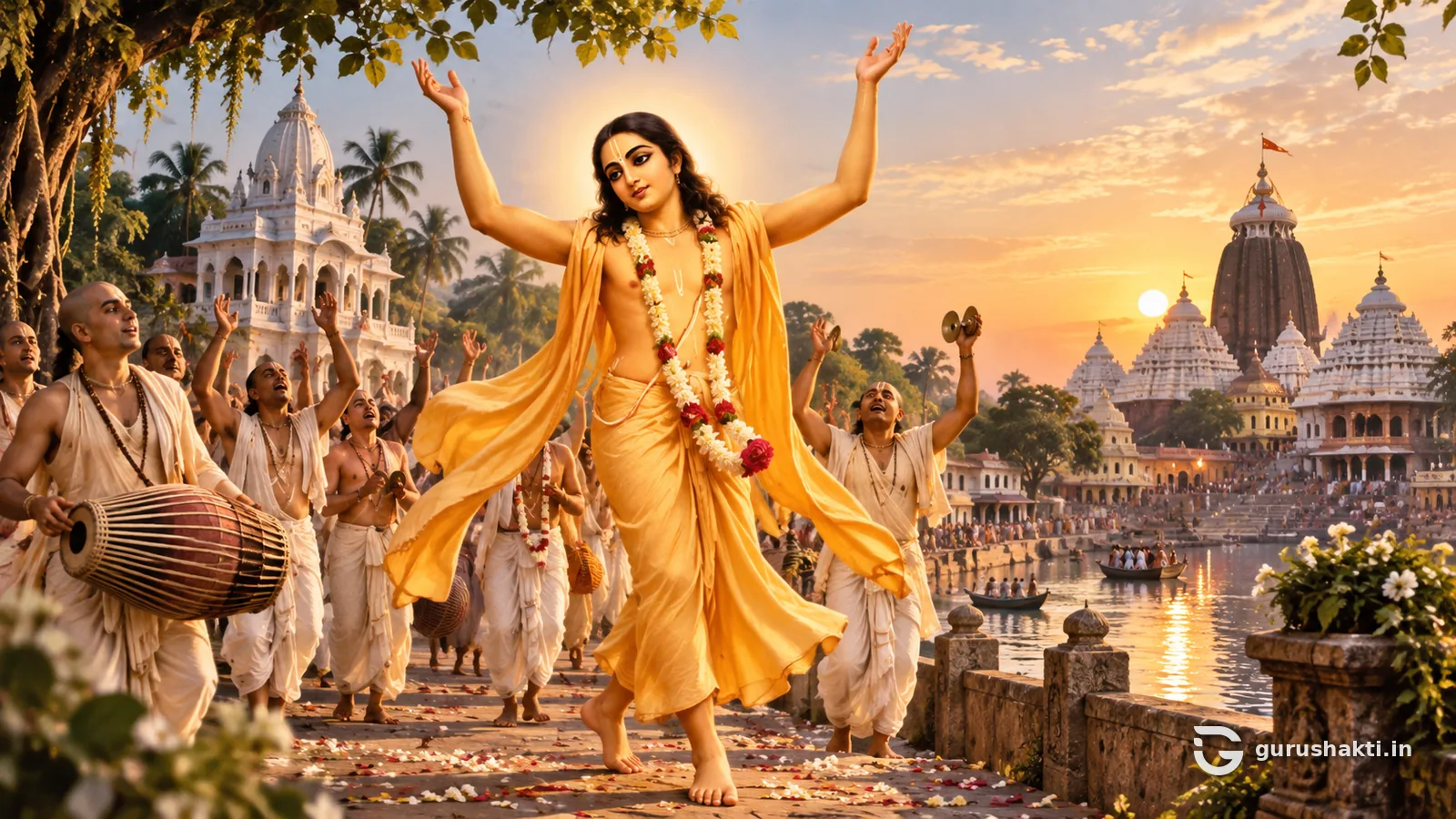
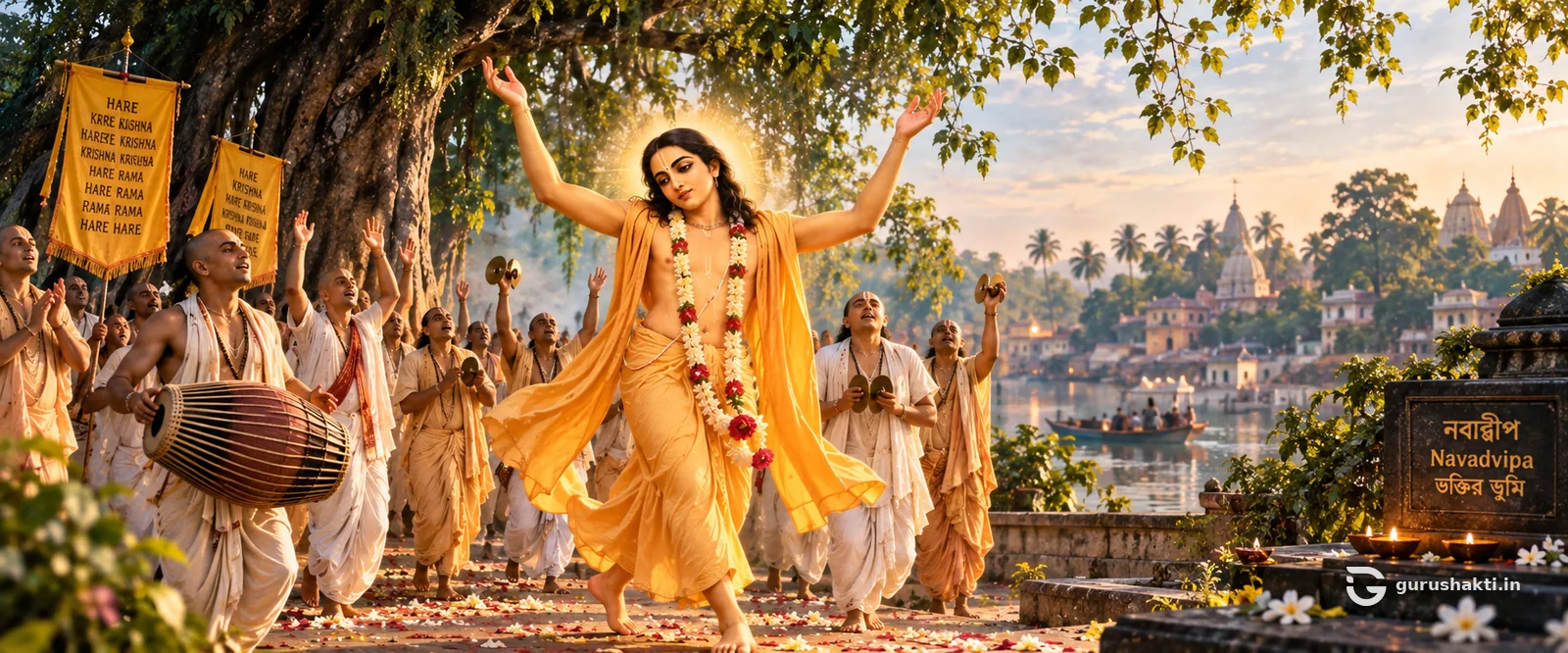
Image may be restored, upscaled or regenerated with generative AI.
Walk the path
Chaitanya's path asks only for a voice and a willing heart. This week, set aside ten minutes each day to sing or softly chant God's names, alone or with family. If there is a kirtan near you, go and sit with the singers; no one will ask who you are. Try to carry the third verse with you: humbler than grass, patient as a tree. And when you pray, ask for nothing but love. Nothing more is needed to start.
Frequently asked questions
Who was Chaitanya Mahaprabhu's guru?
He received diksha (initiation) from Ishvara Puri at Gaya, around 1508, and this meeting changed his life. In 1510 he took sannyasa from Keshava Bharati at Katwa. Gaudiya tradition connects his lineage to that of Madhva. His followers, however, revere him as a teacher in his own right.
What is Shikshashtakam?
The Shikshashtakam is a set of eight Sanskrit verses, the only writing Chaitanya left. It praises the Holy Name, which "cleans the mirror of the heart", asks the devotee to be "humbler than grass, patient as a tree", and prays for pure devotion rather than wealth or fame. It is recorded in the Chaitanya Charitamrita.
How did Chaitanya Mahaprabhu die?
He passed away at Puri in 1533 or 1534, aged about 48. The exact date and circumstances are not historically known. Devotees tell several stories of his departure, and these are held as matters of faith. His last eighteen years were spent in Puri, absorbed in devotion to Radha and Krishna.
Is Chaitanya Mahaprabhu considered an avatar of Krishna?
Gaudiya Vaishnavas, his followers, revere him as Krishna himself, appearing in the mood of Radha. This is a belief of the Gaudiya tradition, held with deep devotion. Others honour him as a great saint and teacher of bhakti.
What is Gaura Purnima?
Gaura Purnima is the celebration of Chaitanya's birth, held on Phalguna Purnima, the full moon of the month of Phalguna. He was born on that day in Shaka 1407, February 1486. For his followers it is the day to remember his birth, and Mayapur, his birthplace in West Bengal, is its natural home.
Sources
Researched and written by GuruShakti, October 2026.