
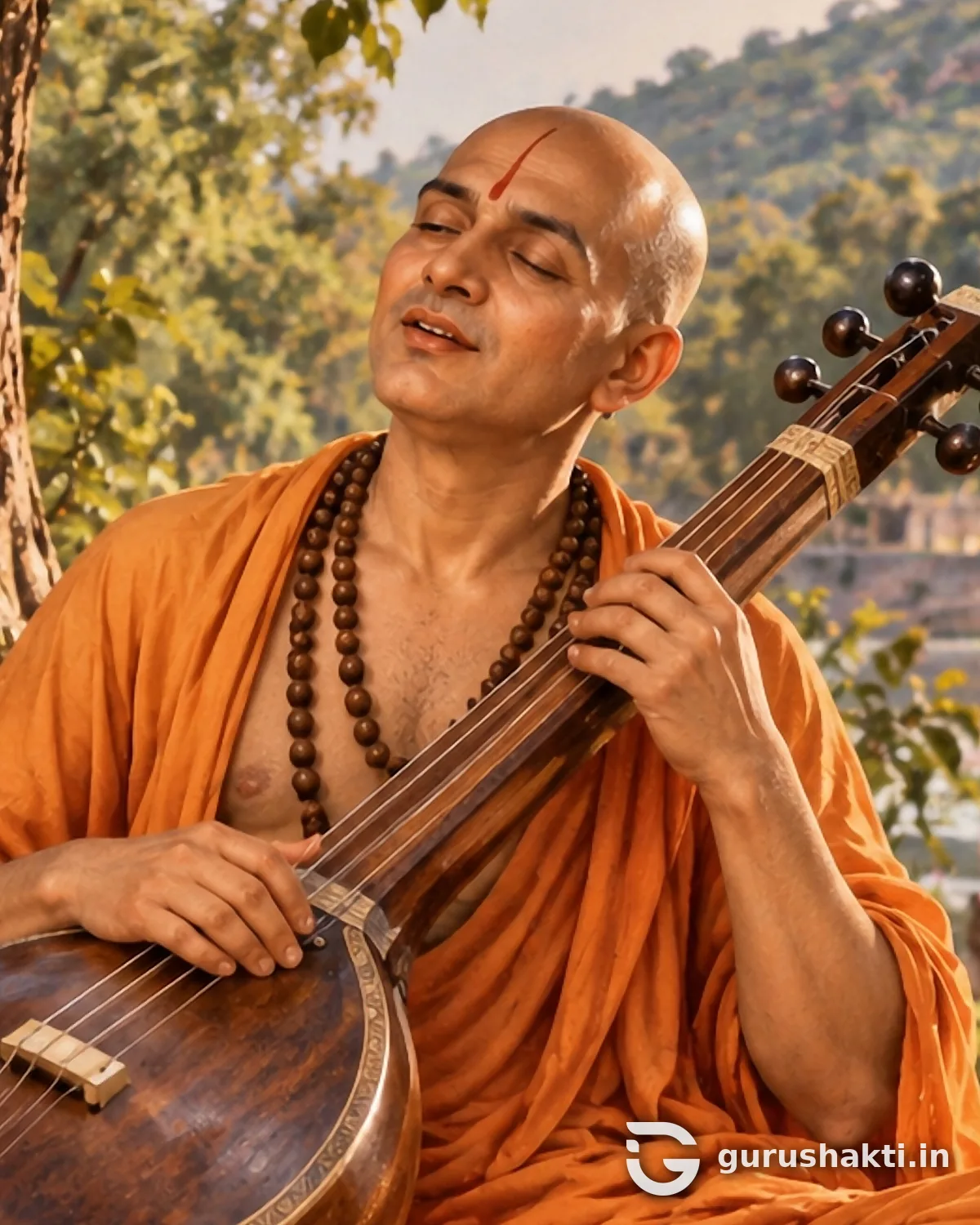
Devotees recount a quiet evening at Parasoli, a village near the hill of Govardhan in Braj. Beside the still water of Chandra Sarovar, an old singer lay in his simple hut, close to the end of his life. Someone asked him where his mind was resting. He did not answer in plain words. According to Pushtimarg literature, he sang one last pada (sung poem), about the eyes of Krishna. Then he was gone.
That singer was Sant Surdas. Tradition says he was blind, yet his songs are full of colour: a child denying he ate the butter, cows led out at dawn, a mother's tender scolding. Nobody needs a scholar's training to enter them. A child scolded for stealing butter, a mother's worry, a lover's longing: these are feelings every home knows. Surdas took them and offered them to God. For anyone who finds formal practice hard, he shows that a song sung with love can itself be prayer.
Life story
A singer of uncertain beginnings
Very little about Surdas's early life is certain. His dates are traditional, and the sources disagree. Britannica gives the traditional dates as 1483 to 1563. Other accounts place him from about 1478 to 1584. All agree that he lived and sang in north India in the 16th century, and Britannica thinks he probably lived in Braj, the land of Krishna's childhood around Mathura.
The Pushtimarg tradition gives a fuller story. It says he was born in Vikram Samvat 1535 at Sihi, a village near Delhi, and that he was blind from birth. Britannica takes a different view and suggests he probably lost his sight later in life. Tradition says he left home as a young man and settled at Gau Ghat, on the Yamuna between Agra and Mathura. There he sang devotional songs, and people came to hear him.
The meeting with Vallabhacharya
According to Vallabha tradition, a teacher came to Gau Ghat. He was Vallabhacharya (c. 1475–1530), the teacher of the Pushtimarg. The tradition dates the meeting to 1510. Devotees recount that Vallabhacharya heard Surdas sing and gave him a charge: sing the glory of Krishna's divine play. Surdas took initiation and turned his gift fully towards Krishna's lila (divine play).
This story comes from the Chaurasi Vaishnavan ki Varta, the "Accounts of Eighty-four Vaishnavas", traditionally written by Gokulnath, Vallabhacharya's grandson. Britannica and the scholar John Stratton Hawley treat the meeting as doubtful history, because no 16th-century Surdas poem names Vallabhacharya. For the Pushtimarg, the story still holds its truth about grace and song.
Singing before Shrinathji
After his initiation, tradition says, Surdas went to Govardhan to sing before Shrinathji, the form of Krishna worshipped there. He is believed to have served as the temple's head kirtan singer. In the Vallabha Sampradaya he is honoured as the foremost of the Ashtachhap, the eight poets whose songs passed into the temple's kirtan.
Stories also tell of the Mughal emperor Akbar admiring his songs. Hawley notes that a musician named Surdas does appear among Akbar's court musicians, but he thinks it unlikely that this was the poet of Braj.
The ocean of songs
The earliest dated manuscript of his poems comes from Fatehpur, in Rajasthan, in 1582. It holds 239 poems. Around 1600 the hagiographer Nabhadas, in his Bhaktamal, singled out Surdas for special praise.
The collection kept growing. By 1640 a manuscript carried 795 poems and was called the Sursagar, "Sur's Ocean". By the 19th century nearly 10,000 poems bore his name. Hawley explains that many later singers composed in Sur's name. So the Sursagar is a living ocean: some waves are his own, and many were added by those who loved him.
Last days at Parasoli
Surdas spent his later years in a simple hut at Parasoli, beside Chandra Sarovar, near Govardhan. There he went on composing songs for Krishna. Tradition dates his passing to 1563 or about 1584. Devotees recount that his last song was about Krishna's eyes. His kuti and a samadhi memorial still stand at the lake.
Core teachings
Sing Krishna's lila
For Surdas, devotion grows by singing the stories of Krishna's play in Braj: the child, the cowherd, the friend of the gopis (cowherd women). The Vallabha tradition says this was his guru's charge to him: to sing the glory of God's play. The songs are simple enough for anyone to join, at home or in a temple.
God as a child to love
Many of the most loved padas in the Sursagar see Krishna through the eyes of his mother, Yashoda. He steals butter, he complains that his brother teases him, he grows up under her watchful eye. In one famous pada attributed to Surdas, the child protests, "Mother, I did not eat the butter." Love of this kind has no fear in it. Surdas invites the devotee to love God as tenderly as a mother loves her child.
Love in separation
Viraha (the pain of separation) runs through his songs. After Krishna leaves Braj for Mathura, the gopis long for him. In the bhramargit (bee songs), Krishna's messenger Udho brings them a lesson in dry philosophy. The gopis turn it away for their living love of Krishna himself. For Surdas, longing is itself a form of love.
Humble petition
The vinaya poems are petitions in the poet's own voice. In them, the poet speaks directly to Krishna about his own failings and his need. One begins, in Hawley's translation, "Danced, I have danced before you."
The Unmanifest cannot be told
Surdas held that the formless God cannot be described. In a pada attributed to him he compares it to sweet fruit tasted by someone who cannot speak: the joy is real, but there are no words for it. So he chose to sing of God with form, the child of Braj whom anyone can picture and love.
Principles for daily life
- Sing one bhajan a day. Choose one song of Krishna this week and sing or listen to it each morning, even for five minutes.
- Love without fear. When you pray, think of God as a child you care for, tenderly and without fear.
- Speak honestly to God. Bring your failings in plain words, as Surdas did in his petitions, and then let them go.
- Let longing be prayer. When God feels far away, do not give up; offer the longing itself, as the gopis did.
- Offer your gift. Whatever you do well, singing, cooking, writing or teaching, do one piece of it this week as an offering.
- Honour those who cannot see. Spend time with, or help, someone who lives with blindness, with respect and without pity.
Places of pilgrimage
- Chandra Sarovar, Parasoli (Parsauli), near Govardhan, Uttar Pradesh. Visit Surdas's kuti and samadhi memorial by the lake, where tradition says he lived his last years and sang his final song.
- Govardhan, Braj, Uttar Pradesh. The holy hill where tradition says Surdas sang kirtan before Shrinathji.
- Gau Ghat, on the Yamuna between Agra and Mathura, Uttar Pradesh. The riverside where tradition places his early years of singing and his meeting with Vallabhacharya.
Legacy today
The Sursagar is still sung. In the Vallabha Sampradaya, Surdas is remembered as the foremost of the Ashtachhap poets, and his padas belong to the temple's kirtan. His songs of the child Krishna, such as the butter-stealing pada, are among the best known of the padas attributed to him. John Stratton Hawley's translation Sur's Ocean brings the poems of the 1582 manuscript and the early tradition to English readers. Blind singers in North India still take the name "Surdas", carrying his name into their own music. At Parasoli, his kuti and samadhi memorial by Chandra Sarovar remain a place of quiet remembrance in Braj.
Images
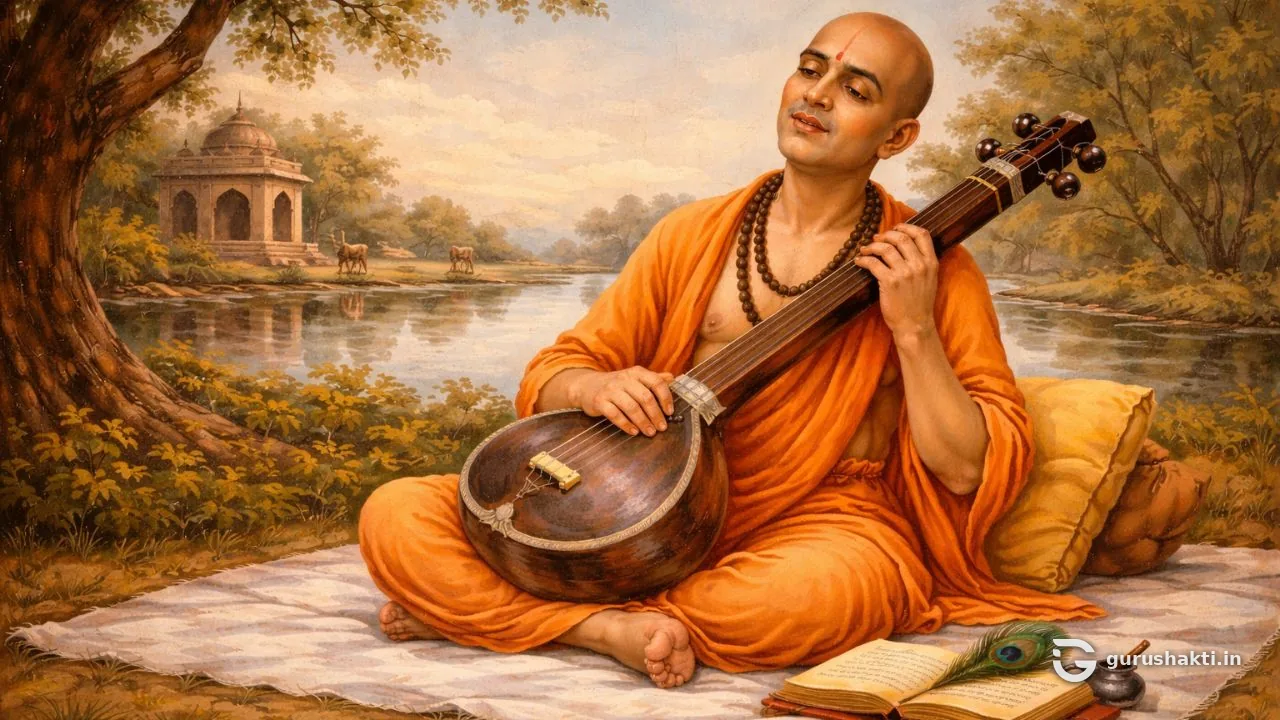
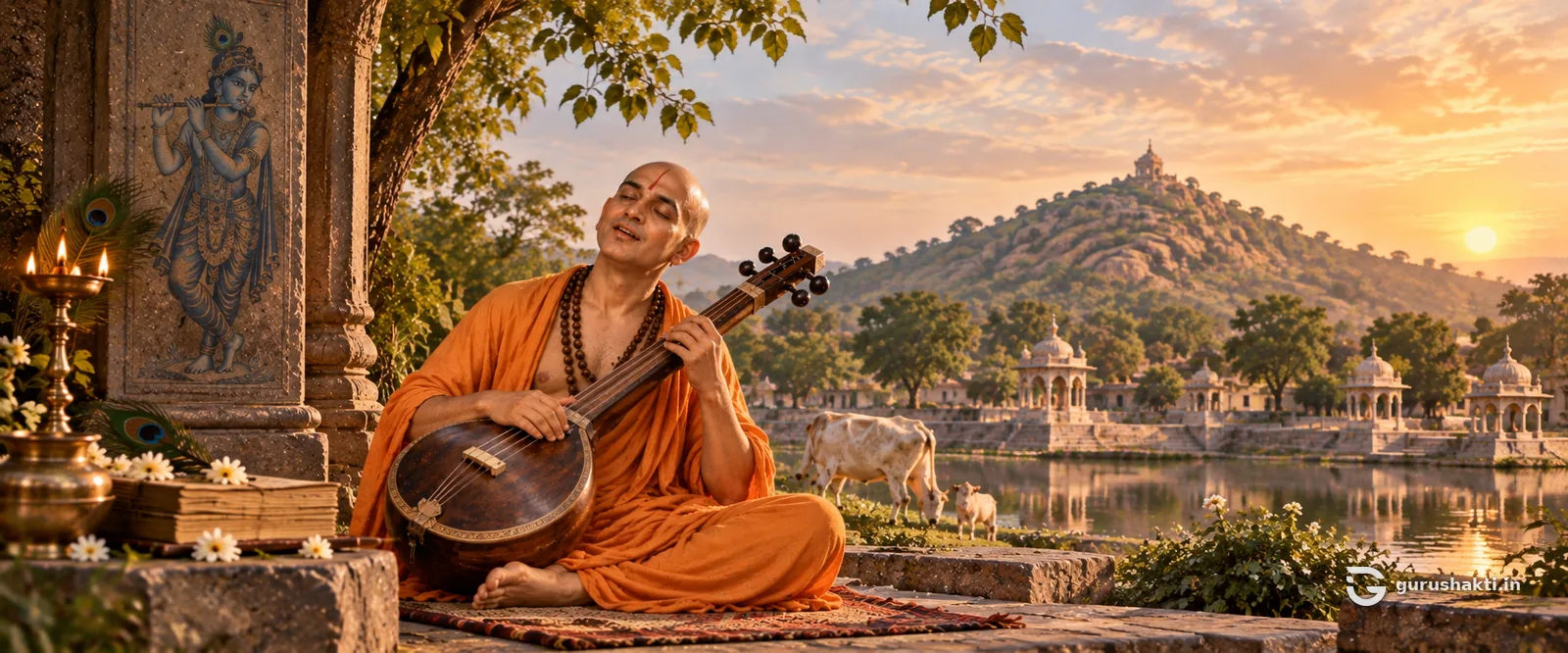
Image may be restored, upscaled or regenerated with generative AI.
Walk the path
Surdas offered his devotion as song. This week, choose one pada of Krishna, perhaps "Maiya mori main nahin makhan khayo", and sing it or listen to it each morning. Picture the child of Braj as you sing. If you like, light a lamp before a picture of Krishna, or take part in a simple puja at a nearby temple. You might also offer seva (selfless service) to someone who lives with blindness, by reading to them or walking with them. Let the song be enough.
Frequently asked questions
Was Surdas blind from birth?
The sources disagree. The Vallabha tradition says he was blind from birth. Britannica suggests he probably lost his sight later in life, and John Stratton Hawley notes that the earliest poems allude to blindness only once. Devotees also tell of him asking Krishna to take away his sight after a darshan. His blindness is best understood through tradition.
What is the Sursagar?
The Sursagar, "Sur's Ocean", is the collection of sung poems attributed to Surdas, mostly on Krishna's life, following the tenth canto of the Bhagavata Purana. The earliest dated manuscript, from 1582, holds 239 poems. The title appears by 1640, and by the 19th century nearly 10,000 poems carried his name.
Who was the guru of Surdas?
According to Vallabha tradition, his guru was Vallabhacharya, teacher of the Pushtimarg, who is said to have met him at Gau Ghat in 1510 and initiated him. Scholars regard this link as historically doubtful, since no early Surdas poem names Vallabhacharya. Within the Pushtimarg he is honoured as the foremost Ashtachhap poet.
Where is Surdas's samadhi?
Tradition places Surdas's passing at Parasoli, also spelt Parsauli, beside Chandra Sarovar near Govardhan in Braj, Uttar Pradesh. His kuti (hut) and a samadhi memorial stand there by the lake.
When did Surdas live?
Surdas lived in north India in the 16th century, but his exact dates are traditional and disputed. Britannica gives the traditional dates as 1483 to 1563. Other accounts place him from about 1478 to about 1584. The earliest dated manuscript of his poems was copied in 1582 at Fatehpur, in Rajasthan.
Sources
Researched and written by GuruShakti, October 2026.