
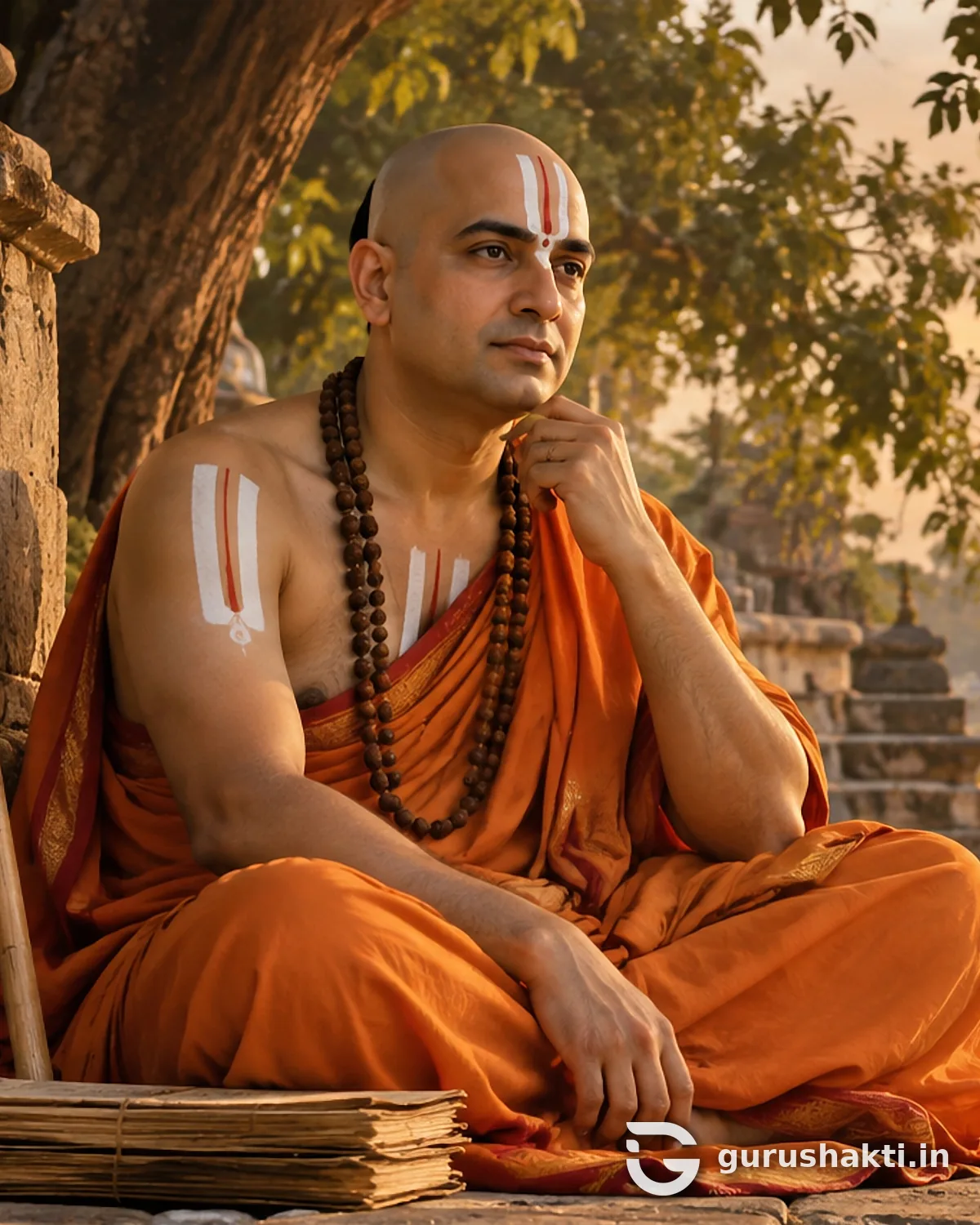
At Thirukoshtiyur in Tamil Nadu, the guru Thirukoshtiyur Nambi taught Ramanuja a sacred mantra and told him to keep it secret. Devotees recount that Ramanuja then climbed the temple tower and called the mantra out to everyone gathered below. Warned that breaking the secret would send him to hell, he answered that he would go gladly if many were saved. His guru, instead of punishing him, embraced him and called him "Emperumanar".
That moment holds the heart of Sri Ramanujacharya. He was a philosopher who wrote dense Sanskrit commentaries, and he was also a man who could not bear to keep God for a few. He taught that the world is real, that God dwells in it as a soul dwells in a body, and that surrender to God is a door open to all, whatever their caste.
Life story
Sriperumbudur and Kanchipuram
Ramanuja was born, by tradition, in 1017 at Sriperumbudur, near today's Chennai, into a Brahmin family. Britannica gives "c. 1017"; some recent scholarship proposes 1077 instead. Either way, his life is known mostly through later hagiographies of the Sri Vaishnava tradition, and the stories below are told as that tradition holds them.
As a young man he went to Kanchipuram to study Vedanta under Yadavaprakasha. Teacher and student disagreed over the meaning of the Upanishads. Tradition says the disagreement grew so sharp that the teacher even plotted against his life.
At Kanchipuram he also befriended Kanchipurna, also called Thirukkachi Nambi, a temple servant of a lower caste. Custom said a Brahmin should not learn from such a man. Ramanuja learned from him anyway, and Kanchipurna became his early mentor.
Yamunacharya's three fingers
At Srirangam, the Sri Vaishnava community was led by Yamunacharya, also known as Alavandar. Ramanuja set out to meet him, but Yamunacharya died before he arrived. Devotees recount that three fingers of the dead teacher's hand were folded, and these were understood as three unfinished wishes. Ramanuja vowed to fulfil them, and the fingers opened.
He became Yamunacharya's spiritual heir without ever meeting him alive. He was initiated by Periya Nambi, also called Mahapurna. Later he took sannyasa (formal renunciation) at Kanchipuram and became known as Yatiraja, "king of ascetics".
Srirangam and the mantra from the tower
Ramanuja moved to Srirangam and led the community there. He reorganised the worship at the temple. At Thirukoshtiyur he received the eight-syllable mantra from Thirukoshtiyur Nambi, and, tradition says, proclaimed it from the temple tower to all.
He wrote the Sri Bhashya, his commentary on the Brahma Sutras, and other works, and travelled across India to debate. Scholars regard three works as securely his: the Sri Bhashya, the Vedartha Sangraha and the Gita Bhashya. The authenticity of some shorter works is still debated.
Exile at Melukote
Tradition holds that a Chola king turned against him and persecuted the community. Ramanuja fled to Karnataka. Devotees recount that his disciple Kuresha went to the king's court in his place, wearing his robes, so that the master could escape, and that Kuresha was blinded for it.
In Karnataka, Ramanuja lived about 12 years at Melukote, also called Thirunarayanapuram, under the patronage of the Hoysala kings. There, devotees recount, he opened the temple to people of all castes.
Return and last years
In time he returned to Srirangam. By tradition he passed away there in 1137, which would make his lifespan 120 years; revised scholarly dating places his death around 1157. His preserved form, known as "Thaan-aana Thirumeni", is venerated in a shrine at the Sri Ranganathaswamy temple.
Tradition says he left 74 simhasanadhipatis (lineage-holders) to carry on his teaching. On 5 February 2022, the 216-foot Statue of Equality near Hyderabad was dedicated to mark his 1000th birth anniversary.
Core teachings
Qualified non-dualism
Ramanuja's philosophy is called Vishishtadvaita, qualified non-dualism. God is one, he taught, yet souls and the world are real and distinct. They are related to God as a body is related to its soul. The body is real and has its own life, yet it is animated and held together by the soul within. In the same way, everything that exists lives within God and belongs to God, without dissolving into nothing.
The world is real
Against the view that the world is maya (illusion), Ramanuja held that the world is real. It is God's own body and God's own creation. This changes how a devotee lives. If the world is God's body, then a river, a field and a neighbour are not distractions from God but places where God is present. The task is not to escape the world but to see it rightly and serve in it.
Bhakti as loving knowledge
For Ramanuja, bhakti (devotion) was not only emotion. It was constant, loving remembrance of God, joined to selfless duty. Knowledge of God and love of God grow together: the more truly you know God, the more you love, and the more you love, the more steadily you remember. Daily worship, study and honest work were all part of this one practice.
Surrender to God
Ramanuja taught prapatti, also called sharanagati, which means taking refuge in God and admitting no other refuge. In the Vedartha Sangraha he writes: "There is no way of emancipation, other than surrender to the supreme Lord." Surrender does not depend on learning, wealth or birth. Anyone who turns to God in humility can walk this path, which is why his tradition holds it open to all.
Equality in devotion
Ramanuja taught that caste does not decide who may approach God. He learned from Kanchipurna, a man of lower caste, when custom forbade it. Tradition holds that he shouted a secret mantra from a temple tower so all could hear, and opened the Melukote temple to people of every caste. For him, God's grace was not the property of any group.
Principles for daily life
- Treat the world as sacred. This week, care for one corner of the world, a plant, a street or a room, as part of God's body.
- Take refuge when your strength runs out. When you feel you have nothing left, say a simple prayer of surrender instead of pushing alone.
- Share what is good. If you have learned something that helps you, pass it on to someone who could use it.
- Respect everyone equally. Notice how you treat people who serve you, and greet them as you would greet an elder.
- Combine study, worship and work. Read a few lines of scripture, offer a short daily worship and do your work honestly; let them support each other.
Places of pilgrimage
- Sri Ranganathaswamy temple, Srirangam, Tamil Nadu. His base for most of his life, and the shrine of his preserved form.
- Sri Adikesava Perumal temple, Sriperumbudur, Tamil Nadu. The shrine at his birthplace.
- Cheluvanarayana Swamy temple, Melukote, Mandya district, Karnataka. Where he lived for about 12 years in exile.
- Sowmya Narayana Perumal temple, Thirukoshtiyur, Sivaganga district, Tamil Nadu. The site of the mantra story.
- Varadaraja Perumal temple, Kanchipuram, Tamil Nadu. Linked with his youth and his sannyasa.
- Statue of Equality, Muchintal, near Hyderabad, Telangana. A 216-foot panchaloha (five-metal) statue surrounded by 108 Divya Desam shrines, dedicated in 2022.
Legacy today
Ramanuja is honoured as the great teacher of the Sri Vaishnava sampradaya and of Vishishtadvaita Vedanta. Tradition says he appointed 74 lineage-holders, the simhasanadhipatis, to carry his teaching forward. His preserved form, "Thaan-aana Thirumeni", is venerated at the Sri Ranganathaswamy temple in Srirangam.
His three secure works, the Sri Bhashya, Vedartha Sangraha and Gita Bhashya, set out his philosophy, and scholars such as Shyam Ranganathan continue to write about it. Temples linked with his life, at Sriperumbudur, Thirukoshtiyur, Kanchipuram and Melukote, are places of pilgrimage for his followers.
In 2022 the Statue of Equality near Hyderabad, run by Chinna Jeeyar Swami's trust, was dedicated for his 1000th birth anniversary. Its name points to one part of his teaching: that every person may approach God.
Images
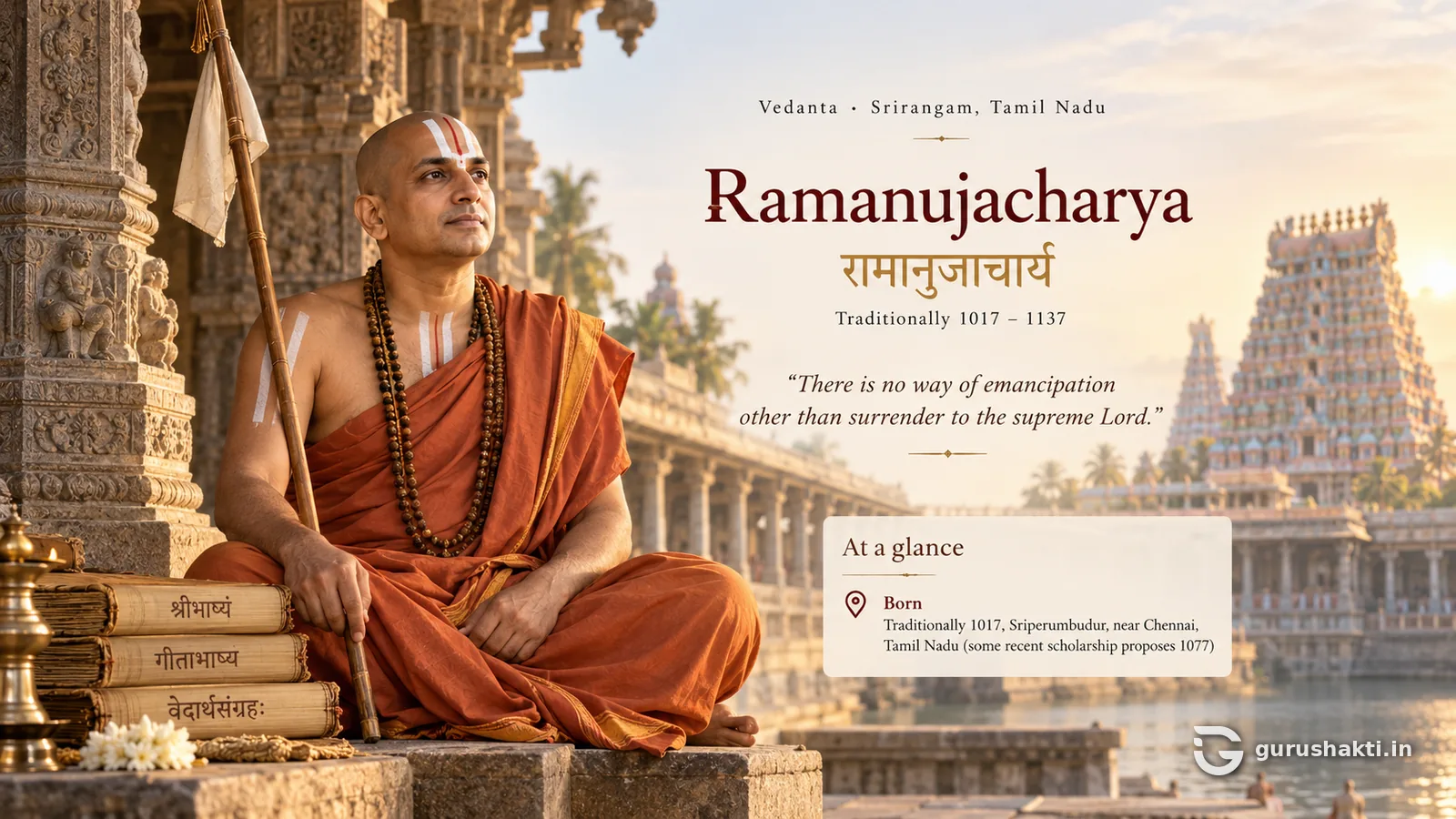
Image may be restored, upscaled or regenerated with generative AI.
Walk the path
Ramanuja's path begins with a simple act: turning to God and admitting you cannot do it all alone. This week, set aside a few quiet minutes each day for a short prayer of surrender, in your own words or with a name of the Lord you love. Then share something good, a meal, some knowledge, or your time, with someone you might usually overlook. Do it without expecting anything back.
Frequently asked questions
Who was Ramanujacharya?
Ramanujacharya was the great teacher of the Sri Vaishnava tradition, traditionally dated 1017 to 1137. Born at Sriperumbudur in Tamil Nadu, he led the community at Srirangam, wrote the Sri Bhashya and taught Vishishtadvaita. He held the world real and taught surrender to God as a path open to all.
What is Vishishtadvaita philosophy?
Vishishtadvaita means qualified non-dualism. It holds that God is one, yet souls and the world are real and distinct, related to God as a body is related to its soul. Everything lives within God and depends on God, without being unreal or dissolving into nothing.
Why is the Statue of Equality dedicated to Ramanujacharya?
The 216-foot Statue of Equality near Hyderabad was dedicated on 5 February 2022 for his 1000th birth anniversary. Its name recalls his teaching that caste does not decide who may approach God, and his tradition of sharing mantras and opening temple access widely.
Did Ramanujacharya really live for 120 years?
The traditional dates, 1017 to 1137, give a lifespan of 120 years, and these dates are used by the Sri Vaishnava tradition and by Britannica. Recent scholarship proposes 1077 to 1157 instead, which would give about 80 years. The question remains open, so the traditional dates are best read as tradition.
What is the difference between Ramanuja's and Shankara's philosophy?
The main difference concerns the world. Against the view, associated with Shankara's Advaita, that the world is maya, Ramanuja held the world and souls to be real and distinct, related to God as a body to its soul. Both are honoured schools of Vedanta, each with its own living tradition.
Sources
- Rāmānuja — Internet Encyclopedia of Philosophy (Shyam Ranganathan)
- Ramanuja — Encyclopaedia Britannica
- PM dedicates the 216-feet Statue of Equality — Press Information Bureau
- Bhagawad Sri Ramanujacharya — Statue of Equality
- Sri Ramanuja & Sri Vedanta Desika, a sketch — TRS Iyengar (community source; hagiographic detail)
Researched and written by GuruShakti, October 2026.