
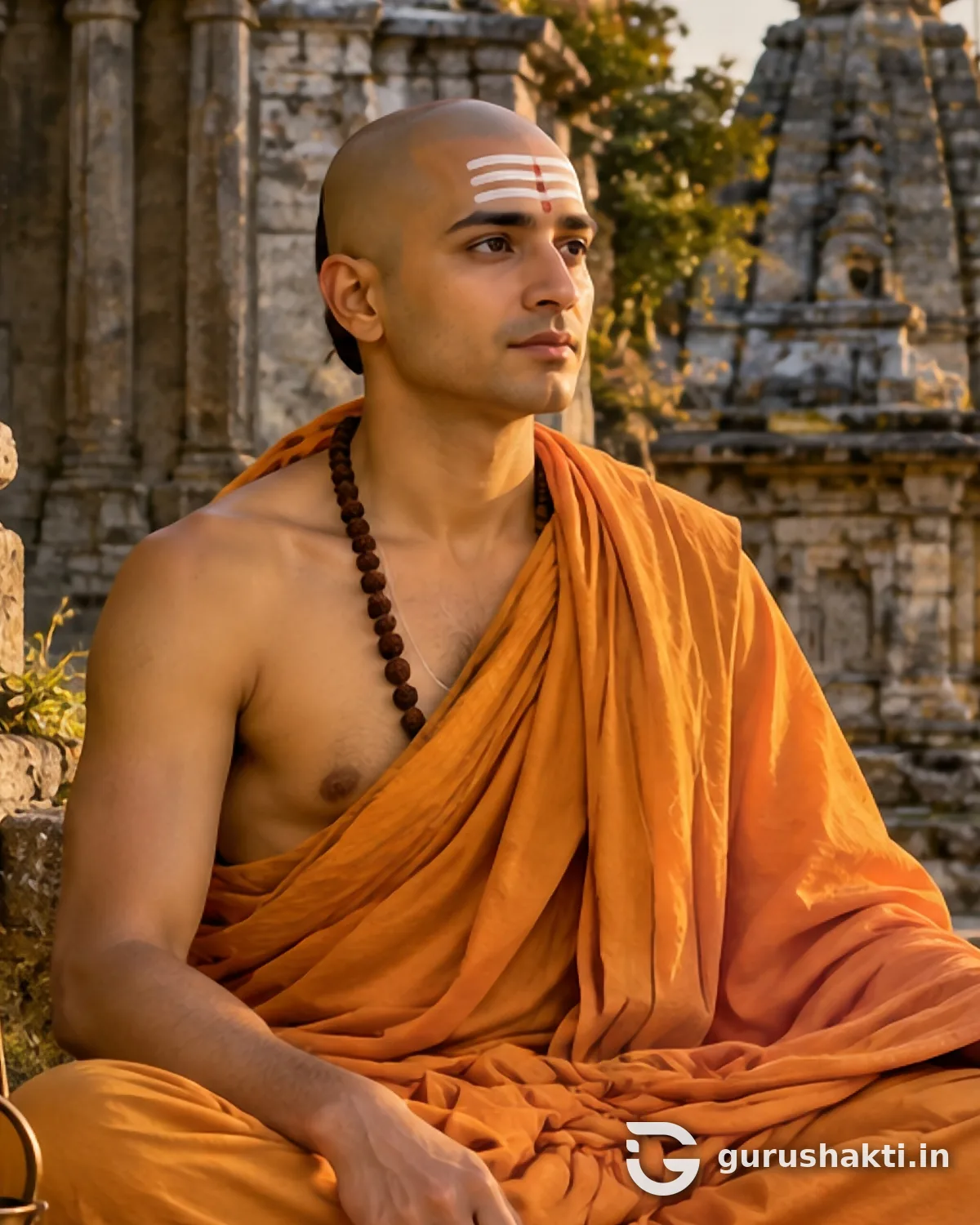
A young monk walks back into the village of Kaladi in Kerala, where he was born. Years earlier he had left home to take sannyasa (the vow of renunciation), and he had promised his mother he would come back when she was dying. Tradition holds that he kept that promise. When she died and the neighbours refused to help, he carried out her last rites himself.
The man was Shankara, later called Adi Shankaracharya, the first teacher of that name. He is remembered as the teacher of Advaita (non-duality): that your deepest self and the one reality behind the world are not two. Yet the story his tradition tells most tenderly is of a son keeping his word. That pairing is the heart of him. The highest knowledge, for Shankara, never meant leaving love or duty behind.
Life story
A boy at Kaladi
Shankara was born at Kaladi, on the banks of the Purna river (today's Periyar) in Kerala, to Shivaguru and Aryamba, a Nambudiri family. Tradition places his birth on Vaishakha Shukla Panchami, the fifth day of the bright fortnight of Vaishakha. His dates are debated. Most scholars place him in the 8th century CE, and the Sringeri matha gives 788 CE. The Kanchi Kamakoti Peetham holds a much earlier date, 509 BCE.
His father died when he was still small. The boy learnt the Vedas very young. The traditional account followed here is the Madhaviya Shankara Digvijayam, as kept by the Sringeri Sharada Peetham, and its dates are not settled.
The vow and the teacher
At about the age of eight, tradition says, the boy was seized by a crocodile while bathing in the Purna. He asked his mother to let him take sannyasa before he died. She agreed, and he was released. He left home with her permission, promising to return at her end.
He travelled to the banks of the Narmada and met his guru, Govinda Bhagavatpada. Govinda was himself a disciple of Gaudapada. There Shankara was initiated as a monk and trained in Vedanta (the teaching of the Upanishads).
Kashi and the great commentaries
At Kashi (Varanasi) he wrote his commentaries, called bhashyas, on the Brahma Sutras, the Bhagavad Gita and the principal Upanishads. Scholars broadly accept these, with the Upadeshasahasri ("Thousand Teachings"), as his own work.
Kashi is also where tradition sets a meeting that changed him. He asked a chandala, a man treated as an outcaste, to step out of his way. The man asked whether he meant the body or the Self should move, since the Self is the same in all. Shankara bowed to him and, devotees recount, composed the Manisha Panchakam, five verses on seeing one Self in every being.
Debate, disciples and the mathas
Shankara taught through discussion as well as writing. Tradition describes a long debate with the scholar Mandana Mishra, judged by Ubhaya Bharati. At its end Mandana became Shankara's disciple and took the name Sureshvara. Padmapada, Hastamalaka and Totakacharya are the other disciples remembered alongside him.
Tradition credits him with founding the matha at Sringeri, in Karnataka, where he installed the goddess Sharada. The amnaya mathas (monasteries of the four directions) are Sringeri in the south, Dwarka in the west, Govardhan at Puri in the east and Jyotirmath in the north. The Kanchi Kamakoti Peetham in Tamil Nadu also holds him as its founder. These institutions differ on the exact number, and each carries his lineage today.
Home, Kashmir and Kedarnath
As promised, he returned to Kaladi when his mother was dying and performed her last rites himself. Later, tradition says, after debates in Kashmir he ascended the Sarvajna Peetha, the "Throne of Omniscience".
His last journey took him to Badrinath and Kedarnath in the Himalaya. Sringeri tradition holds that he disappeared at Kedarnath at about the age of 32, and a samadhi shrine stands behind the Kedarnath temple. The Kanchi tradition holds that he attained siddhi (final completion) at Kanchipuram. Both are remembered with reverence by their followers.
Core teachings
Brahman alone is real
At the centre of Shankara's teaching is Brahman, one consciousness that underlies everything. The world of change, of birth, growth and decay, depends on Brahman and is not ultimately real in itself. This does not mean the world is fake or should be despised. It means the world is like waves, real as waves, but never separate from the water. The Stanford Encyclopedia of Philosophy describes this as the core of his Advaita.
Atman is Brahman
Your deepest self, the Atman, is not the body and not the mind. It is that same consciousness, Brahman. Shankara did not mean this as a belief to hold but a fact to recognise. The verse traditionally attributed to him in the Nirvana Shatakam puts it as a song: "I am consciousness and bliss; I am Shiva." Each person is, at root, what they are searching for.
The snake in the rope
Why then do we suffer? Shankara called the cause adhyasa (superimposition). We mistake the body and mind for the self, as a person at dusk mistakes a rope for a snake. The fear is real while the mistake lasts. When a lamp is brought, nothing has to be destroyed; the rope was always a rope. In the same way, liberation is seeing clearly what was always so.
Knowledge liberates
For Shankara, moksha (liberation) is not manufactured by effort, as a pot is made. It is realised, as the rope is seen. What removes ignorance is jnana (direct knowledge), gained by listening to scripture, learning from a teacher, and reflecting until the truth is plain. He wrote long commentaries for exactly this reason: so that the Upanishads could be studied carefully.
Devotion and duty prepare the mind
Shankara did not throw out worship or ordinary duty. Worship and selfless action purify the mind so it is ready for knowledge. The hymns traditionally attributed to him keep Govinda, Shiva and the Devi at the centre of practice. The Bhaja Govindam, traditionally his, begins with a direct plea: "Worship Govinda, foolish mind." Devotion, in this view, prepares the mind for knowledge.
Principles for daily life
- Ask who you are. When a strong mood or role takes over this week, pause once and ask, "Who am I beneath this?"
- Read a little scripture. Study a few lines each day, with a trusted teacher or a good commentary, and think them over.
- Chant one hymn. Begin with the Bhaja Govindam. Chant a verse and reflect on its meaning.
- See one Self in all. Remember the chandala at Kashi. Treat the person you might overlook today as you would treat God.
- Keep your promises at home. Renunciation is inner. Call a parent, keep a family promise, as Shankara returned to his mother.
Places of pilgrimage
- Kaladi, Ernakulam district, Kerala. His birthplace, with shrines managed by the Sringeri matha and the Adi Shankara Keerthi Sthambha. Walk down to the Purna river.
- Sringeri Sharada Peetham, Chikkamagaluru district, Karnataka. The first matha and the Sharadamba temple, where tradition says he installed the goddess Sharada.
- Dwarka Sharada Peetham, Dwarka, Gujarat; Govardhan Matha, Puri, Odisha; Jyotirmath, Chamoli, Uttarakhand. The other three amnaya mathas, of the west, east and north.
- Adi Shankaracharya Samadhi, Kedarnath, Uttarakhand. The samadhi shrine behind the Kedarnath temple, where Sringeri tradition says his life ended.
- Kanchi Kamakoti Peetham, Kanchipuram, Tamil Nadu. The matha that holds he attained siddhi there.
Legacy today
Shankara's lineage is alive and visible. The amnaya mathas at Sringeri, Dwarka, Puri and Jyotirmath carry his lineage, and the Kanchi Kamakoti Peetham traces its own line to him. The Dashanami orders of sannyasa, the ten named orders of monks, look to him as their source, and the Smarta tradition counts him as its teacher.
Students of Advaita Vedanta still study his commentaries. Meanwhile, in ordinary homes, the Bhaja Govindam and Nirvana Shatakam are sung by people who may never open a commentary. At Kaladi, Sringeri and Kedarnath, pilgrims still come to the places tradition ties to his short life.
Images
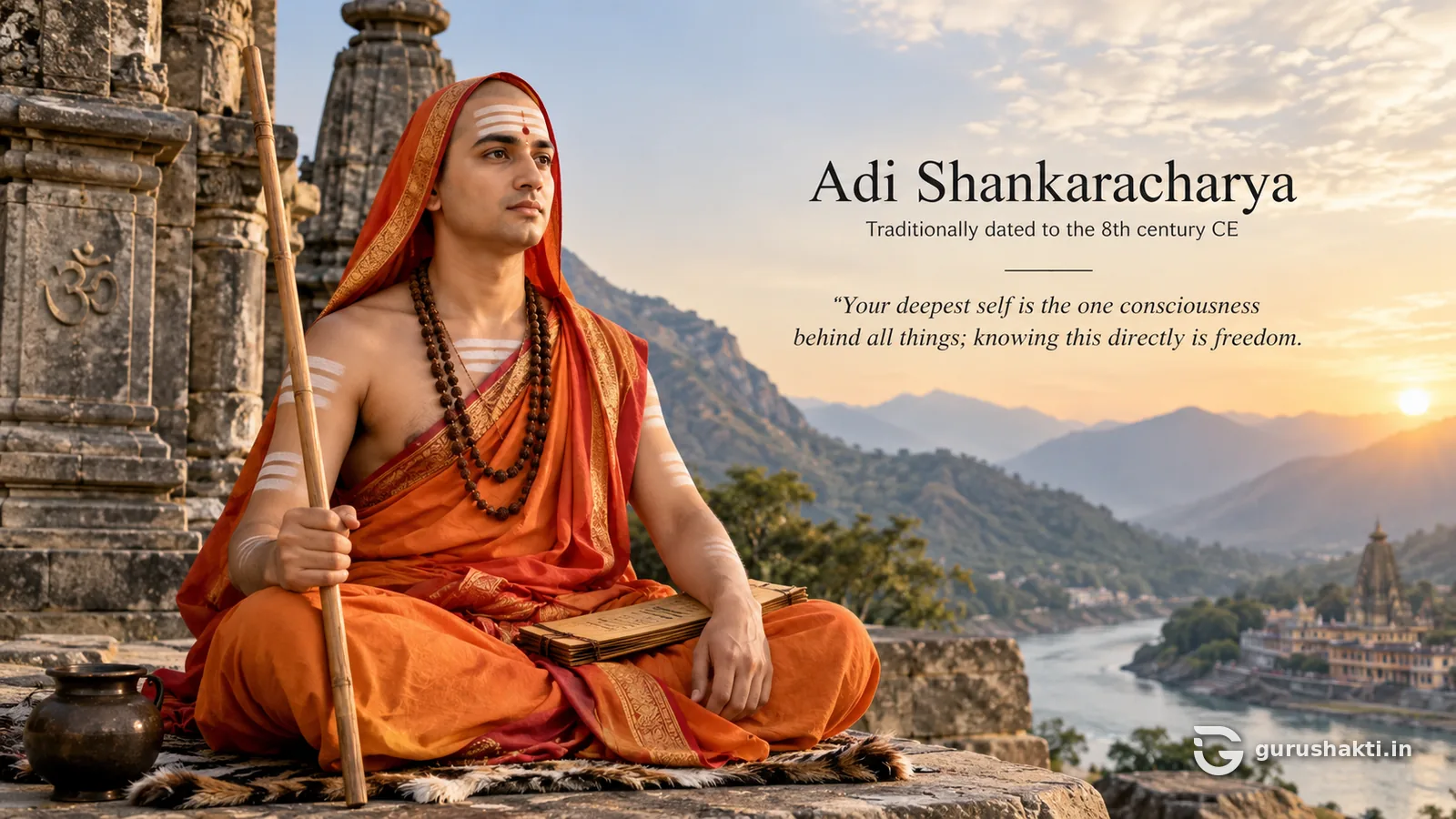
Image may be restored, upscaled or regenerated with generative AI.
Walk the path
Shankara's path begins with a question and a song. This week, sit quietly for five minutes each morning and ask, without hurry, "Who am I beneath my thoughts?" Then chant one verse of the Bhaja Govindam and let its meaning settle. If you can, do one act of seva (selfless service) for someone you would usually pass by, remembering the chandala at Kashi. And keep one small promise to your family. For Shankara, knowledge and kindness walked together.
Frequently asked questions
When was Adi Shankaracharya born?
Most scholars place him in the 8th century CE, around 700 or 788 CE; the Sringeri matha gives 788 CE. The Kanchi Kamakoti Peetham holds that he was born in 509 BCE. Tradition places his birth at Kaladi, Kerala, on Vaishakha Shukla Panchami, the fifth day of the bright fortnight of Vaishakha.
What are the four mathas established by Adi Shankaracharya?
Tradition names four amnaya mathas: Sringeri in the south (Karnataka), Dwarka in the west (Gujarat), Govardhan at Puri in the east (Odisha) and Jyotirmath in the north (Uttarakhand). The Kanchi Kamakoti Peetham in Tamil Nadu also holds him as its founder. The institutions differ on the count.
What is Advaita Vedanta in simple words?
Advaita means "not two". It teaches that one consciousness, Brahman, underlies everything, and that your own deepest self is that same consciousness. The changing world is not ultimately real on its own. We suffer by mistaking body and mind for the self; clear knowledge removes the mistake.
Where did Adi Shankaracharya take samadhi?
The Sringeri tradition, followed by most mathas, holds that he disappeared at Kedarnath in the Himalaya at about 32, and a samadhi shrine stands behind the Kedarnath temple. The Kanchi tradition holds that he attained siddhi at Kanchipuram. Both views are held sincerely by their followers.
Did Adi Shankaracharya write Bhaja Govindam?
The Bhaja Govindam is traditionally attributed to him and is sung in his name across India. Scholars broadly accept only his commentaries and the Upadeshasahasri as certainly his own, so hymns such as Bhaja Govindam and Nirvana Shatakam are best described as traditionally attributed.
Sources
Researched and written by GuruShakti, October 2026.