
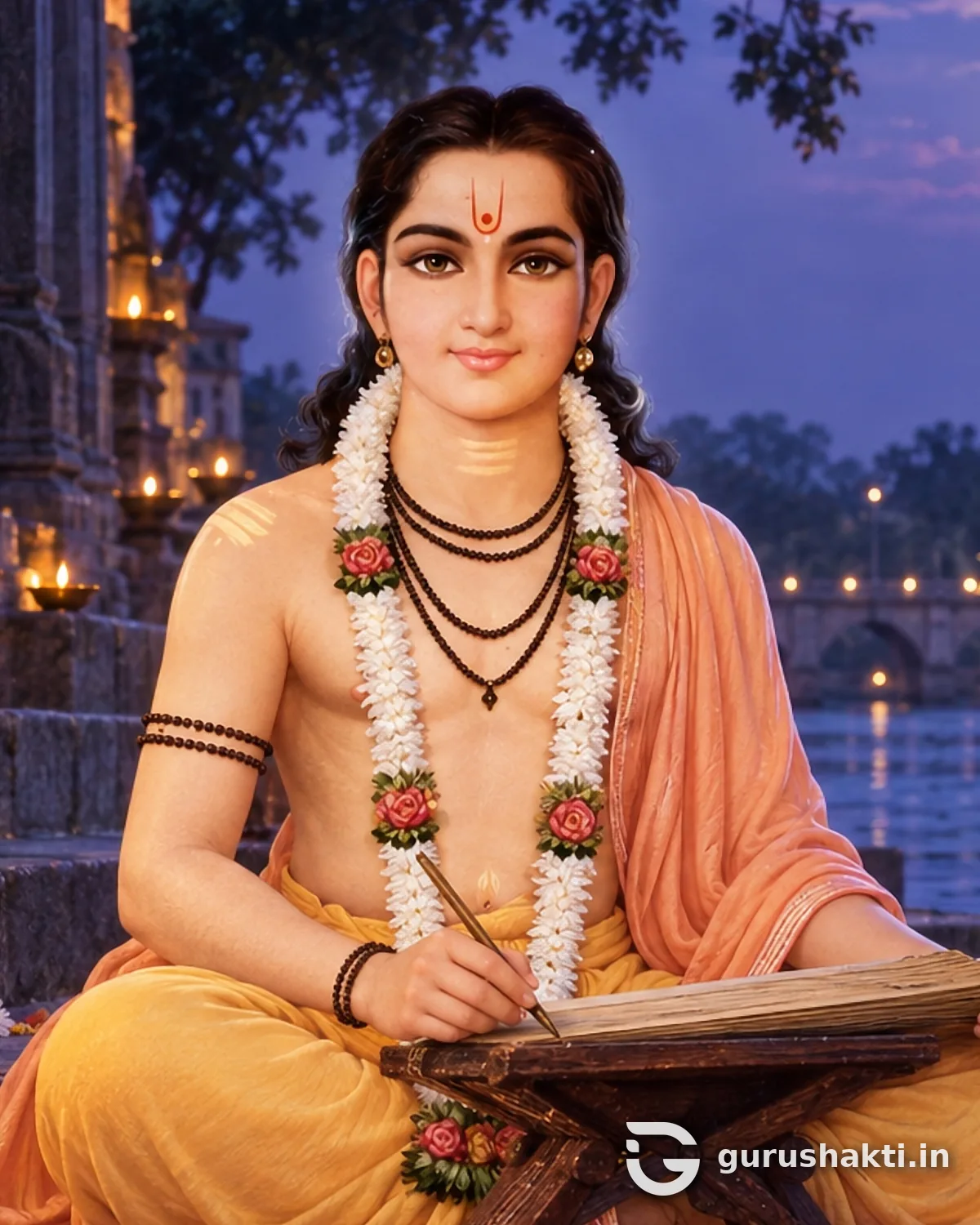
At Nevasa, around 1290, a boy who by tradition was about fifteen sat dictating a book. It was a commentary on the Bhagavad Gita, but not in Sanskrit, the language of the learned. He was putting the Gita into Marathi, so that ordinary people could take it in, in their own words. Tradition still points to the pillar at Nevasa where he is said to have sat.
At the very end of that long work, the young author asked God for something. He did not ask for anything for himself. He prayed: "जे खळांची व्यंकटी सांडो", may the wicked shed their crookedness. He did not ask that they be destroyed. That prayer is the Pasayadan. Sant Jnaneshwar (Dnyaneshwar) lived, by tradition, only about 21 years, and he left behind a way of seeing in which even an enemy is someone to pray for.
Life story
Children of a sannyasi
Jnaneshwar's story begins with his father, Vitthalpant. Vitthalpant had taken sannyasa (formal renunciation), but at his guru's bidding he returned to family life. For this, orthodox Brahmins shunned the family. The children who followed were called "children of a sannyasi", and they grew up outside the circle of acceptance.
Jnaneshwar, also called Dnyandev, was traditionally born in 1275. Varkari tradition gives his birthplace as Apegaon near Paithan; Britannica gives Alandi. He was the second of four children: Nivritti, Jnaneshwar, Sopan and Muktabai.
While the children were still young, their parents died. The orphans went to the Brahmins of Paithan to seek acceptance, asking for a certificate of purification. The story is told today without blame on any community.
The brother who became his guru
Jnaneshwar's guru was his own elder brother, Nivrittinath. Nivritti initiated him into the Nath path, the yogic tradition that traces itself through Matsyendranath and Gorakhnath. At the close of the Jnaneshwari, Jnaneshwar names the line: Adinath, Matsyendranath, Gorakhnath, Gahininath, then Nivrittinath.
All four siblings came to be honoured as Varkari saints. Nivrittinath, Sopandev and Muktabai each have their own place in Marathi devotion.
The Jnaneshwari at Nevasa
Around 1290, in the Shaka year 1212, Jnaneshwar completed his great work at Nevasa, in today's Ahmednagar district. Its proper name is Bhavarthadipika, "the lamp of inner meaning", but everyone calls it the Jnaneshwari. It is a Marathi verse commentary on the Bhagavad Gita, dictated so that ordinary people could read the Gita. Tradition says he was about fifteen.
Soon after, he wrote Amritanubhava, a short philosophical work on the experience of non-duality.
On the road with Namdev
In the 1290s Jnaneshwar met Namdev, another young devotee of Vitthal. The two travelled together to pilgrimage places in north India. Out of their friendship and their singing grew the Varkari movement around Vitthal of Pandharpur, the tradition of pilgrims who walk to his temple.
During these years, devotees recount, he met the yogi Changdev, who came to him proud and left humble. Jnaneshwar addressed a work of 65 verses to him, the Changdev Pasashti.
Samadhi at Alandi
Traditionally in 1296, on Kartik Vadya Ekadashi (the eleventh day of the dark half of Kartik), Jnaneshwar entered sanjeevan samadhi at Alandi, on the Indrayani river. A sanjeevan samadhi is one entered while still alive. He was about 21.
Varkaris believe he remains there in meditation. His shrine at Alandi stands in the Siddheshwar temple complex, beside the Ajanvriksha tree. Each June his palkhi (palanquin procession), carrying his silver padukas (sandals), leaves Alandi for the Ashadhi Wari to Pandharpur.
Core teachings
Wisdom in the people's language
Jnaneshwar took the Bhagavad Gita, which most people could only hear through Sanskrit scholars, and put it into Marathi. His aim was that everyone could understand it, not only the learned. It said that spiritual knowledge belongs to anyone who wants it, in the language they think and dream in. Every Marathi-speaking devotee who reads the Jnaneshwari today receives that gift.
Devotion and knowledge are one
In Jnaneshwar's teaching there is no quarrel between the heart and the mind. Bhakti (loving devotion) to Vitthal and jnana (knowledge of the non-dual Self) lead to the same goal. He wrote the philosophical Amritanubhava and also the devotional Haripath, and saw no contradiction. The singer of God's name and the seeker of the Self are walking the same road from two sides.
Goodwill to all, even the wicked
The Pasayadan closes the Jnaneshwari with a prayer for the whole world. He does not ask God to destroy the wicked. He asks: "जे खळांची व्यंकटी सांडो", may the wicked shed their crookedness. And then: "भूतां परस्परें पडो । मैत्र जीवाचें", may all beings form bonds of heartfelt friendship. The enemy, in this teaching, is not a person but the crookedness in a person.
Each one's own dharma
In the Pasayadan Jnaneshwar prays that the world may see by the sun of its own svadharma (one's own duty). Each person has a path of right action that fits them. Done well, that duty becomes a path of light. Comparing your work with another's and envying it only clouds the way; doing your own part faithfully clears it.
Humility over powers
Devotees recount that the yogi Changdev had gathered great powers and great pride. Meeting the young Jnaneshwar, he learned that such powers are nothing beside love and true knowledge. Jnaneshwar's teaching, as the story is told, is that the urge to impress others is an obstacle. Humility opens the door that display keeps shut.
Principles for daily life
- Pray for everyone's good. This week, include in your prayer one person who has hurt you, asking only that their crookedness ease.
- Share wisdom in plain language. When you explain something you have learned, use the words your listener actually uses.
- Do your own duty well. Choose one task that is yours and do it carefully, without measuring it against someone else's.
- Let go of showing off. Notice the urge to impress, and let one chance to display your ability pass quietly.
- Treat all beings as friends. Greet someone you usually ignore, or show care to an animal or plant near your home.
Places of pilgrimage
- Sant Dnyaneshwar Samadhi Mandir, Alandi, Pune district, Maharashtra. His samadhi, the Ajanvriksha tree and the Indrayani ghats; large fairs gather here on Kartiki Ekadashi.
- Nevasa, Ahmednagar district, Maharashtra. The pillar, called the Paisa khamb, where he is said to have dictated the Jnaneshwari.
- Apegaon, near Paithan, Chhatrapati Sambhajinagar district, Maharashtra. His traditional birthplace.
- Trimbakeshwar, Nashik district, Maharashtra. The samadhi of his brother and guru, Nivrittinath.
- Changdev temple, Jalgaon district, Maharashtra. Linked with the story of the yogi Changdev.
- Vitthal temple, Pandharpur, Solapur district, Maharashtra. The end point of his palkhi on the Ashadhi Wari.
Legacy today
Jnaneshwar is remembered as a co-founder of the Varkari sampradaya. Every June his palkhi, bearing his silver padukas, sets out from Alandi for the Ashadhi Wari to Pandharpur. On Kartiki Ekadashi, large fairs gather at his samadhi in Alandi.
The Jnaneshwari keeps the Bhagavad Gita open to Marathi readers, and its closing prayer, the Pasayadan, carries his goodwill for all beings. His Haripath and Amritanubhava also survive. His siblings Nivrittinath, Sopandev and Muktabai are honoured as saints too, and Nivrittinath's samadhi at Trimbakeshwar draws its own pilgrims. Devotees also call him by the affectionate name Mauli.
Images
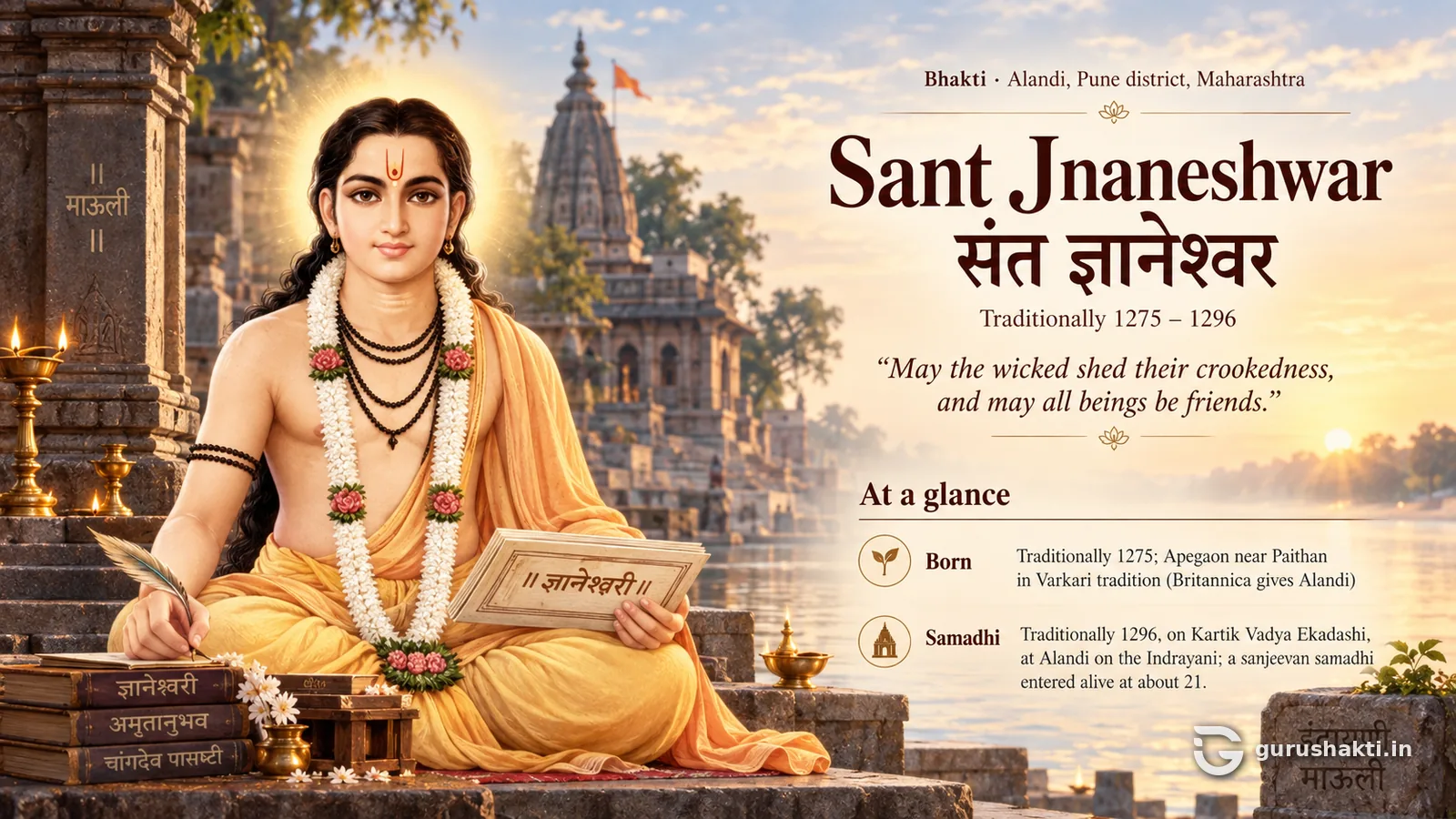
Image may be restored, upscaled or regenerated with generative AI.
Walk the path
Jnaneshwar's gift was a prayer for everyone. This week, take a few quiet minutes each day and read or say one line of the Pasayadan, perhaps "May all beings form bonds of heartfelt friendship." Then hold in your mind one person you find difficult, and wish only that their crookedness, and yours, may ease. You might also share one thing you have learned with someone, in simple words. Nothing more is asked.
Frequently asked questions
Who was Sant Dnyaneshwar?
Sant Jnaneshwar, also spelled Dnyaneshwar, was a Marathi poet-saint who, by tradition, lived from 1275 to 1296. Initiated into the Nath path by his elder brother Nivrittinath, he wrote the Jnaneshwari, a Marathi commentary on the Bhagavad Gita, and helped begin the Varkari movement with Namdev. He entered samadhi at Alandi.
What is the Pasaydan and what does it mean?
The Pasayadan is the prayer that closes the Jnaneshwari. In it Jnaneshwar asks nothing for himself: he prays that the wicked shed their crookedness, that all beings form bonds of friendship and that every creature receive what it longs for.
At what age did Dnyaneshwar write the Dnyaneshwari?
By tradition he completed the Jnaneshwari at Nevasa around 1290 (Shaka 1212), when he was about fifteen years old. He dictated it as a Marathi verse commentary on the Bhagavad Gita, so that ordinary people, not only Sanskrit scholars, could understand the Gita's teaching.
What is sanjeevan samadhi at Alandi?
A sanjeevan samadhi is a samadhi entered while still alive. Tradition holds that in 1296, on Kartik Vadya Ekadashi, Jnaneshwar sat in a chamber at Alandi on the Indrayani and entered it at about 21. Varkaris believe he remains there in meditation. The shrine stands beside the Ajanvriksha tree.
Who were Dnyaneshwar's brothers and sister?
He was the second of four children of Vitthalpant. His elder brother Nivrittinath was also his guru; his younger brother was Sopandev and his sister was Muktabai. All four are honoured as Varkari saints. Nivrittinath's samadhi is at Trimbakeshwar in Nashik district.
Sources
- Jnanadeva — Encyclopaedia Britannica
- Alandi — Eco-Heritage, CPR Environmental Education Centre (MoEFCC)
- Changdev temple — Department of Tourism, Maharashtra
- Jnaneshvara — Encyclopedia of Hinduism (Jones & Ryan, 2007), via en-academic
- Pasayadan, full Marathi text (Bhavarthadipika ch. 18)
- The Procession of Saint Dnyaneshwar — Ananda
Researched and written by GuruShakti, October 2026.