
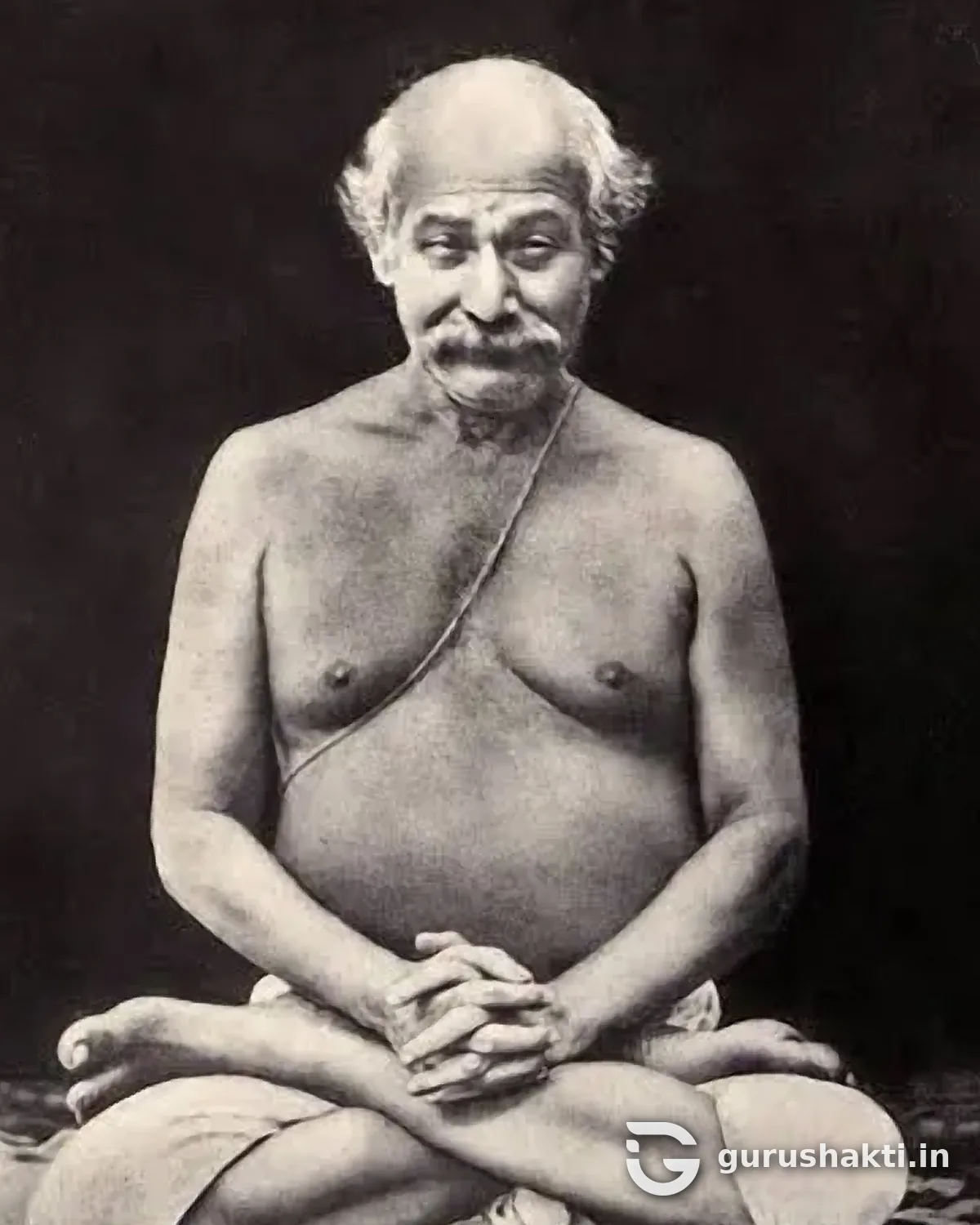
In 1861 a government clerk of 33 was posted to the hills near Ranikhet. One day, his disciples recount, he heard a voice calling his name on the mountain called Drongiri. He followed it and met a yogi who told him he had been waiting for him. The clerk was Shyama Charan Lahiri. The yogi was the one later known as Mahavatar Babaji, and he gave him initiation into Kriya Yoga.
What happened next is why Lahiri Mahasaya matters today. He did not stay in the hills. He went back to Varanasi, to his office desk and his family, and taught Kriya in his spare hours to anyone who came sincerely. He showed, by living it, that a person with a job, a home and children can go deep in the spiritual life. For ordinary householders, that remains the most encouraging part of his story.
Life story
From Ghurni to Varanasi
Shyama Charan Lahiri was born on 30 September 1828 in the village of Ghurni, near Krishnanagar in Nadia district, Bengal. His parents were Gaur Mohan Lahiri and Muktakeshi Devi. In 1833, when he was about five, the family moved to Varanasi. It remained his home for most of his life.
As a young man he studied Sanskrit, Bengali and English. He married Kashi Moni, and together they raised a family. For his living he took service as an accountant and clerk in a government department.
The meeting at Drongiri
In 1861, at 33, his work took him to a posting near Ranikhet. There, according to the Yogoda Satsanga Society (YSS), he met Mahavatar Babaji on Drongiri, also called Dunagiri, and received initiation into Kriya Yoga.
The meeting was more than a private blessing. Kriya, as tradition tells it, had been kept for renunciates. Babaji allowed Lahiri to give it to all sincere seekers, householders included. With that permission he came down from the hills and returned to Varanasi.
A yogi with an office job
Through the 1860s, 1870s and 1880s Lahiri lived two lives at once, or rather one life with no wall in it. He went to work, kept accounts and looked after his family. In the evenings and at other free hours he initiated students into Kriya. They came from every caste. Muslims and Christians came as well, and he taught them too.
He wrote no books for publication. Instead, his disciples recorded his Bengali commentaries on the Bhagavad Gita and other scriptures, and his personal diaries were published long after his death. His teaching passed mostly from person to person, in a Varanasi home.
The circle of disciples
Among those who came to him were men who would carry Kriya far beyond Varanasi. Swami Sri Yukteswar Giri, who later taught Paramahansa Yogananda, was one. Swami Pranabananda, Panchanan Bhattacharya and Swami Keshabananda were others. Yogananda's own parents were his disciples too. Through these students several distinct lines of Kriya grew, and each still honours him as its source.
Mahasamadhi and an old prediction
Lahiri Mahasaya entered mahasamadhi, a yogi's final conscious leaving of the body, on 26 September 1895 in Varanasi. He was days short of his 67th birthday.
Devotees recount that he had said that about fifty years after his passing, interest in yoga in the West would bring about an account of his life. In 1946 Paramahansa Yogananda published Autobiography of a Yogi, which told Lahiri Mahasaya's story to readers around the world. YSS sees in this the fulfilment of his words.
Core teachings
Kriya Yoga
Kriya Yoga is a meditation technique that calms the breath and mind and draws awareness inward toward God. It is taught only through initiation, from a teacher in a recognised line, and its method is not written out for public reading. Lahiri Mahasaya received it from Babaji in 1861 and spent the rest of his life passing it on. YSS describes it as the heart of the path he taught.
God-realisation for the householder
Many people assume that a deep spiritual life means leaving home. Lahiri Mahasaya showed otherwise. Family, a job and a serious inner life can go together, and a person does not have to renounce the world to find God in it. He did not ask his students to leave their duties. He asked them to practise while carrying them, as he did.
Practice over theory
Lahiri Mahasaya valued what is found in meditation above what is found in books or debates. That is how Autobiography of a Yogi presents him: a teacher who pointed students back to their own practice. Scriptures had their place, and he commented on the Gita himself. But reading about the inner life was never meant to replace living it.
Open to all
He initiated Hindus of every caste, and Muslims and Christians as well. In his Varanasi home, no one was asked about birth or background, only about sincerity. YSS and Autobiography of a Yogi both record this.
Steady effort
Lahiri Mahasaya did not promise quick results. He encouraged regular daily practice, however small, trusting that it ripens with time. Swami Pranabananda recalled a phrase of his, recorded in chapter 27 of Autobiography of a Yogi: "Banat, banat, ban jai", "making, making, one day made". A little each day, without giving up, is the whole method.
Principles for daily life
- Keep a fixed time. Set aside the same time each day this week for quiet sitting or prayer, even ten minutes.
- Make work part of the practice. Do your job and your family duties fully. Treat them as part of your sadhana (spiritual practice).
- Practise more, argue less. When you feel drawn into a debate about philosophy, sit quietly instead.
- Keep going when it feels slow. Remember "making, making, one day made". Do not judge your practice by one week.
- Learn Kriya from a true line. If you feel drawn to Kriya Yoga, seek initiation from a recognised lineage, not from random videos.
Places of pilgrimage
- Ghurni, near Krishnanagar, Nadia, West Bengal. His birthplace, a quiet village where his story began in 1828.
- Varanasi, Uttar Pradesh. His home and teaching centre for most of his life, where he lived as a householder and gave Kriya to his disciples.
- Babaji's Cave, near Dunagiri and Dwarahat, near Ranikhet, Uttarakhand. The place associated with his 1861 meeting with Babaji and his Kriya initiation.
- YSS ashrams, Ranchi, Jharkhand, and Dakshineswar, West Bengal. Headquarters of the Yogoda Satsanga Society, the line that spread his Kriya teaching widely.
Legacy today
Lahiri Mahasaya's Kriya Yoga is taught today through several lineages. The Yogoda Satsanga Society of India and Self-Realization Fellowship, the organisations of Paramahansa Yogananda, trace their line through Sri Yukteswar to him. The Karar Ashram in Puri keeps another line. Others descend through Panchanan Bhattacharya and through his own family. Each honours him as the Yogavatar, the incarnation of yoga.
Autobiography of a Yogi, published in 1946, made his name known well beyond India. His Gita commentaries, recorded by disciples, and his diaries are still read by practitioners. Above all he left a model: the yogi who kept his job, raised his children and found God without leaving home.
Walk the path
Lahiri Mahasaya's path begins with a few quiet minutes. This week, choose a fixed time each day, morning or evening, and sit in silence with God, or repeat a name of God you love. Do your work and your family duties as part of that offering. Do not worry if nothing seems to happen; "making, making, one day made". If you feel drawn to Kriya Yoga itself, look to a recognised lineage such as YSS for proper initiation.
Frequently asked questions
Who was Lahiri Mahasaya's guru?
His guru was Mahavatar Babaji, whom he met in 1861 on Drongiri (Dunagiri) near Ranikhet. Babaji gave him initiation into Kriya Yoga and permission to teach it to sincere seekers, including householders. The lineage continued through his disciples, among them Sri Yukteswar, guru of Paramahansa Yogananda.
What is Kriya Yoga?
Kriya Yoga is a meditation technique that calms the breath and mind and draws awareness inward toward God. It is given only through initiation, and lineages such as YSS hold that it should not be learned from books or videos. Lahiri Mahasaya received it from Babaji and taught it to people of every background.
Where did Lahiri Mahasaya meet Babaji?
He met Mahavatar Babaji in 1861 on Drongiri, also called Dunagiri, near Ranikhet in present-day Uttarakhand. He was 33 and had been posted there by his office. Devotees recount that a voice called his name on the mountain, and Babaji told him he had been waiting for him.
Was Lahiri Mahasaya married?
Yes. He married Kashi Moni as a young man and raised a family in Varanasi. He also worked in a government office as an accountant and clerk. This is central to his teaching: he showed that a householder with a family and a job can lead a deep spiritual life.
Who were Lahiri Mahasaya's disciples?
His disciples included Swami Sri Yukteswar Giri, Swami Pranabananda, Panchanan Bhattacharya and Swami Keshabananda. The parents of Paramahansa Yogananda were also his disciples. He initiated people of every caste, as well as Muslims and Christians, and several Kriya lineages today trace themselves to him.
Sources
Researched and written by GuruShakti, October 2026.