
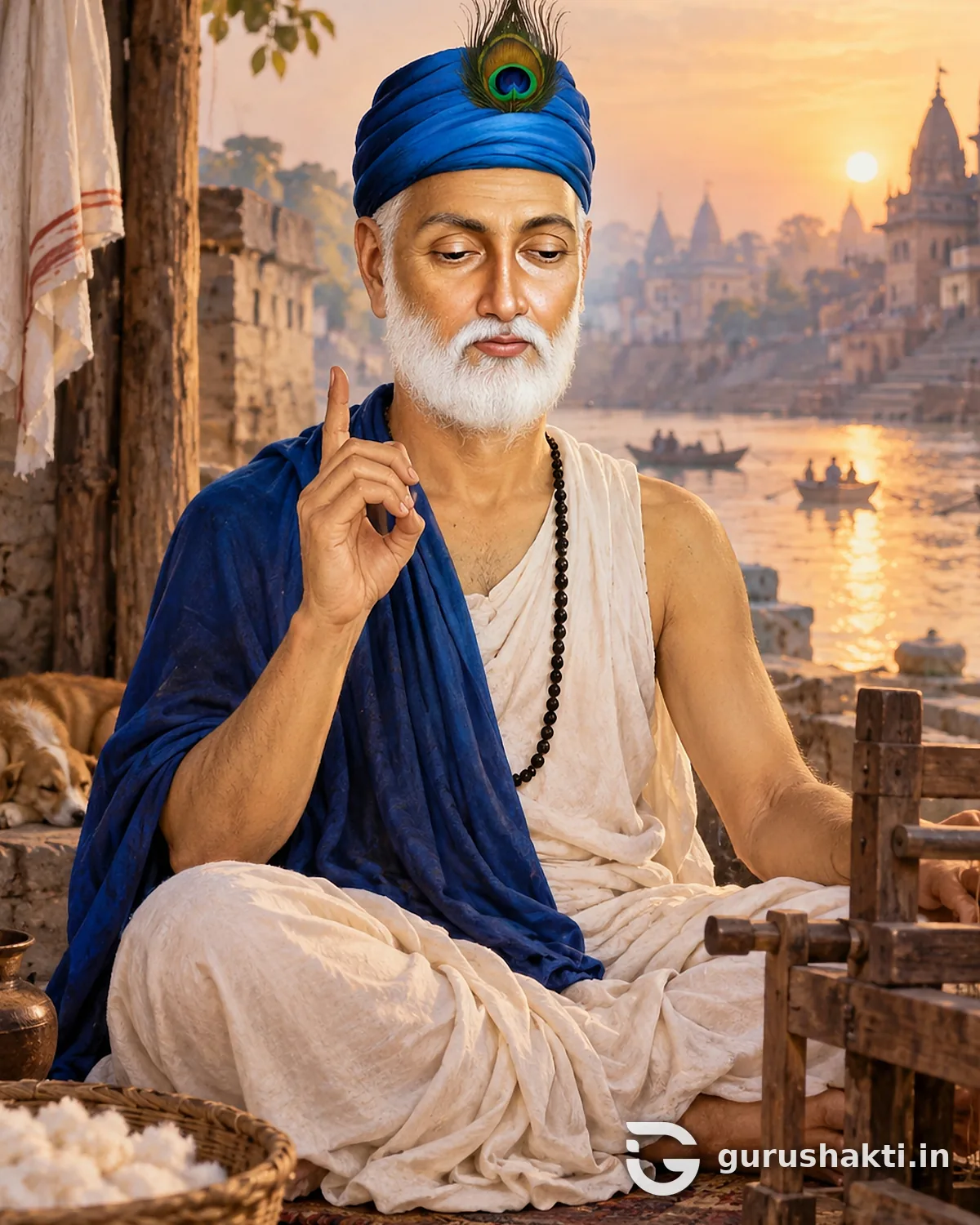
- Sant Kabir was a weaver-poet of Kashi who sang of a formless Ram living in every heart, like musk in the deer.
- He taught that the ego must go, and that one word of love makes a person wiser than all book-learning.
- He rejected empty ritual and caste pride, and by tradition went to Maghar to die, showing that God looks at the heart.
Tradition says that when Kabir was old, he left Kashi and went to Maghar to die. In his day many believed that whoever dies in Kashi wins liberation, and whoever dies in Maghar does not. Kabir had spent his life in Kashi, weaving cloth and singing of Ram. At the end he walked away from Kashi itself, defying that belief.
That one act sums up Sant Kabir. He was a weaver who never wrote a line himself, yet his couplets are still sung, and taught in Indian schools. He sang of a Ram without form, who lives in every heart. He mocked pride of learning and pride of birth, and empty ritual of every kind. For a seeker today, surrounded by display and outward show, Kabir's plain, sharp words still point inward: to the heart, to love, and to the Name.
Life story
The child of Lahartara
No one knows exactly when Kabir was born. Tradition gives the year 1398, in Kashi (Varanasi); historians place his life in the 15th century. The Kabir Panth, the community of his followers, tells how a weaver named Niru and his wife Nima found a baby at Lahartara pond in Kashi. They took him home and raised him as their own. That child was Kabir.
A weaver at the loom
Kabir grew up in a weaver (julaha) family and worked at the loom all his life. The thread, the shuttle and the cloth run all through his verses. He lived as a householder in Kashi. He did not withdraw to a forest or a monastery. He earned his living with his hands and sang of God while he worked.
He sang in the language of ordinary people, not in Sanskrit. His sakhis (two-line couplets, also called dohas), padas (songs) and ramainis (verses) were passed on by mouth. He did not write them down himself. Later singers carried them on, and added many verses of their own in his name.
The Name from Ramananda
Tradition holds that the young Kabir longed to have Swami Ramananda of Kashi as his guru. The story of how he received the Name is told below. Kabir took the word "Ram", spoken by Ramananda on the Panchganga ghat steps, as his initiation. The Kabir Panth accepts Ramananda as his guru, though historians question whether their dates allow it.
The Ram of Kabir, however, is not an image in a temple. He is nirgun, without form or qualities, present in every heart. In his own words, as printed in the NCERT Sparsh reader, Ram is in every heart, just as musk is inside the deer that searches the forest for its scent.
Songs against pretence
Through the 15th century Kabir sang against empty ritual, against caste pride and against hypocrisy. He was sharp with anyone who mistook outward forms for devotion. Britannica notes that he criticised empty ritual in every community equally. What he asked for instead was inner devotion to the one Ram, and sincere love.
He did not spare the learned either. Reading books, he sang, the whole world died, and no one became wise. One who reads the single word of love becomes the true pandit (learned man).
The last journey to Maghar
Late in life, tradition says, Kabir left Kashi for Maghar, in today's Sant Kabir Nagar district of Uttar Pradesh. People believed that dying in Kashi brought liberation and dying in Maghar did not. Kabir went anyway. By tradition he died there in 1518; some scholars place his death around 1448. If the traditional dates are right, he lived 120 years, but no one can be sure.
Around 1521, Kabir Chaura Math was established in Varanasi at the place where he used to meditate. In 1604 his verses were included by Guru Arjan in the Adi Granth, the Guru Granth Sahib. Kabir is also revered by many Muslims and by Sikhs, whose scripture includes his verses.
Core teachings
God is within
Kabir's best-known image is the musk deer. The scent of musk comes from the deer's own body, yet the deer runs through the forest looking for it. "Ram is in every heart," he sings, "but the world does not see." Pilgrimages and searching outside, for Kabir, are effort spent in the wrong place. The one he called Ram is already present within.
Ego must go
"When 'I' was, Hari was not; now Hari is, and 'I' am not," Kabir sings in a sakhi printed in the NCERT Sparsh reader. As long as the sense of a separate "I" fills the mind, God cannot be felt. When the ego dies, an inner lamp is lit and the darkness goes. Kabir also applied this to speech: speak in a way that lets go of the ego, so that your words cool your own mind and comfort others.
Love over book-learning
Kabir lived among the learned of Kashi, yet he sang that the world had read and read until it died, and still no one had become wise. The true pandit, in his couplet, is the one who reads a single word: the word of love for the Beloved. Learning without love, for Kabir, leaves the heart untouched. He asked his listeners to value love and sincerity above learning and status.
The guru shows the way
For Kabir, the true guru is honoured because the guru reveals God to the seeker. His own life, as tradition tells it, turned on a single word from his guru, the Name "Ram" spoken on the ghat steps. Tradition holds that this guru was Swami Ramananda of Kashi. What mattered was that one Name, received with longing and kept in the heart for the rest of his life.
Beyond ritual and caste
Kabir taught that outer forms, pilgrimages and pride of caste do not bring anyone closer to God. Sincerity and the Name do. Britannica observes that he was equally critical of empty ritual in every community. His last journey to Maghar made the same point with his own body. God, for Kabir, looks at the heart, not at a person's birth, dress or place of death.
Principles for daily life
- Look within first. Before you go looking for God outside, spend a few quiet minutes this week looking within.
- Speak cool words. Choose words that drop the ego, so that they calm your own mind and comfort the listener.
- Keep your critic close. Welcome honest criticism this week instead of avoiding it; Kabir said it cleans the character without soap or water.
- Put love before status. Value love and sincerity over learning, rank and display, in yourself and in others.
- Work and remember. Do honest work with your hands, and remember the Name while you work, as Kabir did at the loom.
Places of pilgrimage
- Kabir Chaura Math, Varanasi, Uttar Pradesh. Headquarters of the Kabir Panth, at the place where he meditated; relics associated with him are kept here.
- Lahartara (Kabir Prakatya Sthal), Varanasi, Uttar Pradesh. The pond where, by tradition, he was found as a baby.
- Kabir samadhi, Maghar, Sant Kabir Nagar, Uttar Pradesh. The site of his passing, with a samadhi shrine.
- Kabir Panth centres, Damakheda, Chhattisgarh. Seat of the Dharamdas branch of the Panth.
Legacy today
The Kabir Panth, the community that follows his teaching, has kept his memory alive for more than five centuries. Its headquarters is Kabir Chaura Math in Varanasi, founded around 1521 at his place of meditation, and it traces branches to his early disciples, including the Dharamdas line centred in Chhattisgarh. The Bijak is the Panth's scripture. His verses also stand in the Guru Granth Sahib, compiled in 1604, and in the Kabir Granthavali published in 1928 by the Nagari Pracharini Sabha. His sakhis are printed in NCERT's Class 10 Hindi reader, Sparsh. Scholars note that later singers added many verses in his name, so careful readers rely on these editions.
Images
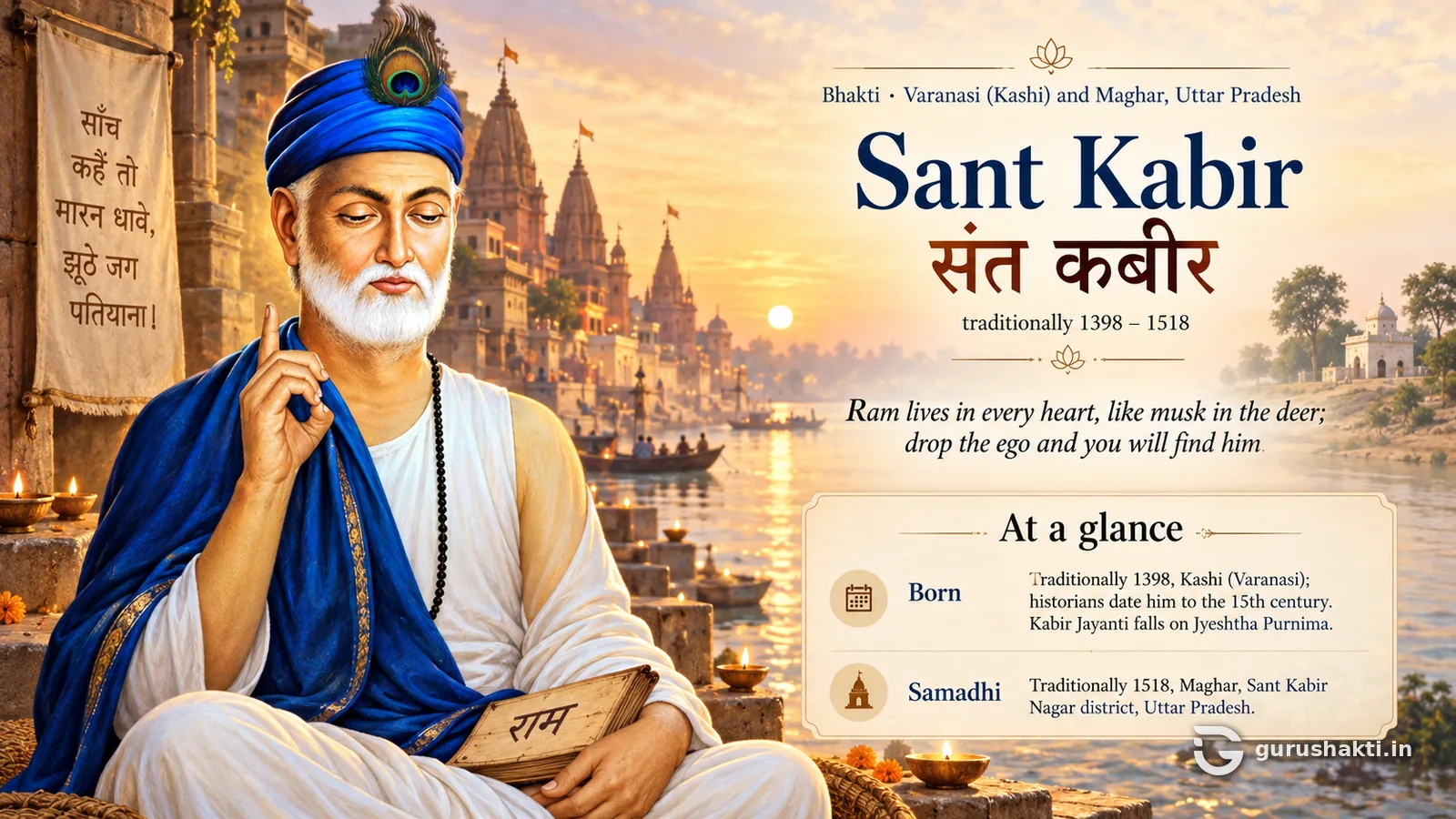
Image may be restored, upscaled or regenerated with generative AI.
Walk the path
Kabir asked for nothing elaborate. This week, take one of his couplets and live with it. Each morning, sit for a few minutes and quietly repeat the Name of Ram, remembering that he is within. While you work, at a desk or in a kitchen, let the Name keep running, as Kabir's did at his loom. And once this week, listen to a criticism without defending yourself, and thank the person who gave it.
Frequently asked questions
Who was the guru of Sant Kabir?
By tradition, Kabir's guru was Swami Ramananda of Kashi. The Kabir Panth tells how Kabir lay on the Panchganga ghat steps before dawn, Ramananda stepped on him and cried "Ram! Ram!", and Kabir took that Name as his initiation. Historians question whether their dates overlap, but the tradition is held dear by his followers.
What are Kabir's most famous dohas and their meanings?
Among his best known is "कस्तूरी कुंडलि बसै": the musk is in the deer, yet it searches the forest; so Ram is in every heart. Another is "पोथी पढ़ि पढ़ि जग मुवा": reading books makes no one wise, but one word of love does. Many popular "Kabir dohas" online are later additions.
When and where was Kabir born?
Kabir was born in Kashi (Varanasi), but the exact date is not known. Tradition gives 1398, while historians place his life in the 15th century. The Kabir Panth celebrates Kabir Jayanti on Jyeshtha Purnima, the full moon of the month of Jyeshtha. Lahartara pond in Varanasi is honoured as the place he was found.
Why did Kabir go to Maghar at the end of his life?
In his time, many believed that dying in Kashi brought liberation, while dying in Maghar did not. Tradition says Kabir deliberately left Kashi for Maghar in old age. In doing so he taught that liberation depends on devotion and the Name, not on the place where one dies. His samadhi shrine stands at Maghar.
What is the Bijak of Kabir?
The Bijak is the scripture of the Kabir Panth. It collects his sakhis (couplets), padas (songs) and ramainis (verses), which he sang but never wrote down. Two other main sources of his verses are the Kabir Granthavali, edited by Shyamsundar Das in 1928, and the Guru Granth Sahib.
Sources
- Kabir – Britannica
- The Mystic Mind and Music of Kabir – Hinduism Today
- NCERT Hindi Sparsh Part II (Class 10), chapter 1, "Sakhi"
AIతో అన్వేషించండి
ఈ వ్యాసాన్ని మరింత లోతుగా తెలుసుకోవడానికి ఒక AI సహాయకుడిని ఎంచుకోండి:
కొత్త ట్యాబ్లో తెరుచుకుంటుంది. ChatGPT, Claude, Perplexityలో ప్రాంప్ట్ ముందే నిండి ఉంటుంది; Gemini, DeepSeek, Qwen కోసం ప్రాంప్ట్ కాపీ అవుతుంది, మీరు పేస్ట్ చేయండి.
Researched and written by GuruShakti, October 2026.