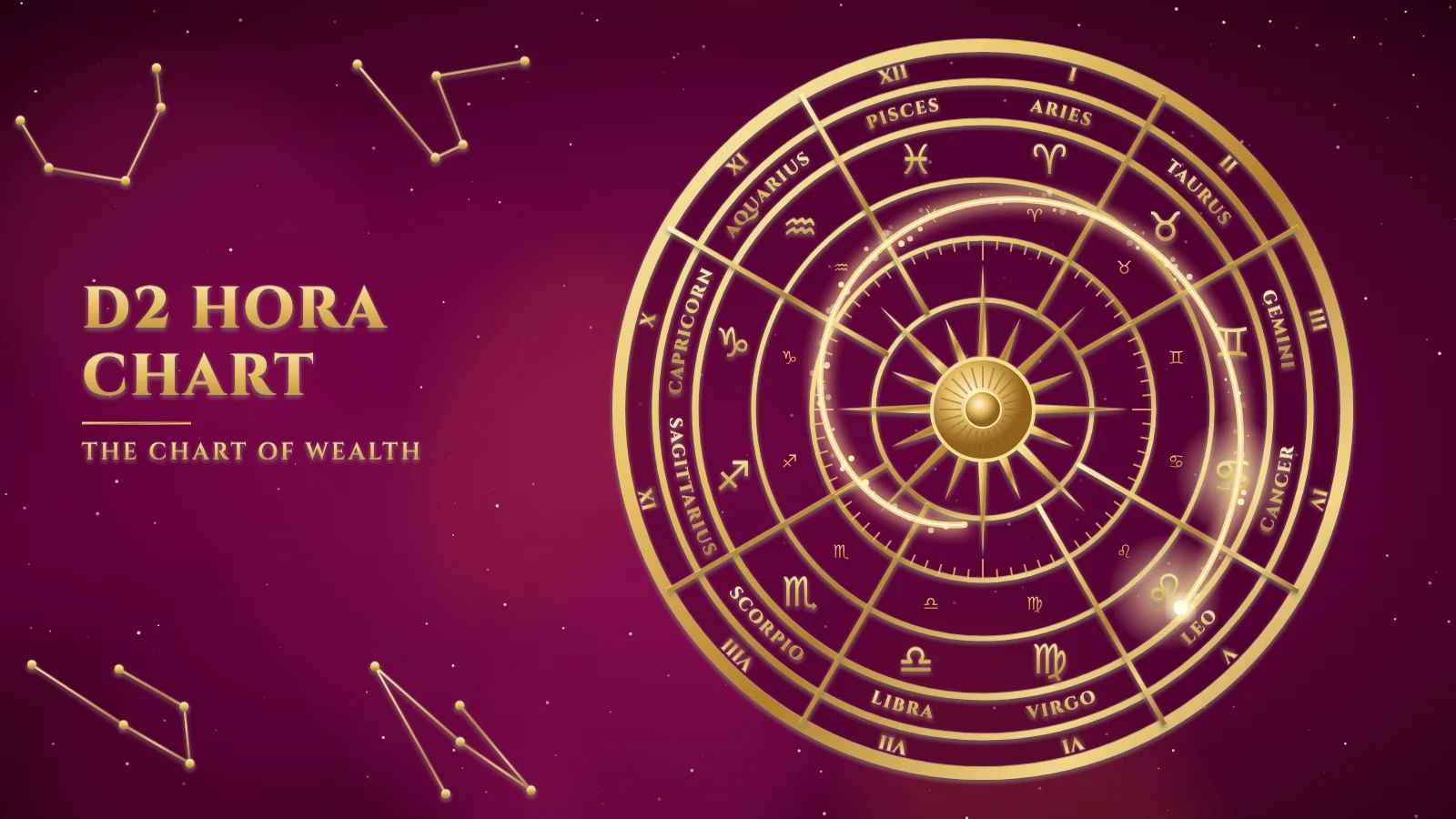
- The D2 Hora is the divisional chart of wealth: each sign is split into two 15 degree halves, one ruled by the Sun (Leo) and one by the Moon (Cancer), so the chart holds only those two signs.
- Read it in three steps: the 2nd and 11th houses and their lords in D1, then the hora each of those planets falls in, then the running dasha; the Sun, Mars and Jupiter are said to do well in the Sun's hora, the Moon, Venus and Saturn in the Moon's.
- Neither hora is better, D2 shows earning style and not a fixed fate, other Hora methods exist, and a birth time near a 15 degree boundary can flip the whole chart.
The D2 Hora chart is the divisional chart of wealth in Vedic astrology: it splits every sign into two halves of 15 degrees, one ruled by the Sun (Leo) and one by the Moon (Cancer), and it is read for how you earn, hold and use resources. Because each half goes to either the Sun's sign or the Moon's sign, a D2 chart in the common Parashari method has only two signs, Leo and Cancer. It never stands alone: it refines what the 2nd house (savings, family wealth) and the 11th house (income, gains) already show in your birth chart (D1). This guide explains how D2 is built, what Sun hora and Moon hora mean, how to read it in three steps, and walks through an invented example. It is for learning, not prediction.
What is the D2 Hora chart?
The word hora comes from ahoratra, "day and night": drop the first and last syllables and you are left with hora. The Sun rules the day and the Moon the night, and the Hora chart follows the same pair. (The same word also names the planetary hour, and is the root of the English "horoscope"; this article is about the divisional chart.)
D2 is one of the sixteen divisional charts of the Parashari system, the Shodashavarga. Like every varga chart, it takes the planetary degrees of your birth chart and re-places them in a smaller division of each sign. For the bigger picture of how divisional charts work, read our guide to the Navamsa (D9) chart, and for the main chart itself, the free Academy lesson The birth chart.
How the Hora sign is found
Each sign of 30 degrees is cut into two horas of 15 degrees:
| Sign type | Signs | 0° to 15° | 15° to 30° |
|---|---|---|---|
| Odd (male) | Aries, Gemini, Leo, Libra, Sagittarius, Aquarius | Sun's hora, Leo | Moon's hora, Cancer |
| Even (female) | Taurus, Cancer, Virgo, Scorpio, Capricorn, Pisces | Moon's hora, Cancer | Sun's hora, Leo |
So a planet at 10° Aries is in the Sun's hora (Leo in D2), while a planet at 10° Taurus is in the Moon's hora (Cancer in D2). That is the whole calculation. A free kundli calculator will draw the chart, but knowing the rule lets you check it, and lets you see which planets sit near a boundary.
Because there are only two signs, the D2 chart looks very different from D1. You will see every planet piled into Leo or Cancer. That is normal.
What the D2 chart is read for
The Hora is the chart of dhana, wealth and resources. It is looked at for:
- The style of earning. Does money come mostly through your own initiative, position and visibility, or through steady work, support from others, family and the public?
- The ability to hold resources. The 2nd house in D1 is savings and family wealth; D2 refines how comfortably that holding happens.
- Which planets support finances. A planet that is comfortable in its hora is read as giving its results in money matters more easily.
It does not show a bank balance or a fixed fate. It shows tendencies, read with the whole birth chart and the running dasha.
Sun hora and Moon hora: what they mean
| Sun's hora (Leo) | Moon's hora (Cancer) | |
|---|---|---|
| Nature | active, solar, outgoing | receptive, lunar, nurturing |
| Commonly read as | wealth through effort, authority, one's own name, government or leadership | wealth through steady accumulation, family, trade, the public, care-based work |
| Planets said to do well here | Sun, Mars, Jupiter | Moon, Venus, Saturn |
| Mercury | gives results in either hora | gives results in either hora |
This split comes from the Parashari tradition; texts and teachers explain the detail in different ways. Neither hora is better. A chart full of Moon-hora planets is not "poor", and one full of Sun-hora planets is not "rich". They describe two ways resources flow. Many charts mix both, and the mix is the point.
How to read a D2 chart in 3 steps
- Start in D1, with the 2nd and 11th houses. Note the sign on the 2nd house and its lord (savings, family wealth, speech) and the 11th house and its lord (income, gains, networks). Add Jupiter, the natural significator of wealth, and Venus, of comfort. This is the promise. See the free pages 2nd house, 11th house and Jupiter.
- Find those planets' horas in D2. For the 2nd lord, the 11th lord, Jupiter and Venus, note whether each falls in the Sun's hora (Leo) or the Moon's hora (Cancer), and whether that hora suits it (the table above). Note the D2 ascendant too. Count how many planets sit in each hora to see the overall balance.
- Combine with D1 and the dasha. A strong D1 promise with supportive horas tends to flow more smoothly; a strong D1 with less comfortable horas often asks for more effort or planning. Then look at the planet running your current dasha: its D1 house and its hora show which kind of earning that period favours.
A planet in an uncomfortable hora is not a verdict. Every chart has easier and harder placements, and effort, skill and choices matter.
A small worked example (invented, not a prediction)
Take an invented chart, "Arjun", with a Taurus ascendant at 18°. For Taurus, the 2nd house is Gemini (lord Mercury) and the 11th house is Pisces (lord Jupiter).
- Ascendant: 18° Taurus. Taurus is even, so 15° to 30° is the Sun's hora. The D2 ascendant is Leo.
- Mercury (2nd lord) at 7° Gemini: Gemini is odd, so 0° to 15° is the Sun's hora: Leo.
- Jupiter (11th lord) at 22° Pisces: Pisces is even, so 15° to 30° is the Sun's hora: Leo. Jupiter is said to do well in the Sun's hora.
- Moon at 4° Cancer: Cancer is even, so 0° to 15° is the Moon's hora: Cancer, which suits the Moon.
- Venus at 25° Aries: Aries is odd, so 15° to 30° is the Moon's hora: Cancer, which suits Venus.
How a reader would use it: the lords of both wealth houses and the D2 ascendant sit in the Sun's hora, so the reader would note an earning style that leans on initiative and one's own name, while the Moon and Venus in the Moon's hora add a steadier, family-and-comfort side. The next steps would be the 2nd and 11th houses in D1 in full and the current dasha. This example is invented to show the method. It says nothing about any real person.
Other Hora methods and why birth time matters
The method above is the one most Indian software uses by default, often called the Parashara Hora. Some astrologers prefer other schemes, such as the parivritti (cyclical) hora, which spreads the halves through all twelve signs, or the Kashinatha hora. If two apps show you different D2 charts, check which method each uses before comparing.
The D2 ascendant changes about once every hour on average (15 degrees of the rising sign). That sounds safe, but if your ascendant degree is near 0°, 15° or 30°, a few minutes either way can flip it from Leo to Cancer, and because there are only two signs, a flip changes the whole chart. The same is true for any planet sitting right on a boundary. If your birth time is uncertain, say so to your astrologer, and give the D2 less weight than D1. Learn how houses and the ascendant work in The 12 houses in a kundli.
Learn more, free: the birth chart, the twelve houses, the nine planets, and the signs Leo and Cancer.
Have a money question?
D2 is most useful when it answers a real question: a job change, a business, debt, or why savings never seem to stay. A Detailed Problem Report, ₹999, studies your own chart for that one problem, including the 2nd and 11th houses, the dashas and the divisional charts, and explains it in plain words with practical next steps. It shows tendencies and timing, not guaranteed results.
Personal guidance from GuruShakti
If you have a specific money or career problem, the Detailed Problem Report, ₹999, goes deep into it. If you would rather have your whole chart explained, D1 with the divisional charts alongside, Basic GuruShakti Guidance is ₹499. Not ready to buy? Ask a free question first.
Frequently asked questions
What is the D2 Hora chart?
The D2 Hora is a divisional chart that splits each sign into two halves of 15 degrees, one for the Sun (Leo) and one for the Moon (Cancer). It is read for wealth and resources, together with the 2nd and 11th houses of the birth chart.
Why does the D2 chart only have Leo and Cancer?
Because in the Parashari method every half-sign goes to either the Sun or the Moon, and the Sun rules only Leo and the Moon only Cancer. So every planet in D2 falls in one of those two signs.
How do I read my D2 chart for wealth?
Start with the 2nd and 11th houses and their lords in D1, plus Jupiter and Venus. Then see whether each of those planets is in the Sun's hora or the Moon's hora in D2 and whether that hora suits it, and combine this with your running dasha.
Is Sun hora or Moon hora better for money?
Neither. Sun hora is read as wealth through effort, position and one's own name; Moon hora as wealth through steady accumulation, family and the public. Most charts mix both.
Which planets are good in the Sun's hora and the Moon's hora?
A common Parashari teaching is that the Sun, Mars and Jupiter do well in the Sun's hora, the Moon, Venus and Saturn in the Moon's hora, and Mercury in either.
Why is my D2 chart different in two apps?
Probably because they use different Hora methods. Most use the Parashara Hora (only Leo and Cancer), but some offer the parivritti (cyclical) hora that uses all twelve signs. A birth time near a boundary can also change it.
Can the D2 chart predict if I will be rich?
No. D2 refines the wealth houses of the birth chart and shows tendencies in earning and saving. It does not fix an outcome; effort, skill and choices matter, and it is always read with D1 and the dasha.
Explore with AI
Choose an AI assistant to explore this article further:
Opens in a new tab. ChatGPT, Claude and Perplexity open with the prompt filled in; for Gemini, DeepSeek and Qwen the prompt is copied for you to paste.