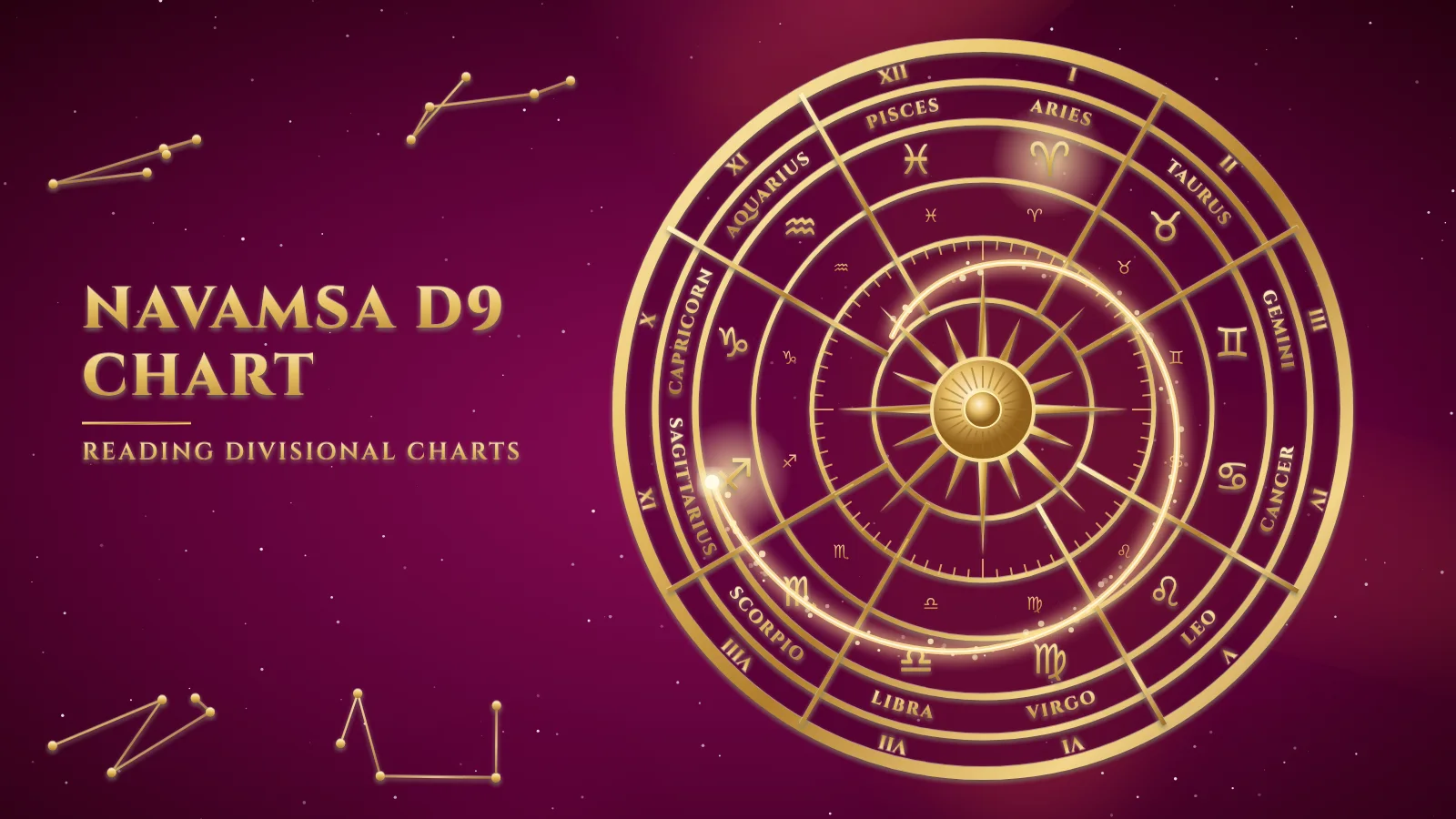
- The Navamsa (D9) chart splits every 30 degree sign into nine parts of 3 degrees 20 minutes and is read for marriage, dharma, inner strength and the true strength of planets.
- Think of D1 as the tree and D9 as the fruit; a planet in the same sign in both is vargottama, which tradition reads as steady, and D2, D3, D7, D10 and D12 look at wealth, courage, children, career and parents.
- Read D9 in three steps: the D9 ascendant and 7th house, each planet's sign and any vargottama, then compare with D1 and the dasha; the D9 ascendant changes about every 13 minutes, so birth time must be accurate.
The Navamsa (D9) chart is a divisional chart in Vedic astrology that splits every sign into nine equal parts of 3 degrees 20 minutes, and it is read for marriage, dharma, inner strength and the true strength of your planets. It is one of the 16 divisional charts, called varga charts, and is treated as the most important one after your main birth chart (D1, the rashi chart). A simple way to hold the idea is that D1 is the tree and D9 is the fruit: the birth chart shows what is promised, the Navamsa shows how well it can ripen. This guide explains divisional charts, shows what D2, D3, D7, D9, D10 and D12 are looked at for, and teaches you how to read D9 in three steps, with an invented worked example. It is for learning, not prediction.
What is a divisional (varga) chart?
Your birth chart (D1) shows where each planet sits in a sign at the moment of your birth. A divisional chart takes the same planetary degrees and divides each 30 degree sign into smaller equal parts. Each part is then given a sign of its own, and the planets are re-placed using those signs. The result is a new chart with a new ascendant and its own twelve houses, built from the same birth data.
The classical Parashari system names sixteen such charts, the Shodashavarga: D1, D2, D3, D4, D7, D9, D10, D12, D16, D20, D24, D27, D30, D40, D45 and D60. Each looks at one area of life in greater detail. They are not separate horoscopes, and none replaces D1. They refine it. Because the divisions are small, they depend heavily on an exact birth time. To learn the main chart first, see the free Academy lesson The birth chart and the full Academy.
The common divisional charts at a glance
| Chart | Name | Division of a sign | Usually looked at for |
|---|---|---|---|
| D1 | Rashi | whole sign (30°) | the whole life: body, mind, circumstances; the base chart |
| D2 | Hora | 2 parts of 15° (only Sun's sign Leo and Moon's sign Cancer appear) | wealth and resources |
| D3 | Drekkana | 3 parts of 10° | courage, siblings, effort |
| D7 | Saptamsa | 7 parts of about 4°17' | children, creativity |
| D9 | Navamsa | 9 parts of 3°20' | marriage, dharma, inner strength, planetary strength |
| D10 | Dashamsa | 10 parts of 3° | career, public role |
| D12 | Dwadashamsa | 12 parts of 2°30' | parents, lineage |
The areas are the commonly taught ones; texts and astrologers differ in detail. In every case the divisional chart supports the reading of D1 and the matching house in D1, it does not replace it.
If you are curious about the D2 chart: the Hora has only two signs, Leo and Cancer, because each sign is split into two halves of 15 degrees, one for the Sun and one for the Moon. It is looked at for the flow and keeping of wealth, together with the 2nd and 11th houses and their lords in D1.
Vargottama: the same sign in D1 and D9
A planet is vargottama when it falls in the same sign in D1 and in D9. This happens at the first navamsa of the movable signs (Aries, Cancer, Libra, Capricorn), the fifth navamsa of the fixed signs (Taurus, Leo, Scorpio, Aquarius) and the ninth navamsa of the dual signs (Gemini, Virgo, Sagittarius, Pisces). Tradition reads a vargottama planet as steady, because its promise in D1 is repeated in D9. It is a plus, not a guarantee, and it is read together with the rest of the chart.
How to read a D9 chart in 3 steps
- Check the D9 ascendant and the 7th. Note the D9 ascendant sign and its lord, then the 7th house of D9 and its lord. This is the marriage lens. Also look at Venus and, for many, Jupiter, the usual significators of partnership and wisdom.
- Check each planet's sign in D9. Is it in its own sign, its exaltation sign, or a friend's sign (comfortable), or in its debilitation sign (it works harder)? Mark any vargottama planets. Give special attention to the lords of the D1 ascendant, the 7th and the 9th, and to the planet running your current dasha.
- Compare with D1. A D1 promise that D9 also supports tends to deliver more smoothly. A D1 promise with a weaker D9 does not mean failure; it often means the matter asks for more patience and effort. Always read both together, with the dasha, and never judge a life from one planet.
Weak signs in D9 are not a verdict. Every chart has strong and weak planets, and the chart shows tendencies, not destiny.
A small worked example (invented, not a prediction)
Take an invented chart, "Meera", with an ascendant at 8° Gemini, Venus at 14°10' Taurus and the Moon at 22° Leo.
- Ascendant: 8° Gemini is in the 3rd navamsa. Gemini starts from Libra, so Libra, Scorpio, Sagittarius. The D9 ascendant is Sagittarius, and its 7th house is Gemini, ruled by Mercury.
- Venus: 14°10' Taurus is in the 5th navamsa (13°20' to 16°40'). Taurus starts from Capricorn, so Capricorn, Aquarius, Pisces, Aries, Taurus. Venus is in Taurus in D9 as well, so it is vargottama and in its own sign in both charts.
- Moon: 22° Leo is in the 7th navamsa. Leo starts from Aries, so Aries, Taurus, Gemini, Cancer, Leo, Virgo, Libra. The Moon is in Libra in D9, a sign ruled by Venus.
How a reader would use it: the Moon's D9 sign is ruled by Venus, and Venus is steady in both charts, so the reader would note that support and then go on to the 7th house and dasha. These are only the first steps of a reading. This example is invented to show the method. It says nothing about any real person.
Why an accurate birth time matters
A navamsa spans 3 degrees 20 minutes. The ascendant moves through one degree in roughly four minutes, so the D9 ascendant changes about every 13 minutes on average. If your birth time is off by 15 or 20 minutes, your D9 ascendant and the house placements can change. If your time is uncertain, check your birth certificate or hospital record, ask family, and tell any astrologer how sure you are. Learn how the ascendant is found in How to find your lagna and the Academy lesson The twelve houses.
Learn more, free: the birth chart, the twelve houses and the nine planets in the free Academy.
Want your own D1 and D9 read?
Reading D9 well needs the whole chart in front of you. Basic GuruShakti Guidance, ₹499, is a reading of your own birth chart, in which the Navamsa is looked at alongside the main chart, house by house.
Personal guidance from GuruShakti
If you want your own D1 and D9 explained in plain words, Basic GuruShakti Guidance, ₹499, is the place to start. If your question is marriage, Marriage Matching Pro, ₹999, compares two charts including the Navamsa. Not ready to buy? Ask a free question first.
Frequently asked questions
What is the Navamsa (D9) chart?
The Navamsa (D9) is a divisional chart that splits each sign into nine parts of 3 degrees 20 minutes. It is read for marriage, dharma, inner strength and the true strength of planets, together with your main birth chart.
Why is the D9 chart important?
D9 is treated as the most important divisional chart after D1. It shows a planet's inner strength and the quality of marriage, so it refines what the birth chart promises.
What does vargottama mean?
A planet is vargottama when it is in the same sign in D1 and D9. Tradition reads it as steady and strong, but it is one factor and not a guarantee.
How do I read my D9 chart for marriage?
Note the D9 ascendant and its lord, then the 7th house of D9 and its lord, then Venus and Jupiter and the sign each planet holds. Compare all of it with the 7th house in D1 and with the running dasha.
What is the D2 chart (Hora)?
The D2 Hora splits each sign into two halves of 15 degrees, one for the Sun (Leo) and one for the Moon (Cancer). It is looked at for wealth and resources, together with the 2nd and 11th houses in D1.
Is D9 more important than D1?
No. D1 is the base chart and D9 refines it. Read D9 with D1, not instead of it. Think of D1 as the tree and D9 as the fruit.
Do I need an accurate birth time for the D9 chart?
Yes, more than for D1. The D9 ascendant changes about every 13 minutes on average, so a time that is off by 15 to 20 minutes can change the chart. Check your birth record if you can.
Explore with AI
Choose an AI assistant to explore this article further:
Opens in a new tab. ChatGPT, Claude and Perplexity open with the prompt filled in; for Gemini, DeepSeek and Qwen the prompt is copied for you to paste.