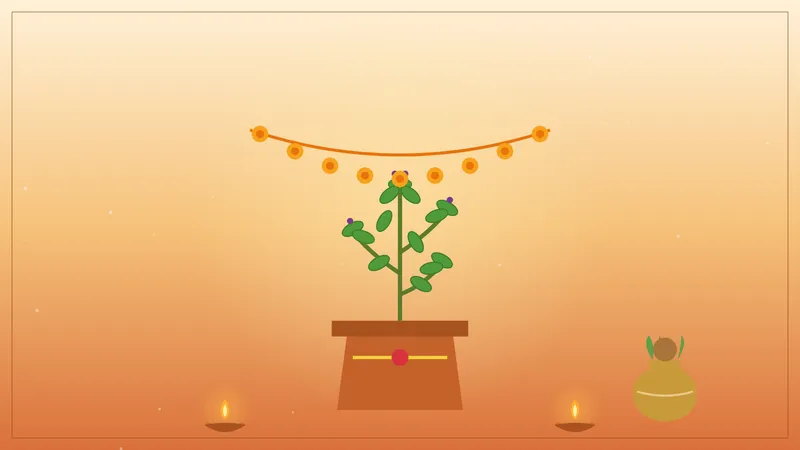

- The Tulsi Namashtak, Vrinda Vrindavani Vishvapujita Vishvapavani, Pushpasara Nandaniya Tulasi Krishnajivani, gives the eight sacred names of Tulsi from the Brahma Vaivarta Purana.
- Recite it at the tulsi plant at dawn or at lamp-lighting, daily in Kartik and especially during Dev Uthani Ekadashi and Tulsi Vivah, 20 to 24 November 2026; Om Tulasyai Namah is a simple alternative.
- By custom tulsi is not plucked on Ekadashi, Sunday, Amavasya, Sankranti, during an eclipse or after sunset; before plucking, say Matas-tulasi Govinda-hridayananda-karini.
"Vrinda Vrindavani Vishvapujita Vishvapavani, Pushpasara Nandaniya Tulasi Krishnajivani" is the Tulsi Namashtak, a verse that holds the eight sacred names of Tulsi, the holy basil worshipped as the beloved of Vishnu. It comes from the Brahma Vaivarta Purana, which says that one who worships Tulsi and recites these eight names with their meaning gains great merit. Devotees say it at the tulsi plant every day in Kartik, and above all on Dev Uthani Ekadashi and during Tulsi Vivah, Friday 20 to Tuesday 24 November 2026. Below are the meaning of each name, the other Tulsi mantras people use, and the rules for plucking leaves.
The eight names of Tulsi and their meaning
| Name | Meaning |
|---|---|
| Vrinda | "she who grows in clusters"; also her name as the devoted wife in the Puranic story |
| Vrindavani | "she of Vrindavan", the forest where she first appeared and Krishna's land |
| Vishvapujita | "worshipped by the whole world" |
| Vishvapavani | "purifier of the world" |
| Pushpasara | "the essence of all flowers"; no flower pleases Vishnu without her |
| Nandini (Nandaniya) | "she who gives joy" to her devotees |
| Tulasi | "the incomparable" (tulana, comparison; she has none) |
| Krishnajivani | "the life of Krishna" |
These meanings follow the traditional explanation in the Purana itself; the verse is called namarthasamyutam, "joined with the meaning of the names".
Tulsi mantras with meaning
From the namashtak itself to the simplest name mantra. Choose what suits you; one sincere recitation is better than many hurried ones.
1. Tulsi Namashtak
वृन्दा वृन्दावनी विश्वपूजिता विश्वपावनी।
पुष्पसारा नन्दनीया तुलसी कृष्णजीवनी॥
Vrinda Vrindavani Vishvapujita Vishvapavani,
Pushpasara Nandaniya Tulasi Krishnajivani.
Meaning: Vrinda, she of Vrindavan, worshipped by the world, purifier of the world, essence of flowers, giver of joy, the incomparable one, the life of Krishna.
2. The phala-shruti (fruit of reciting)
एतन्नामाष्टकं चैव स्तोत्रं नामार्थसंयुतम्।
यः पठेत्तां च सम्पूज्य सोऽश्वमेधफलं लभेत्॥
Etan-namashtakam chaiva stotram namartha-samyutam,
Yah pathet tam cha sampujya so'shvamedha-phalam labhet.
Meaning: Whoever worships her and recites this hymn of eight names together with their meaning gains the merit of an Ashvamedha sacrifice.
This is the Purana's way of praising devotion. Recite it as a prayer; it is not a promise of any particular result.
3. Tulsi pranam mantra
वृन्दायै तुलसीदेव्यै प्रियायै केशवस्य च।
कृष्णभक्तिप्रदे देवि सत्यवत्यै नमो नमः॥
Vrindayai Tulasi-devyai priyayai Keshavasya cha,
Krishna-bhakti-prade devi satyavatyai namo namah.
Meaning: Again and again I bow to Vrinda, Goddess Tulsi, dear to Keshava; O Devi, giver of devotion to Krishna, O truthful one.
Many Vaishnava homes say this while bowing to the plant, especially in the evening.
4. "Yanmule" verse
यन्मूले सर्वतीर्थानि यन्मध्ये सर्वदेवताः।
यदग्रे सर्ववेदाश्च तुलसीं तां नमाम्यहम्॥
Yan-mule sarva-tirthani yan-madhye sarva-devatah,
Yad-agre sarva-vedashcha tulasim tam namamyaham.
Meaning: I bow to Tulsi, at whose root are all the holy places, in whose middle are all the gods, and at whose top are all the Vedas.
5. Daily watering and puja mantra
महाप्रसाद जननी सर्वसौभाग्यवर्धिनी।
आधिव्याधिहरा नित्यं तुलसि त्वं नमोऽस्तु ते॥
Mahaprasada janani sarva-saubhagya-vardhini,
Adhi-vyadhi-hara nityam tulasi tvam namo'stu te.
Meaning: O Tulsi, mother of the great prasad, who increases every good fortune and always removes worries and ailments, I bow to you.
Said while pouring water at the root in the morning.
6. Mantra before plucking tulsi leaves
मातस्तुलसि गोविन्दहृदयानन्दकारिणि।
नारायणस्य पूजार्थं चिनोमि त्वां नमोऽस्तु ते॥
Matas-tulasi Govinda-hridayananda-karini,
Narayanasya pujartham chinomi tvam namo'stu te.
Meaning: O Mother Tulsi, who brings joy to Govinda's heart, I gather your leaves for the worship of Narayana; I bow to you.
7. Tulsi Gayatri
ॐ तुलसीदेव्यै च विद्महे विष्णुप्रियायै च धीमहि।
तन्नो वृन्दा प्रचोदयात्॥
Om Tulasi-devyai cha vidmahe Vishnu-priyayai cha dhimahi,
Tanno Vrinda prachodayat.
Meaning: We know Goddess Tulsi; we meditate on the beloved of Vishnu; may Vrinda inspire us.
8. Simple name mantra for everyone
ॐ तुलस्यै नमः॥
Om tulasyai namah.
Meaning: Om, salutations to Tulsi.
No rules and no counting needed. Pair it with Om Namo Bhagavate Vasudevaya, since Tulsi's worship is complete with Vishnu's name.
Have a question about your home, family or a decision this season? Ask GuruShakti, ₹299, answers one specific question.
How to recite the Tulsi Namashtak
- Time: at dawn after bathing, or at dusk when you light the lamp at the tulsi plant. Kartik month, Ekadashi and Tulsi Vivah are the most loved times.
- Prepare: offer a little water at the root (not after sunset), apply a dot of haldi or kumkum to the pot and light a ghee lamp.
- Recite: say the namashtak three, eleven or 108 times. A tulsi-bead mala is traditional.
- Parikrama: walk around the plant three or seven times, clockwise.
- Close: sing the Tulsi aarti and bow with the pranam mantra.
During Tulsi Vivah, recite it while dressing Tulsi as the bride; see the Tulsi Vivah samagri list and home vidhi.
Rules for plucking tulsi leaves
- Days avoided by custom: Ekadashi, Sunday, Amavasya, Sankranti, Dwadashi in many families, and during a solar or lunar eclipse. Today, Friday 20 November 2026, is Ekadashi, so use leaves picked earlier.
- Time: not after sunset. Pluck in the morning after bathing.
- How: say the plucking mantra, use the fingertips of the right hand, and take the leaves gently with the tip or the manjari. Do not use nails, scissors or tear whole branches.
- Fallen leaves: leaves that drop naturally can always be used. Washed tulsi leaves are traditionally not considered stale, so leaves picked a day before are fine for puja.
- Where tulsi is not offered: by long custom tulsi is not offered to Ganesha, and Shiva is usually worshipped with bel rather than tulsi.
- Watering: water the plant in the morning; in the evening, light a lamp instead.
These are traditions, kept with respect. If your family follows a different custom, follow it.
Tulsi Namashtak in other scripts
- Sanskrit / Hindi: वृन्दा वृन्दावनी विश्वपूजिता विश्वपावनी
- Bengali: বৃন্দা বৃন্দাবনী বিশ্বপূজিতা বিশ্বপাবনী
- Telugu: వృందా వృందావనీ విశ్వపూజితా విశ్వపావనీ
- Tamil: வ்ருந்தா வ்ருந்தாவனீ விஶ்வபூஜிதா விஶ்வபாவனீ
- Kannada: ವೃಂದಾ ವೃಂದಾವನೀ ವಿಶ್ವಪೂಜಿತಾ ವಿಶ್ವಪಾವನೀ
Personal guidance from GuruShakti
Prayer brings calm; clear advice helps with the decision in front of you. For one specific question, Ask GuruShakti is ₹299. For guidance on career, money and relationships from your own birth chart, choose Basic GuruShakti Guidance for ₹499. Not ready to buy? Ask a free question first.
Frequently asked questions
What is the Tulsi Namashtak?
It is the verse "Vrinda Vrindavani Vishvapujita Vishvapavani, Pushpasara Nandaniya Tulasi Krishnajivani", which gives the eight names of Tulsi. It comes from the Brahma Vaivarta Purana.
What are the eight names of Tulsi?
Vrinda, Vrindavani, Vishvapujita, Vishvapavani, Pushpasara, Nandini (Nandaniya), Tulasi and Krishnajivani.
What is the mantra for plucking tulsi leaves?
"Matas-tulasi Govinda-hridayananda-karini, Narayanasya pujartham chinomi tvam namo'stu te": O Mother Tulsi, I gather your leaves for Narayana's worship; I bow to you.
On which days should tulsi not be plucked?
By custom, not on Ekadashi, Sunday, Amavasya or Sankranti, not during an eclipse and not after sunset. Many families also avoid Dwadashi.
Can tulsi leaves be plucked on Dev Uthani Ekadashi?
No. Dev Uthani Ekadashi falls on Friday 20 November 2026; pick leaves a day earlier or use fallen leaves.
When should the Tulsi Namashtak be recited?
At the tulsi plant at dawn or at lamp-lighting, daily in Kartik month, and especially on Ekadashi and during Tulsi Vivah.
Can women chant Tulsi mantras?
Yes. Tulsi worship is kept above all by women in many homes, and anyone can say these mantras.
Explore with AI
Choose an AI assistant to explore this article further:
Opens in a new tab. ChatGPT, Claude and Perplexity open with the prompt filled in; for Gemini, DeepSeek and Qwen the prompt is copied for you to paste.