- Kalabhairav Jayanti 2026 is on Tuesday 1 December, Margashirsha Krishna Ashtami, which runs from about 12:15 AM to about 11:15 PM in Delhi, so the midnight puja sits at the edge of the tithi.
- In the Shiva Purana telling, Shiva takes the form of Bhairav and cuts off Brahma's fifth head; the skull falls free at Kashi, where Kalabhairav stays as the city's kotwal (versions differ).
- At home, light a mustard oil lamp, offer black sesame and urad dal prasad, chant Om Kalabhairavaya Namah and feed a dog; Bhairav is worshipped as a protector, not to be feared.
Kalabhairav Jayanti falls on Tuesday 1 December 2026, the Krishna Ashtami of Margashirsha, six days from today. It is the day devotees remember Kalabhairav, the fierce and protective form of Shiva, with a lamp, a simple offering, a few quiet hours of prayer and kindness to dogs. By the Delhi panchang, Ashtami tithi runs from about 12:15 AM to about 11:15 PM on 1 December. Because it begins just after midnight, the traditional midnight (Nishita) puja sits right at the edge of the tithi, and temples and families follow different practices. Many worship through the day and at Pradosh, around sunset. Timings shift by city, so check your local Panchang and your temple's schedule before you plan.
Kalabhairav Jayanti 2026 date and the midnight question
| Day | Tuesday 1 December 2026 |
| Tithi | Krishna Ashtami, about 12:15 AM to about 11:15 PM (Delhi) |
| Month | Margashirsha in the purnimanta (North Indian) calendar; Kartik in the amanta calendar (Maharashtra, Karnataka, Andhra, Telangana). The day is the same. |
| Other names | Bhairav Ashtami, Kalabhairav Ashtami |
| Best time | Daytime, Pradosh (around sunset) or Nishita (midnight), as your family or temple follows |
Kalabhairav is traditionally worshipped at night, and the Nishita hour, the middle of the night, is the classical time. This year Ashtami begins only a few minutes after midnight and ends at about 11:15 PM, so the midnight on the night of 30 November and 1 December falls at the very start of the tithi, and the next midnight falls after it has ended. There is no single answer. Many devotees simply worship during the day on 1 December and again at Pradosh, which is fully inside Ashtami; others keep the Nishita watch after midnight at the start of the day. Ask your priest or follow the temple you visit, and look up your city on the Panchang. If you are unsure, an evening puja on 1 December with a lamp and a prayer is a sound choice.
The katha: how Shiva took the form of Kalabhairav
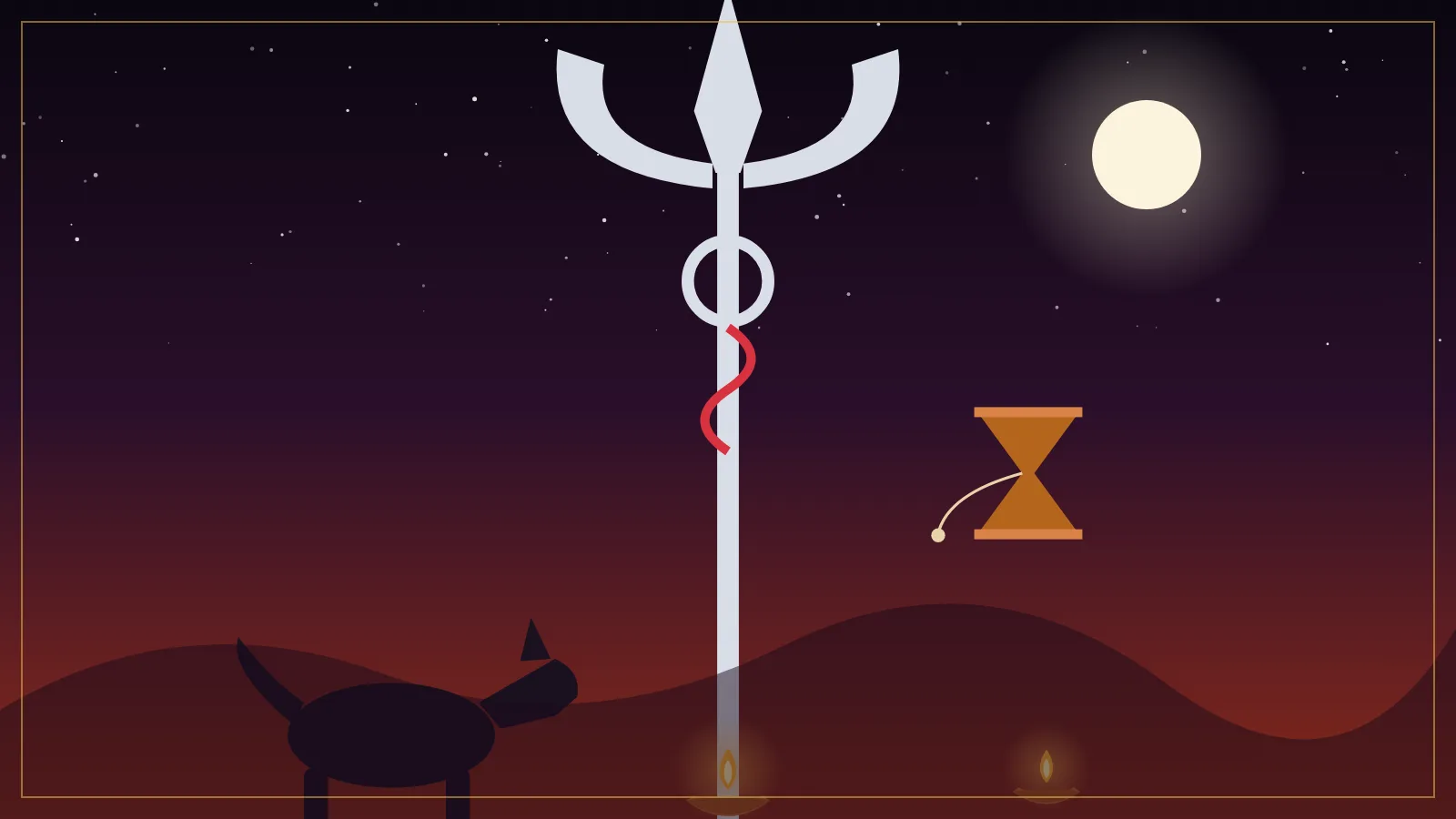
In the Shiva Purana telling, Brahma and Vishnu once argued about who is greater. Brahma, who then had five heads, grew proud and spoke slightingly of Shiva. From Shiva's anger a dark, awe-inspiring form took shape, Bhairav, who holds a trident, a damaru and a staff and is accompanied by a dog. With the nail of his finger Bhairav cut off Brahma's fifth head, the head that had spoken with pride.
The cut head stuck to Bhairav's hand, and with it came the burden of the sin of killing a Brahmin (Brahmahatya). He wandered the three worlds with the skull in hand, and it would not fall. When he finally reached Kashi, the skull dropped from his hand at a spot that is remembered as Kapalamochana, "where the skull was released". Bhairav stayed in Kashi, and the city made him its kotwal, its guardian. Pilgrims say a visit to Kashi is not complete without his darshan.
Tellings differ. In some, Brahma's head is cut for a lie rather than for pride; in others Vishnu plays a larger part; and some traditions say Brahma kept four heads from then on. Read the story as the Puranas tell it, not as a single fixed version. Its message is simpler than the details: pride, even in the highest, falls before dharma, and the fierce form of Shiva exists to protect, not to frighten the faithful.
Who is Kalabhairav?
Kala means both time and death. Bhairav is traditionally read as "the one who removes fear" (bhaya). Kalabhairav is Shiva as the Lord of Time, the one even Death answers to. Traditions list eight Bhairavs (Ashta Bhairav): Asitanga, Ruru, Chanda, Krodha, Unmatta, Kapala, Bhishana and Samhara. Kalabhairav is the form most families mean when they say simply "Bhairav". In Kashi he is the guardian of the city; in Ujjain there is a well-known Kalabhairav temple; and across India the same Ashtami each month is kept as Kalashtami, with the Margashirsha one called the Jayanti.
Kalabhairav Jayanti puja vidhi at home
- Wake early, bathe and wear clean clothes. Many devotees keep a simple fast (see the health note below).
- Clean the place of worship. Set up an image of Shiva or Kalabhairav, or simply a Shivling.
- Light a mustard oil lamp. Offer water, flowers, incense, a few black sesame seeds, jaggery and coconut.
- Offer prasad that is traditional for Bhairav: urad dal vadas, imarti or any simple sweet.
- Chant "Om Kalabhairavaya Namah" 108 times, or begin with Om Namah Shivaya if you prefer a simple naam mantra anyone can chant.
- Read the Kalabhairav Ashtakam, the hymn attributed to Adi Shankara, with its meaning.
- Do aarti, bow, and end with a prayer for protection, steadiness and a clear mind.
- In the evening, light a lamp again, and break your fast with sattvic food.
If you are unwell, elderly, pregnant or on medicines, keep the fast light or skip it; prayer needs no fast. For a longer Shiva puja at home, see Rudrabhishek at home.
The dog custom: serving the vahana
The dog is Bhairav's companion, and feeding dogs is the best-known act of the day. Give a stray or neighbourhood dog a plain roti with a little ghee, milk or proper dog food, and a bowl of fresh water. Keep it kind and safe: chocolate, onion and heavily spiced food are harmful to dogs, and never approach or feed an animal that seems unwell or aggressive. If dogs are not nearby, a donation to an animal shelter does the same work.
What Kalabhairav worship is not
- It is not about fear. Bhairav is worshipped as a protector. If a story or a person makes you afraid of him, that is not the tradition's point.
- It is not black magic. Tantric practice around Bhairav exists as a path with its own discipline and teachers, but ordinary household worship is a lamp, a prayer and kindness. You need no secret method.
- It does not need anything unusual. Some temples, such as the Kalabhairav temple at Ujjain, have their own local offering customs; at home none of that is required.
- It is not a guarantee. Puja and mantras support intention and calm; they do not promise results, and they do not replace medical, legal or professional help.
Astrology note
Many traditions link Kalabhairav with discipline, protection and the shadow planets Rahu and Ketu, and people often pray to him when they feel stuck in a loop or anxious about the unknown. At present Rahu is in Aquarius and Ketu in Leo, and Saturn is in Pisces, with Sade Sati for Aquarius, Pisces and Aries and Dhaiya for Leo and Sagittarius. If a doubt keeps returning, you do not have to guess about a dosha. A Dosha Check, ₹999, looks at your own birth chart and tells you what is and is not present. To read more, see Kaal Sarp Dosha: meaning, types and how to check.
Learn more, free: the nine planets and how to read a birth chart in the free Academy.
What comes next
After Kalabhairav Jayanti comes Utpanna Ekadashi on Friday 4 December, then Pradosh on 6 December and Margashirsha Amavasya on 8 December. The full list is in Margashirsha 2026: vrat and festival list.
Personal guidance from GuruShakti
If Kalabhairav Jayanti makes you think about protection or a recurring block, start with facts rather than fear. The Dosha Check, ₹999, reviews your birth chart for the major doshas in plain words. If Rahu and Ketu are the particular question, the Kaal Sarp Dosha report, ₹499, looks at that alone. For one specific question, Ask GuruShakti, ₹299. Not ready to buy? Ask a free question first.
Frequently asked questions
When is Kalabhairav Jayanti in 2026?
Kalabhairav Jayanti is on Tuesday 1 December 2026, Margashirsha Krishna Ashtami. Ashtami runs from about 12:15 AM to about 11:15 PM that day in Delhi, so check the Panchang for your city.
What is the best time for Kalabhairav puja on 1 December?
Traditionally it is Nishita, the middle of the night, but this year Ashtami begins only just after midnight, so the Nishita window sits at the edge of the tithi. Many devotees worship during the day and at Pradosh instead; follow your family or temple custom.
Is Kalabhairav Jayanti the same as Kalashtami?
Kalashtami is the Krishna Ashtami kept every month for Kalabhairav. The Margashirsha one, on 1 December 2026, is called Kalabhairav Jayanti, the day Bhairav is said to have appeared.
Why do people feed dogs on Kalabhairav Jayanti?
The dog is Kalabhairav's vahana, his companion, so feeding dogs is seen as serving him. Give plain roti, milk or dog food, and avoid chocolate, onion and spicy food.
What should I offer to Kalabhairav?
A mustard oil lamp, black sesame seeds, urad dal vadas or imarti, jaggery, coconut, flowers and incense. A simple offering with sincere intent is enough.
Which mantra should I chant on Kalabhairav Jayanti?
Chant "Om Kalabhairavaya Namah" 108 times, or the simple Om Namah Shivaya. Reading the Kalabhairav Ashtakam is also traditional.
Is Kalabhairav worship something to fear?
No. Bhairav is understood as the one who removes fear, and he is worshipped as a protector. Everyday worship is a lamp, a prayer and kindness to dogs.
Explore with AI
Choose an AI assistant to explore this article further:
Opens in a new tab. ChatGPT, Claude and Perplexity open with the prompt filled in; for Gemini, DeepSeek and Qwen the prompt is copied for you to paste.