- Ganesh Atharvashirsha is a short Sanskrit text of the Atharvaveda tradition that praises Ganesha as the supreme Brahman, beginning with Om Namaste Ganapataye.
- This page shows the key verses with transliteration and meaning, including the Gam bija verse behind Om Gam Ganapataye Namah and the closing phalashruti.
- Wednesday, Chaturthi and Sankashti Chaturthi (Friday 27 November 2026) are favoured days to recite it; the text is for key verses only, so check full lines with a pandit.
Ganesh Atharvashirsha (Ganapati Atharvashirsha) is a short Sanskrit text that praises Ganesha as the supreme reality, and its best-known line is "Om Namaste Ganapataye", salutations to Ganapati. It belongs to the Atharvaveda tradition, is also called the Ganapati Upanishad, and is recited on Wednesdays, on Chaturthi and by many families every morning. Today is Wednesday 25 November 2026, Ganesha's day, and Sankashti Chaturthi is on Friday 27 November, so this is a good time to understand what you are reading. Below are the key verses with transliteration and meaning, the Gam bija verse and the phalashruti. This is an introduction and not the full text.
What is Ganesh Atharvashirsha?
Atharvashirsha means "the head (crown) of the Atharvaveda", a name given to a group of Upanishad-style texts. The Ganapati Atharvashirsha does something bold: it addresses Ganesha not only as the remover of obstacles but as Brahman itself, the one reality behind everything. The text is short, usually one page, and has three parts.
| Part | What it does |
|---|---|
| Praise | Calls Ganesha the visible truth, the creator, sustainer and dissolver of the world |
| Bija verse | Explains the seed syllable Gam and the Ganesha vidya (the Ganesha mantra) |
| Phalashruti | Lists the benefits of recitation and the rules for it |
It is popular in Maharashtra, where it is recited at Ganesh Chaturthi, in temples and at home, and it is chanted across India. Different printed editions differ slightly in spelling and in some small lines. See the pandit note at the end.
Key verse 1: the salutation
ॐ नमस्ते गणपतये। त्वमेव प्रत्यक्षं तत्त्वमसि। त्वमेव केवलं कर्तासि। त्वमेव केवलं धर्तासि। त्वमेव केवलं हर्तासि।
Om namaste Ganapataye. Tvam eva pratyaksham tattvam asi. Tvam eva kevalam kartasi. Tvam eva kevalam dhartasi. Tvam eva kevalam hartasi.
Meaning: Om, salutations to Ganapati. You alone are the visible truth (tattva). You alone are the creator. You alone are the sustainer. You alone are the dissolver.
The idea is that the Ganesha you can see in a murti points to something larger. For a householder the practical message is simple: begin with humility, and remember that the one who removes obstacles is also the one who holds everything together.
Key verse 2: "You are Brahman"
त्वमेव सर्वं खल्विदं ब्रह्मासि। त्वं साक्षादात्मासि नित्यम्॥ ऋतं वच्मि। सत्यं वच्मि॥
Tvam eva sarvam khalv idam Brahmasi. Tvam sakshad atmasi nityam. Ritam vachmi. Satyam vachmi.
Meaning: You are indeed all of this, you are Brahman. You are, always, the Self itself. I speak what is in order (ritam). I speak the truth (satyam).
This is why the text is called an Upanishad: it links Ganesha with the Self within you. The lines "Ritam vachmi, satyam vachmi" are a small vow of honest speech before the prayer begins.
Key verse 3: the Gam bija
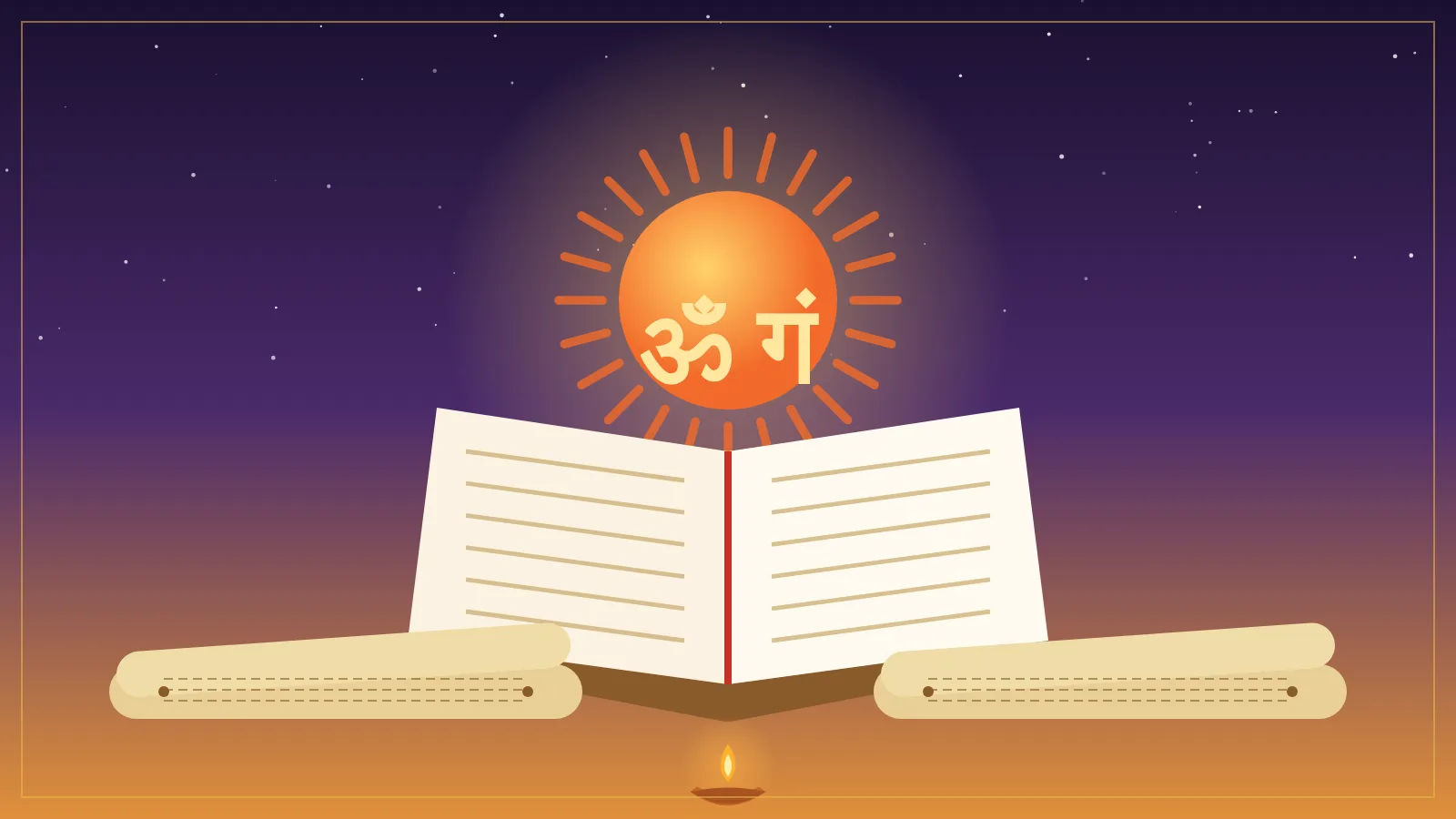
गकारः पूर्वरूपम्। अकारो मध्यमरूपम्। अनुस्वारश्चान्त्यरूपम्। बिन्दुरुत्तररूपम्। नादः सन्धानम्। सैषा गणेशविद्या। ॐ गं गणपतये नमः॥
Gakarah purvarupam. Akaro madhyamarupam. Anusvarash chantyarupam. Bindur uttararupam. Nadah sandhanam. Saisha Ganesha vidya. Om Gam Ganapataye Namah.
Meaning: The letter Ga is the first form, the letter A the middle form, the anusvara (the nasal "m") the last form, the bindu (the dot) the higher form, and the resonance (nada) joins them. This is the Ganesha vidya: Om Gam Ganapataye Namah.
In other words, the seed sound Gam is built from the sounds G, A and M plus the resonance that follows. This is the verse behind the popular mantra. You can chant it on its own: Om Gam Ganapataye Namah.
Key verse 4: the Ganesha Gayatri
एकदन्ताय विद्महे वक्रतुण्डाय धीमहि। तन्नो दन्तिः प्रचोदयात्॥
Ekadantaya vidmahe vakratundaya dhimahi. Tanno dantih prachodayat.
Meaning: We know the one-tusked one, we meditate on the one with the curved trunk. May that tusked lord inspire us.
This is the Ganesha Gayatri found within the text. It is also on its own page: Ganesha Gayatri.
The phalashruti: what the text says about its benefits
The closing section is called the phalashruti, "the hearing of the fruits". It says that one who studies this Atharvashirsha is not troubled by obstacles, finds happiness everywhere and is freed from sins, and that reading it in the evening and in the morning clears the faults of the day and the night. It also names special practices: reciting it on Chaturthi with fasting is said to bring learning, and repeated recitation is said to fulfil sincere wishes.
Please read these lines as tradition's encouragement and not as a guarantee. Most devotees find the real benefit is quieter: a steady morning habit, a calmer mind before study or work, and a feeling of beginning the day well. The text itself sets conditions: it asks the reciter to be truthful and humble, and not to share it casually with those who have no interest.
How and when to recite Ganesh Atharvashirsha
- Choose the day. Wednesday (Ganesha's and Mercury's day), Chaturthi, Sankashti Chaturthi and Ganesh Chaturthi are favoured. Many families recite it every morning.
- Bathe, sit facing east or north before a Ganesha picture or idol, with a lamp lit.
- Offer a red flower, 21 blades of durva grass and a modak or laddoo. Do not offer tulsi to Ganesha, as custom goes.
- Begin with the peace prayer Om bhadram karnebhih shrinuyama devah, then recite slowly and clearly.
- Recite once for daily practice. Tradition also mentions 21 recitations on special occasions and 1,000 for large offerings; start with one and increase only if you wish.
- End with Om shantih shantih shantih and a short aarti: Jai Ganesh Deva aarti.
If Sanskrit is new to you, first read the meaning, listen to a trusted recitation and practise a few lines at a time. Correct pronunciation matters more than speed. If it feels long, the Ganesh Chalisa or the Sankat Nashan Ganesh Stotra are shorter ways to the same devotion.
Welcoming a child or giving a new beginning a name? Ganesha is invoked first at every start. Child Name Guidance, ₹1,499, suggests names that suit the birth chart and numerology.
Atharvashirsha on Wednesday and on Sankashti
Wednesday belongs to Ganesha and to Mercury (Budh), the planet of speech and study, which is why students and professionals recite it midweek. Sankashti Chaturthi, the Krishna paksha Chaturthi, is the day to ask for relief from troubles; this month it is on Friday 27 November 2026, with the fast broken after moonrise. Read the full plan in Sankashti Chaturthi November 2026, and see the Chaturthi vidhi in Vinayaka Chaturthi November 2026. Timings vary by city, so check your local Panchang.
Learn more, free: The nine planets and Mercury in Vedic astrology.
A note for proofreading
This page gives key verses only, with the standard words as commonly printed. Editions and traditions differ in small details such as the order of a few lines, and the Sanskrit sandhi can be read in more than one way. If you plan to recite the full text regularly or in a temple setting, learn it from a pandit or a printed edition you trust and check any line you are unsure of.
Personal guidance from GuruShakti
Ganesha is worshipped first at every beginning. For a newborn or a new venture's name, Child Name Guidance is ₹1,499. To see how your name and birth date numbers sit with this season, Personal Numerology is ₹699. If you have one specific question, Ask GuruShakti is ₹299, and you can always send a free question first. These are guidance to support your own decisions, not promises of outcomes.
Frequently asked questions
What is Ganesh Atharvashirsha?
It is a short Sanskrit text of the Atharvaveda tradition, also called the Ganapati Upanishad, that praises Ganesha as the supreme Brahman and explains his Gam bija mantra.
What are the benefits of Ganesh Atharvashirsha?
The text's own phalashruti says it frees the reciter from obstacles and the faults of the day and night, and many devotees find it builds focus and calm; these are traditional beliefs, not guaranteed results.
Which day is best to recite Ganesh Atharvashirsha?
Wednesday, Chaturthi and Sankashti Chaturthi are favoured, and many people recite it every morning; the next Sankashti is Friday 27 November 2026.
How long does Ganesh Atharvashirsha take to recite?
Reading it once takes about 5 to 10 minutes, depending on your pace and pronunciation.
What does "Om Namaste Ganapataye" mean?
It means "Om, salutations to Ganapati", the opening line of the Atharvashirsha.
Can anyone recite Ganesh Atharvashirsha?
Devotion is open to everyone, and the text asks for truthfulness and respect; beginners can start with the meaning and a few lines, or with the shorter Om Gam Ganapataye Namah.
Should I recite it 21 times?
Traditions mention 21 recitations for special occasions, but one calm, correct recitation daily is a perfectly good practice.
Explore with AI
Choose an AI assistant to explore this article further:
Opens in a new tab. ChatGPT, Claude and Perplexity open with the prompt filled in; for Gemini, DeepSeek and Qwen the prompt is copied for you to paste.